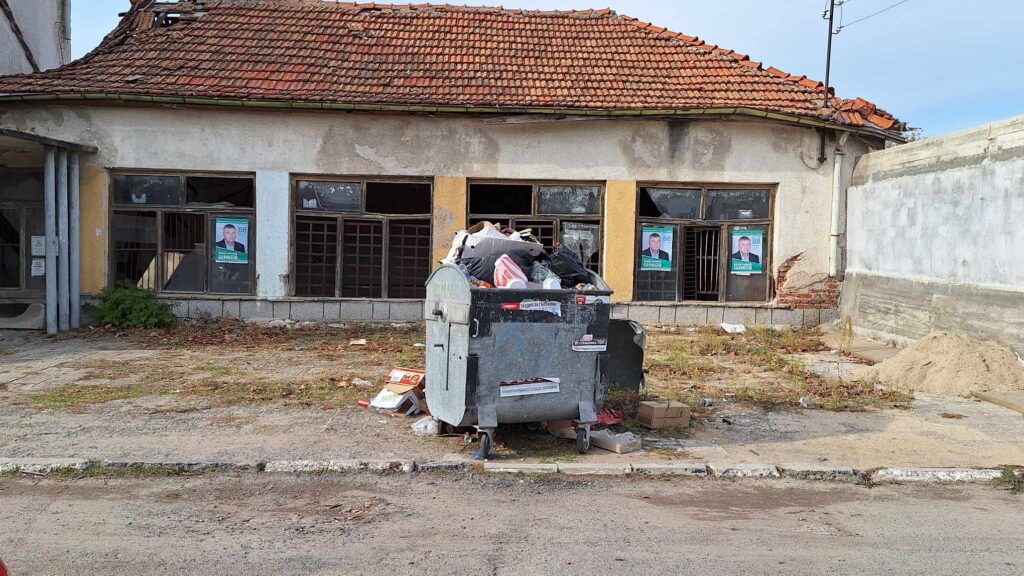
The elections are over, but life continues. In some places, worse than before; in others, much worse.
In three villages of the municipality of Gulubovo, where Nikolai Tonev begins his sixth term after 20 years in office, the locals face problems.
Indeed, they are domestic issues, but quite unpleasant, as life in the villages of the Eastern Maritsa mining basin seems to be frozen in time, as if stuck decades ago or more. The only sign that time is moving, albeit slowly, is the occasional shinier car parked in front of an unplastered brick house.
There are almost no paved streets, or if there are remnants of asphalt, they are barely visible amidst the huge potholes that cars must carefully avoid if their owners want to reach their homes without a flat tire.
“For the Truth” received signals from residents of the three villages—Iskritsa, Madrets, and Glavan—stating that after the elections, garbage collection has ceased, and the containers are overflowing with household waste.
The signals also pointed out that there is no street lighting in these villages during the evening, and that the pensioners’ clubs and ritual halls—the only places for social contact among the elderly, especially women who do not frequent the village pubs—are closed.
These elections revealed trends that have solidified over the years.
A site visit confirmed the information from the signals.
Fear prevails in the villages, and people speak with difficulty, almost in half-words. When someone dares to speak out, others look at them apprehensively and advise them to “be careful.”
A young woman in Madrets, visiting relatives with her young child, explained that the residents have reasons to be mistrustful. She then asked how she could be sure that the person before her was not a provocateur, but a journalist.
Similarly, a mother with a child in Iskritsa reacted when new partial elections for mayor will be held there in the spring. An elderly woman asked why she was being punished after voting for Nikolai Tonev, along with 45 other villagers. In Iskritsa, the mayor of Gulubovo received two votes less than his rival Georgi Mihailov from VMRO-BND, while in the neighboring village of Madrets, Tonev has a lead of 50 votes.
Despite this, the containers have not been emptied since the elections, and it remains dark in the evenings except for the occasional light illuminating the road passing through the village. The pensioners’ club and the ritual hall are also closed. The community center is sealed off, currently undergoing an audit, despite having only three invoices for the previous year.
At a bus stop, several women shared that residents of the village who worked for municipal companies were laid off after the elections. They suspected this was related to the election results:
“The young people want change. But if they monitor and know how everyone voted, then why should we hide behind curtains? It would be better to cast our ballots right in the center of the village,” one of them commented.
Rumors were also spreading among the residents that their power supply would be cut off during the winter. The newly elected mayor of Madrets promised to reopen the school and had other ambitions, but the women did not believe that anything good could happen in the village. It now looked as if it had just come out of a war.
The situation is no different in the largest of the three villages—Glavan. There, at least people collect their household waste in plastic bags and leave them next to the garbage bins in front of their yards. A chatty elderly woman did not stop voicing her complaints while sitting with several other women in a small café in the village center on a warm November day:
“I am 90 years old, what can I do—I burn my trash in the fireplace. Since the 29th (of October), they haven’t come to collect it… But he (the mayor of Gulubovo) can’t tell me who to vote for, even though I voted for him. We used to take care of the pensioners’ club ourselves, but now there’s nowhere for the old women to sit and chat. One young man couldn’t arrange an engagement for three days; on Thursday, they opened the ritual hall, and on Friday, they closed it. The mayor should come and turn on the streetlights, not stop the buses.”
Using the car of Milyo Kavaljiev—the former mayor of Glavan—we toured the village so he could show us the condition of the road network and the enormous potholes on the road to the village of Pomoshtnik, the filling of which has stopped since the elections, even though the weather is suitable for repair work. The several empty containers for separate waste collection were conspicuous, but the man explained that they are placed far from the inhabited houses, and no one had explained to the residents how to use them.
We tried to speak with the mayors of two of the villages, but they understandably were reserved, as they are entirely dependent on the municipal mayor—in every respect. One of them explained that he had already raised the issue of garbage collection and street lighting with the municipal administration.
Along with a colleague from Radio Stara Zagora, who was touring these villages for the same purpose, we attempted to meet with the municipality’s mayor, Nikolai Tonev, but it turned out he was on leave.
At 2 PM on November 21, the municipality had no one to receive us or answer our questions. Neither Tonev nor his deputies, Plamen Barakov and Gyuldzhan Durmush, were answering their phones.
Gulubovo grants over 2,000 acres of land for solar parks without a tender for 50 years
On Tuesday, November 22, we managed to reach Deputy Mayor Barakov, who stated that he was in the hospital and could not speak earlier than late afternoon. Meanwhile, Nedelcho Manolov, head of the municipal department for landscaping and cleanliness, briefly explained that they are expecting spare parts for the garbage collection vehicles and that household waste removal from the villages would likely start next week. When asked how garbage collection was possible in the remaining seven villages of the municipality, the response was that there are designated trucks for each village.
We therefore reported the situation in the three villages to the regional governor, Iva Radeva, and the District Health Inspectorate in Stara Zagora.
This afternoon, Iva Radeva announced to “For the Truth” that she had spoken with Mayor Nikolai Tonev, who assured her that the phased removal of garbage from Iskritsa, Madrets, and Glavan would begin the next day, and this was officially communicated in a letter to their mayors—evidently following our visit to the communities.
However, due to low tax collection rates, which were less than the costs for this service, containers would no longer be provided in front of every house, but only in certain locations in the villages, said Mayor Tonev.
The reorganizing the placement of large containers in Glavan has also been raised with the village mayor, Diyan Petkov, explaining that this is necessary to facilitate access to them in winter conditions. The reasons for the attitude toward the residents of the village become even clearer in a statement from Nikolai Tonev published on the Facebook page of the newspaper “Gulubovi Vesti.”
Whether the residents of Glavan should kiss the hand of the mayor of Gulubovo for breathing clean air and having access to drinking water is a question beyond any comment. They are also affected by coal mining and the activities of thermal power plants in the Eastern Maritsa basin. The so-called “black lake” in Gulubovo is located in the territory of the village of Iskritsa, and in Glavan, 15,000 decares of fertile land have been destroyed by coal mining. It is worth noting that, apart from the waste fee, residents of these villages also pay building tax, vehicle tax, and so on, as well as that the delegated budgets of each municipality include funds for communal activities.
Moreover, the taxes paid to the municipality of Gulubovo come from Maritsa East Mine and the two so-called “American thermal power plants”—ContourGlobal Maritsa East 3 and AES Maritsa East 1—which, through their corporate social responsibility initiatives, support the local community of Gulubovo. Additionally, the Brikel TPP provides free heating during the winter season for municipal companies and the hospital as a small compensation for the air pollution caused by its operations.
As a reason for the closure of pensioner clubs and ritual halls in the three villages, Mayor Nikolai Tonev cited the expenses for heating and maintaining them to the regional governor. However, anyone who makes the effort to visit these villages will see, at least through the windows, the deplorable state of these premises. The villages in question are already so desperately grim that the local authority in a municipality should, if it cannot allocate funds for their improvement, at least not take away the little social contact spaces the residents have left. Moreover, it should not forget that its mayors are elected to be “servants” of the people, not the other way around.