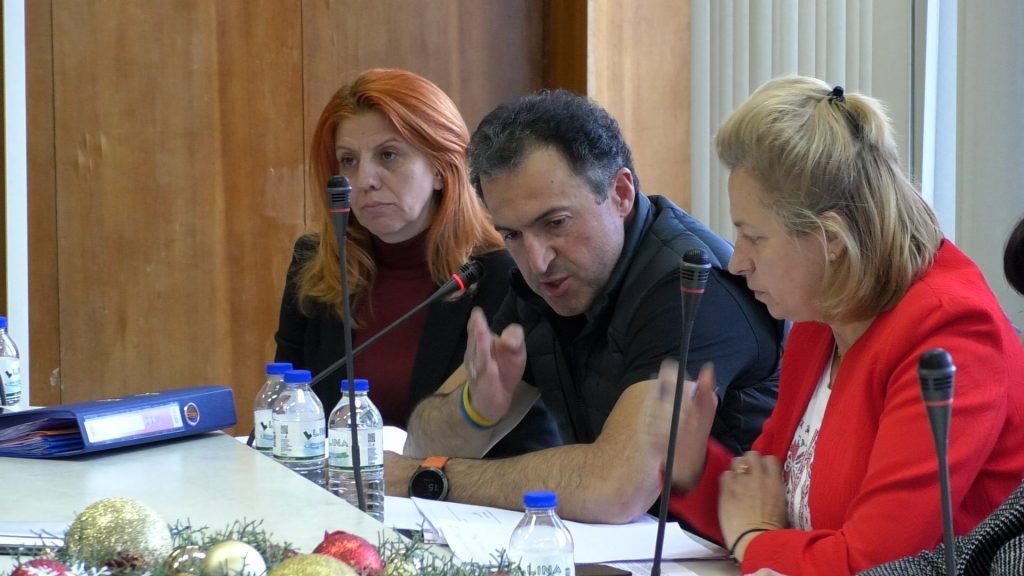
On December 14, a notification was submitted to the Municipality of Zlatograd by an initiative committee seeking to hold a local referendum with two questions. The first question is whether to build a new cooperative market near the park in the city center, given that there is already one in that location. The second question is whether to take out a bank loan of 1.7 million leva, which would be repaid by the citizens over a period of 10 years.
The request for the referendum was announced by the Chairman of the Municipal Council, Attorney Grigor Djangalov, at the beginning of a joint meeting of standing committees held on the same day. According to Djangalov, the initiative committee has complied with all requirements of the Law on Direct Participation of Citizens in State Power and Local Self-Government. They will have three months to gather signatures from 20% of the voters in the municipality for the referendum to become mandatory.
The request for a public polling provoked a sharp reaction from Mayor Miroslav Yanchev. “I suggest we do not wait with tricks—let’s request it now, but we will follow the legal procedures within three months. We should formulate it today after committee discussions and hold the referendum in a very short time,” he said, self-identifying as a “democrat.” In his opinion, the goal of this “quickly gathered” initiative committee is to prevent the market from happening in the year before the elections.
Why is the Mayor of Zlatograd rushing to secure the loan?
The potential referendum in the last year of his fourth term clearly complicates Miroslav Yanchev’s plans for the upcoming local elections next year. The consultation with voters has the power to serve as a referendum on their assessment of the mayor’s governance. Therefore, he felt free to assert that the rights of citizens, as enshrined in law, are mere tricks.
The mayor admits that the new market is part of his electoral campaign—his and that of his party, GERB. However, he does not mention another reason for his urgency. On November 27, he signed a contract with the firm that will utilize the aforementioned 1.7 million leva “for the new cooperative market”—“Ekip Holding” EOOD from Kardzhali.
A Tender with a Preordained Winner
The public procurement for the “construction of a municipal cooperative market” was announced on August 18 of this year, with an estimated value of 1,399,976.68 leva excluding VAT. The deadline for submitting offers was September 13, 2022. The criteria for selecting a contractor were: Price—50% and “Management Program of Activities—P1”—also 50%. Two bids were submitted—from “Ekip Holding” EOOD and “Enchev Group” from Zlatograd. A commission chaired by Engineer Tsvetelina Bodurova held meetings from October 5 to 7 and determined that the technical proposal from “Enchev Group” “did not meet the requirements of the contracting authority,” recommending to Mayor Miroslav Yanchev to disqualify it from participation.
On October 14, the same commission evaluated the “Management Program of Activities—P1” proposed by “Ekip Holding” EOOD. The commission concluded that the Kardzhali-based firm not only met the requirements of the contracting authority but even enhanced them, awarding it the maximum score of 100 points. Following this, on October 27, Mayor Miroslav Yanchev made a decision to disqualify “Enchev Group” from participation and appointed “Ekip Holding” as the contractor.
Yanchev Requested to Start with a Clear “Winner”
The Law on Municipal Debt mandates that mayors publicly announce the project to be financed through long-term debt and invite the local community to discuss it at least one month before its submission to the municipal council. On November 9, Mayor Miroslav Yanchev’s invitation was published in the newspaper “Otzzvuk” and was uploaded to the Zlatograd Municipality website on the same day. The discussion took place on November 17, 2022 (Thursday) at 17:00 in the meeting room of the Municipal Council of Zlatograd.
And since he accuses his fellow citizens of using “tricks” to delay the loan withdrawal by three months, Yanchev owes his constituents answers to several questions:
- Why did he not hold a public discussion about taking on the debt before announcing the public procurement? And if he wanted to save time, why did he not start both procedures simultaneously? He should have only signed the contract with the contractor he selected after receiving approval from the Municipal Council.
- After identifying himself as a democrat, why did the mayor not request a referendum to determine if people want a new market in the center of Zlatograd and whether they agree for the municipality to incur a debt of 1.7 million leva? Moreover, such a loan is quite large for a municipality like Zlatograd, being equivalent to its own revenues for an entire year. Records show that in 2020, the municipality’s own revenues were 1,759,946 leva, and in 2021, they were 1,863,263 leva.
- Since the long-term debt is “for financing investment projects benefiting the local community” (Article 4, Paragraph 1 of the Municipal Debt Law), as Yanchev claims, why does he not specify anywhere in his justification what the municipality’s revenues from this cooperative market will be over the next 10 years? Is he afraid that such an analysis will show that the project is not an investment, but rather an electoral one, and that it does not benefit the local community but only a few traders, primarily from neighboring municipalities?
When Price Loses Its Meaning, Corruption Wins
Contracting authorities for public procurement are not allowed to restrict competition by including conditions or requirements that limit it. This is mandated by law (Article 2, Paragraph 2 of the Public Procurement Act). It obliges contracting authorities, such as the mayor of Zlatograd, who spend public money, to award contracts based on the economically most advantageous offer—lowest price, cost level, or optimal quality/price ratio.
Miroslav Yanchev has chosen to seek the “optimal” quality/price ratio. In the announcement for the new cooperative market dated August 18 of this year, he allocated 50% weight to price and 50% to quality. In this case, his criterion for quality is the “Management Program of Activities—P1,” where each candidate outlines their intentions regarding how they plan to fulfill the assigned contract. Not the quality of materials, nor the quality of construction. Why did Yanchev choose this criterion in the evaluation methodology, assigning it the same weight as price? Because it gives him unlimited freedom in selecting the contractor. However, this contradicts the law, which requires him to apply a quality measuring metric. What is the measure of quality in a “management program of activities”? I do not see it, and I hope Mayor Yanchev will provide an answer.
According to case law of both the Plovdiv Administrative Court and the Supreme Administrative Court, methodologies that include criteria without quantitatively measurable indicators, such as “organization of personnel,” “organization for executing the contract,” “management program of activities,” and similar, restrict competition and have a potential discouraging effect. As a result, fewer firms participate in public procurement announced by certain mayors. When they see a methodology with the aforementioned “criteria,” it becomes clear to them that the mayor has the ability to select a specific firm. Consequently, they refrain from submitting documents to avoid wasting time, resources, and money. Too often, the “selected” candidate offers a price close to the maximum allowable amount. In this specific case, the price offer from “Ekip Holding” is 1,398,616.30 leva, which is just 1,360.38 leva less, or only 0.001% lower.
Regarding “Ekip Holding,” Hakan Aziz, Tsveta Karayancheva, and professionalism.
“Ekip Holding” is a company that has been highlighted in media reports as being close to the Movement for Rights and Freedoms (DPS). Its headquarters are in Kardzhali. The owner and manager of the company is Djevdet Adem, who is the first cousin of the mother of the mayor of Kardzhali, Hasan Aziz. Their familial relationship became public and sparked a scandal years ago following a statement from the former Speaker of the National Assembly from GERB, Tsveta Karayancheva, who announced that Hasan Aziz was funnelling money through public procurement to firms close to DPS and the Bulgarian Socialist Party (BSP). One of these firms, “Ekip Holding,” received 1.3 million leva. In response to Karayancheva, Djevdet Adem stated that “it is not family ties that determine the execution of public procurement in Kardzhali Municipality, but the professionalism of the company and the quality and timely execution of the assigned work.”
A review by “Za Istinata” at the Public Procurement Agency indicates that “Ekip Holding” has two contracts with Kardzhali Municipality. One of them, for 1.3 million leva including VAT, is from 2008 and is the one referred to by Karayancheva, while the second, from 2018, is for the renovation of the “MIR” kindergarten in the city for 1.3 million leva excluding VAT. In a consortium with other companies, the firm participated in the construction of the producers’ market in Kardzhali.
The flawed model of Yanchev is not a precedent, but a long-standing practice
The criterion of “management program of activities” is not an incidental occurrence in the awarding of the construction of the new cooperative market in Zlatograd. Rather, it has been a favored method for selecting contractors for public procurement in the municipality for years.
On October 8, 2020, the mayor of Zlatograd announced a competition for the development of a technical project for the construction of the internal distribution network for mineral water for the city of Zlatograd, intended for balneotherapy. The criteria for selecting a contractor were: price with a weight of 45%, “work program for execution” with 20%, and “measures to ensure quality during the design process” with 35%.
On April 27, 2021, an announcement was published for awarding the repair of the street network and municipal roads in the municipality, divided into four specific lots. Here too, the price carried only a weight of 40%, the same as the “work program for the execution of construction,” while 20% weight was attributed to “measures to reduce user difficulties during the execution of construction and installation works.” The three lots were won by “Odesosstroy” from Aksakovo, Varna Province, while the fourth was awarded to “Yugstroy” from Zlatograd.
On March 11, 2022, a competition was announced for the construction of a park environment in Zlatograd. Here, too, Yanchev’s quality criterion is his favorite “management program of activities,” which is weighted at 50%. Therefore, it is not surprising that there was only one candidate—”Vera Stroy” EOOD from Sofia, which offered a price just 17.67 leva below the maximum and signed a contract for over 464,000 leva excluding VAT.
On May 16, 2022, another procurement was announced for the major repair of streets in Zlatograd for over 2 million leva including VAT. For Mayor Yanchev, again, price is not the most important factor. Its weight is 40%, equal to that of his favored “work program for the execution of construction,” while an additional 20% is allocated for “measures to reduce difficulties” for citizens. The contract was won by “Dani Trading” from Smolyan. Two of the disqualified companies—DZZZD “Aqua-Odesos” and “Parsek Group,” however, filed complaints with the Commission for Protection of Competition (CPC). On October 27, 2022, the CPC annulled the order of the mayor of Zlatograd for determining a contractor due to a significant flaw in the public procurement procedure. The commission ordered the Municipality of Zlatograd to pay 5,250 leva in expenses to DZZZD “Aqua-Odesos.”
On August 4, 2022, without secured financing, Miroslav Yanchev signed a contract for nearly 2.5 million leva excluding VAT for an external water pipeline to Zlatograd with the company “NAR” from Momchilgrad. This company was again selected using the flawed methodology in which the importance of price is only 40%, while the construction execution program is given greater weight at 50%, and 10% is designated for the construction timeline. According to the contract, the pipeline was to be completed within 120 days, that is, by December 4. However, the construction of the pipeline has not yet begun, as the mayor has been unable to secure funding for the project.
Despite the CPC decision from October 27, 2022, the mayor of Zlatograd continues with the acrobatics of “work program for execution” and “measures to reduce difficulties.” On December 14, he announced yet another procurement with these criteria, where the weight is again 60% for execution and only 40% for price. This procurement is for the rehabilitation of “Hristo Botev” Street in the city and is valued at nearly 400,000 leva including VAT. The deadline for submitting offers is until January 9, 2023. There is no secured funding for this project either. It remains to be seen whether the mayor will seek a new long-term loan. However, it is clear that over the past year he has taken on commitments exceeding 5.5 million leva, severely worsening the financial condition of Zlatograd Municipality. Moreover, during his management, the city has also incurred approximately 2 million leva in damages from penalties on European projects due to tainted procurements, where the mayor unjustifiably restricted competition and did not allow firms to participate that could have offered lower prices for the announced public procurement.