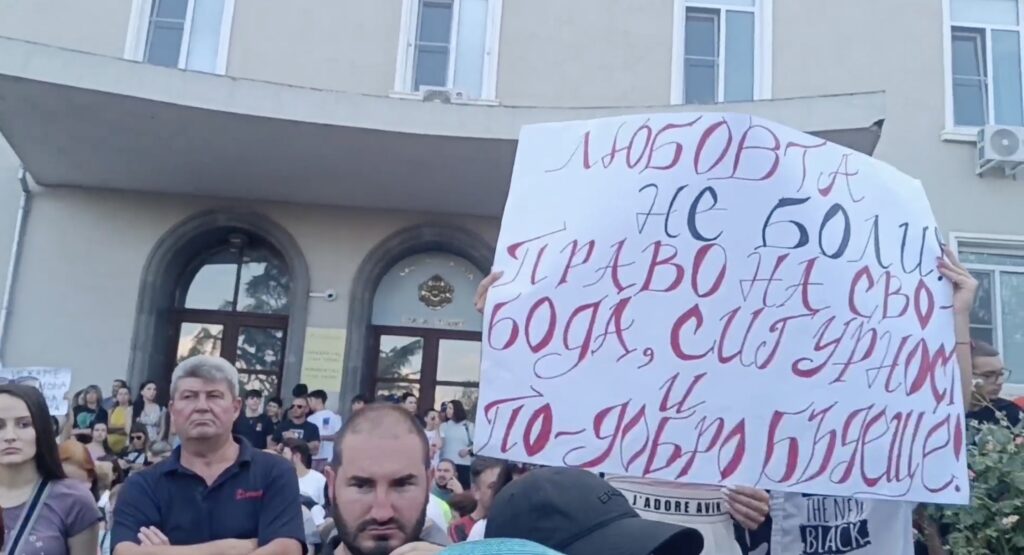
Controversial witness testimonies, discrepancies in the facts described in them, hesitations and uncertainties, sadistic brutality in the attack on 18-year-old Deborah, and a firm denial from the lawyer of the accused in the serious crime, Georgi Georgiev. These reflect the data included in the protocols from the interrogations conducted so far and in the forensic medical examination, which “For the Truth” possesses. Nevertheless, the case, which has sparked a wave of protests against violence, is slowly beginning to clarify.
“For the Truth” has been monitoring the case since the first day it gained public attention and continues to seek facts and circumstances that will provide a clearer context. This context is important because without it, the case will continue to appear black and white, which it certainly is not.
The first forensic medical examination was conducted by Dr. Teodor Stamatov on June 29 of this year. At that time, he visited the injured girl in the neurosurgery department of the university hospital in Stara Zagora, examined her, and reviewed the medical documentation from her medical history, which did not reflect the admission diagnosis.
The injuries on Deborah were treated under local anesthesia, and a computed tomography (CT scan) was also performed. The forensic doctor noted “traumatic edema, bruising, and abrasions on the left side of the face and eyelids, a hemorrhage in the left eye, a fracture in the sinus area, and a concussion.” Additionally, 21 lacerations on the body were described in detail, which, according to Dr. Stamatov, have characteristics consistent with injuries inflicted by a craft knife. The remaining traumatic injuries, he stated, were caused by blunt objects.
The of the examination states that the described traumatic injuries caused the victim
a temporary impairment of health, not life-threatening,
and based on witness testimonies, it should be assessed whether the sustained concussion was accompanied by a complete loss of consciousness.
In the examination, there is no mention of the 400 stitches for the wounds, although the district prosecutor of Stara Zagora, Tanya Dimitrova, stated at a press conference on July 30 that they were counted by the doctor who prepared the examination. We also asked orthopedic surgeon Dr. Stoyan Petrov, who first treated Deborah in the Emergency Center, whether he counted the stitches. His response was that at one point he got tired of stitching, as he put in up to 15 stitches on the longer cuts.
The Deborah did not undergo a number of medical tests.
For instance, no blood sample was taken for drugs, Dr. Stoyan Petrov told “For the Truth,” stating that this was not his responsibility and that “the police were involved.” However, in the protocol from the police interrogation of the victim’s mother, Ivylina, it is recorded that she herself requested such a test. They told her to buy a test from the pharmacy that indicated 4-5 substances, but the result was negative: “The doctor (not naming him) told me that if there had been any narcotic substances, she would have reacted to the test,” the mother stated to investigators.
The examination lacks data (from the medical history) on whether Deborah received a blood transfusion and whether blood tests for anemia were conducted. There is also no record of a consultation with a resuscitator or psychiatrist given the shock state she was presumed to be in. This consultation is absolutely necessary, said forensic doctors.
“I who the man was that I saw yesterday in my room… I reiterate that based on his build and part of his beard that I saw, I thought it might be my friend Georgi. However, I didn’t see his face and I can’t be certain that it was him.”
However second interrogation, Deborah claims that she had seen the black clothes and sneakers of the masked man before, and the build and beard of the attacker, the craft knife, and especially the scent of the “Black Orchid” perfume that her friend regularly used gave her reason to believe that the man who appeared in her doorway,
masked and wearing blue medical gloves,
was indeed Georgi, but he did not have keys to the apartment. Deborah explains that she often forgot to lock the front door, which her mother confirms. Neighbors from the building did not testify to the police who arrived at the scene having heard any noise, arguments, or screams coming from the apartment of the assaulted girl.
The testimonies of the victim form the basis upon which the prosecution builds its case. A witness for the prosecution, a man from the village of Bratya Kunchievi, where Georgi Georgiev’s permanent address is located, claims that on the evening of June 26, he drove Georgi to Stara Zagora in his car, waited for him for 15-20 minutes, and then they returned together to the village. In his testimony, he provided the make and registration number of his vehicle, which means that the cameras on the road between Bratya Kunchievi and Stara Zagora should have recorded this movement, as well as the time the car passed in both directions.