On February 27, 1990, the then still existing State Council in Bulgaria decided to designate March 3rd as the national holiday of Bulgaria instead of September 9th. Six days later, the decision was confirmed by the National Assembly. Thus, ostensibly „breaking with its past“, hastily and strategically Bulgaria was left in the chalk circle between Russia and Europe.
In the first years after 1989, although hesitant and wasted, the energy for change could still bring back the historically true sobriety in the Bulgarian view of Russia.
Probably that’s why there was a need to hurry – whoever rules the past, rules the future.
Everything you need to know about: Reading of the history (233)
That is why March 3rd was needed as a national holiday. To hastily and strategically replace the heroic decor of September 9th with another – just as heroic. And still suitable for sketches of eternal gratitude to the „double liberators“.
As a last attempt to prevent replacement
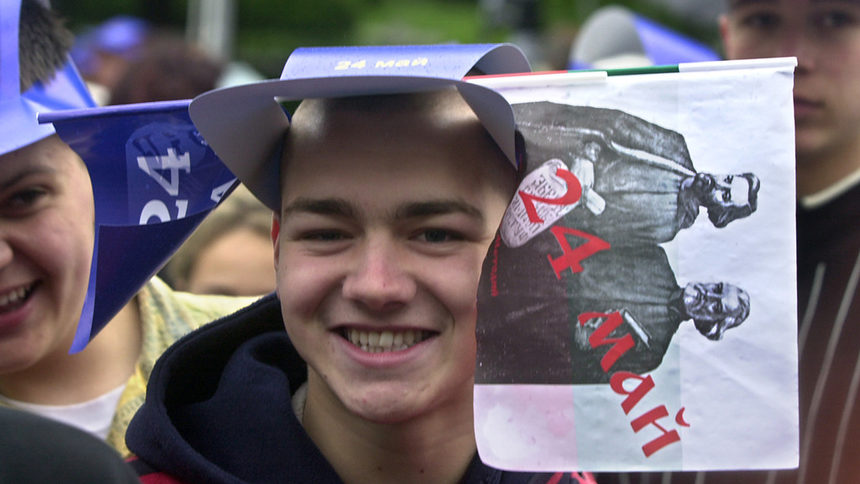
in May 1990 – just a month before the elections to the VII Grand National Assembly, a debate was born – „Can May 24th unite the nation“. Its traces can be easily tracked due to the still loose media landscape in the first year after the removal of Todor Zhivkov. They lead to the then youth weekly newspaper „Polet“ in Varna. Together with Plovdiv’s “Komsomolska Iskra” and Sofia’s “Kultura”, it was part of the autonomous territory of the totalitarian Bulgarian press, won by the spirit of perestroika.
The discussion „Can May 24th unite the nation“ sounded irrational, rather intellectual and somewhat post-dissident. It had to gather the opinions of the then editors-in-chiefs of the newspapers „Culture“, „Literary Front“ and „Duma“ – Koprinka Chervenkova, Marko Ganchev and Stefan Prodev, of Valeri Petrov and Kiril Marichkov, of Acad. Nikolay Todorov, of the „young faces in the church „- the now deceased Metropolitan Cyril, the „blue“ hieromonk Christopher Sabev. And of course – to the culturologist Petar Uvaliev.
That the conversation was important in the efforts to get Bulgaria out of the post-Soviet sphere of influence would become clear much later. That these efforts have been unsuccessful – too.
Twenty-four years after 1990
the rift between failed Russian democracy and the West again seems deep and insurmountable
To the European Union, Putin’s Russia opposes the Eurasian Union, to the liberal democracy – some kind of own „sovereign“ version of a soft dictatorship. In recent years, Russia has increasingly and openly exporting nationalism to its periphery, plunging the fiction of „Pan-Slavic unity“ and „Orthodox conservatism“ into a fictional battle with Western culture, and is turning this opposition into a civilizational choice.
Between the complexes of its underestimated historical belonging to Europe and the Stockholm syndrome of love for Russia, Bulgaria is obviously increasingly divided.
In mid-May, “Alpha Research” published data from a public opinion poll. It summarizes the results of the answer to the question: „How would you vote if there was a referendum today and you had to choose – for Bulgaria’s accession to the European Union or the Eurasian Union?“.
Compared with 28% who said they would not participate in such a referendum at all, 40% would still support membership in the European Union. At the same time, the choice in favor of Putin’s Eurasian project would be 22%.
In the context of the political runaround after Kiev, Crimea and what is happening in Eastern Ukraine (and probably influenced by them), the results quoted above are frightening. They prove the suspicions that there is a sufficiently active and politically significant public sector in Bulgaria that would gladly reorient the country to the east. And this is unconditionally a serious test both for the stability of Bulgaria as a member of the European Union and for the reliability of the country as a partner in the Euro-Atlantic security system.
In this long provoked schizophrenia
now the topic of Bulgaria’s holiday calendar should become part of the debate on the values and the future. This is not a dispute between „philes“ and „phobes“. This is a conversation about Putin’s strategy for „buying back“ territories. Bulgaria is also on this list. That is why in Russia, even today, they cynically joke that „the hen is not a bird and Bulgaria is not abroad”. In our country this happens openly through the constant reminder of some historical indebtedness or through the provocations of cultural, Orthodox or Slavophile sentimentality.
Because of all this, it is now important to talk again about the debate of 1990 that remained without consequences. To realize that if the date of May 24th had won in it, and not March 3rd, now the perspective of the Bulgarian view towards Russia would have been different. More worthy!
In the years before 1989, professors at the philological faculties of Bulgarian universities mentioned the name of the Russian academician Dmitry S. Likhachov as a sign of difference, a sign of
academic dissidence
Because Likhachov was part of another, classified Russian legend. Not the one for the „big“ brother and his younger relative. But about the advantage of spirituality over statehood.
„We in Russia are very grateful to Bulgaria for our literary language, for the beginning of Russian literature and for those remarkable ideas that were proclaimed in the Simeon century – universal ideas“, Likhachov wrote in his lecture „State of the Spirit“ (presented before the First International Congress of Bulgarianists in the early 1980’s). The Church Slavonic language, transmitted to Russia from Bulgaria not only through books but also orally through worship, immediately became in Russia a kind of indicator of spiritual values. Bulgaria gave the Eastern Slavs the highest layer of language, the „pole of spirituality“, which greatly enriches their languages, giving them moral strength – the ability to elevate thought, concepts, ideas, emotions“.
Academician Dmitry Likhachov was historically honest at an unfair time. Enough reason to receive all the academic gratitude in our country after the cited report. And at the same time to be exiled to the periphery of ideologized science. In this science, the links between cause and effect are often removed, and conclusions do not follow the facts. For example:
– that the Christian culture created in Bulgaria contributes to the Christianization of Kievan Rus.
– that the baptizer of Russia – St. Prince Vladimir accepted Christianity from the Bulgarians.
– that the first spiritual head of the Russian Church and the first Russian bishops were Bulgarians.
– that Metropolitan Mikhail Bolgarin, who lived in Kiev until the end of the Xth century, introduced the Old Bulgarian language as the liturgical and state-administrative language among the newly converted Russian people. That he is the first of totally 8 Bulgarian pontiffs, the most famous of whom was Cyprian, all of them serving as Great Russian metropolitans in different periods of time.
– or that Cyprian introduced in Russia the Patriarch-Euthymius orthographic reform, by which he overcame the attempts to impose Catholicism in the lands of Western Russia.
If what Likhachov had written was not been turned into an apocryphal, and history had not been written by patriots in the secret services of „mature socialism“, today the Bulgarian perspective in the attitude to Russia would probably have been completely different.
In March 1990, the alphabet lost
The honesty of culture lost in a duel with the hypocrisy of politics. It lost it for the second time in May of the same year, when people of statute in Bulgarian culture, literature and history tried to talk to their anonymous counterfeiters. This battle was lost in the mandate of the Grand National Assembly, and several times later in sporadic and weak intellectual shootouts „for“ or „against“ May 24th as a national holiday.
But the saddest thing is that the victors gave up voluntarily, without resistance, basic political positions. We have abandoned the historical and cultural arguments that we need today to defend our European rather than our Eurasian affiliation. Now, even on the eve of May 24th, we do not think of the Cyrillic alphabet as the strongest, as our only national brand in Europe. We think of our letters not as the most important signs of our European cultural identity. We think of them as a difference that paves a saving way for us backwards, whenever we find it difficult to move forward.
As a proof, that in politics as well, there is nothing stronger than letters, words and speech, of that lost debate in May 1990, only these few sentences of the indisputable Petar Uvaliev have left:
„Ideologists and demagogues of my cursed generation will hardly ever understand this multifaceted but unanimous Europe. But our grandchildren and great-grandchildren are increasingly aware of it and are increasingly aware that this mental and spiritual Europe does not divide, it unites. Think: „The founder of Slavic dignity is buried in Latin Rome. The guardian of Orthodoxy rests in peace in a Catholic church. This Roman tomb is a remembrance and a harbinger, an example and a lesson.“
*Solomon’s parable about the dispute between two mothers (the real and the imaginary) about the same child, decided by the sage judge, gives a plot to Bertold Brecht about his drama „The Caucasian Chalk Circle“.