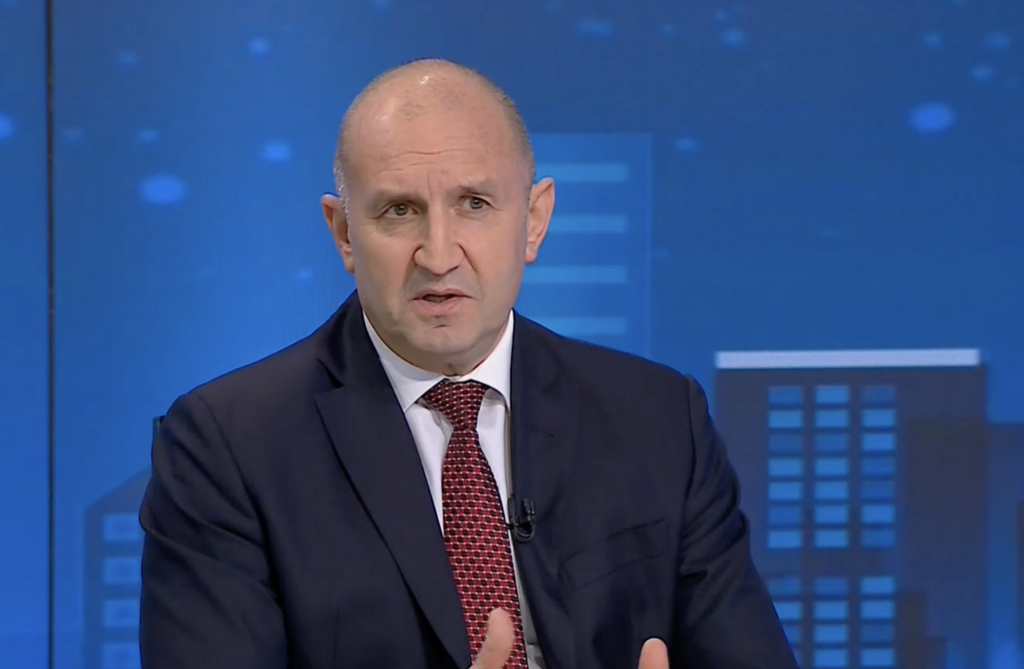
The media are continuing to discuss Rumen Radev’s first television interview on Bulgarian National Television (BNT). He was no longer appearing in his capacity as head of state, yet was treated with the deference normally reserved for a sitting president. I cannot recall another politician being afforded such comfortable treatment by the public broadcaster. If this does not happen again, we might let it pass and assume it was due to the high expectations surrounding Radev personally and the role he is expected to play in the next parliament and government. Indeed, BNT and other media outlets have already assigned him that role, even before voters have had their say.
We know virtually nothing about his future political project, which he has announced will take the form of a political party.
Speaking from the intellectual pedestal on which he has placed himself, Ivo Hristov said, once again on BNT, that there were enough qualified people working on the programme of the presidential party. If we adapt the words of Matthew 7 – “By their fruits you will know them” – into “By their advisers you will know them”, this might offer us some clues as to who is behind Rumen Radev.
It is understandable that, before the election campaign begins, he would not want to reveal details of his project, particularly since he has announced that he intends to register the party only after the election. But surely he should at least have outlined the ideological profile of his new formation. If Simeon Saxe-Coburg-Gotha once demeaned the role of political parties and did much to fuel public nihilism towards them, the president has an obligation to tell his supporters what kind of party he intends to build.
One thing, however, already seems clear: it will once again be a leader-centred party, and most probably a populist one as well.
What society expects
In his interview on Panorama, as well as in other public statements, Rumen Radev repeatedly insists that he is leaving the presidency because society expects him to take on the oligarchy and corruption. And the mafia, too.
“The Bulgarian mafia has achieved the impossible: it has united decent people against itself. It is up to us to drive the mafia out of the executive branch and the prosecution service, which the mafia uses with utter impunity as a shield for political repression.”
Yet neither in 2020 nor now has Radev explained how he intends to defeat the mafia, or who will help him do it. He knows perfectly well that only in fairy tales can a hero single-handedly slay a three-headed dragon. Nevertheless, through both his words and his conduct, he continues to suggest that he has embraced this as his personal cause and intends to see it through.
Such a battle requires political will, courageous magistrates and strong public support.
For now, the only force clearly present is public intolerance of the mafia-style model of governance in Bulgaria. The country needs police officers, prosecutors and judges willing to enter this battle, fully aware that they could become its victims. Like Giovanni Falcone, the Italian prosecutor murdered by the Mafia, who famously said: “The coward dies every day, the brave man only once.”
Whether Radev shares this philosophy remains unknown. But in Bulgaria’s popular mindset, heroes are often dismissed as madmen, while those prepared to sacrifice themselves for freedom and the common good are few and far between.
History, unfortunately, has proved this time and again. So even if the current wave of public discontent gathers momentum in his favour, the new political “messiah” will still need to secure a parliamentary majority to elect a new Supreme Judicial Council and a new Prosecutor General. Whether that will be possible depends on the electoral weight of the individual parties. Only after that could the clean-up of the Augean stables of the state and the battle against the mafia begin – if things ever get that far.
Mafias around the world have names
Both the Italian and American mafias have their principal clans, or families, and their leaders are sometimes referred to as capo di tutti capi – the boss of all bosses.
In Bulgaria, the mafia has no name, and we do not know the identities of its bosses. It is true that one of the country’s most powerful politicians is whispered about as a possible capo di tutti capi. Social media also contain photographs showing members of his party kissing his hand – a traditional Mafia ritual symbolising submission to the highest-ranking figure in a criminal hierarchy.
Perhaps that is why Bulgaria is often described as a country where the mafia has its own state.
One thing is beyond dispute: the former repressive security services of the communist state, operating under the direction of the country’s party elite, created the first criminal groups from which the Bulgarian mafia later emerged.
When generals become presidents
There are numerous examples around the world of generals becoming presidents, usually on the strength of military victories and exceptional influence, and often during periods of crisis. George Washington and Dwight Eisenhower in the United States, Mustafa Kemal Atatürk in Turkey and Charles de Gaulle in France are among them. Others came to power through military coups, including Augusto Pinochet in Chile, Juan Perón in Argentina and Artur da Costa e Silva in Brazil.
There are also cases of prime ministers later becoming presidents, such as Boris Tadić in Serbia. The reverse sequence is less common, with Charles de Gaulle being one of the most prominent examples. Called upon by the people, the general took charge of France, then destabilised by political divisions, on the condition that he organise a referendum on changes to the country’s system of government. Thus, in 1958, the Fifth Republic was established, creating what is effectively a semi-presidential system.
Ideas about changing the Constitution and transforming Bulgaria from a parliamentary into a presidential republic have been circulating in the public sphere for some time.
We cannot know whether such ideas were discussed in private circles inside the presidential administration at 2 Dondukov Boulevard during Rumen Radev’s two terms in office. But they should not be dismissed out of hand. After a succession of parliamentary crises and seemingly endless elections, it is entirely possible that certain circles operating behind the scenes have begun considering scenarios of this kind. The same power brokers are visibly finding it increasingly difficult to manufacture new political projects for every election.
And the example of Russia, where Vladimir Putin changed the Constitution to pave the way for remaining president for life, may well appeal to the deep state and its associated mafia networks.
This is, of course, only a hypothesis. At this stage, it may seem eccentric or even impossible. But such sentiments could emerge in Bulgarian society, particularly if the political crisis and cycle of repeated elections continue.
For now, society is waiting for Rumen Radev, the general, to answer a host of questions. During the campaign, and especially after the election, he will have to demonstrate whether he has the qualities of a strategist. Tactics can be changed along the way. Vision, however, is a gift not everyone possesses.