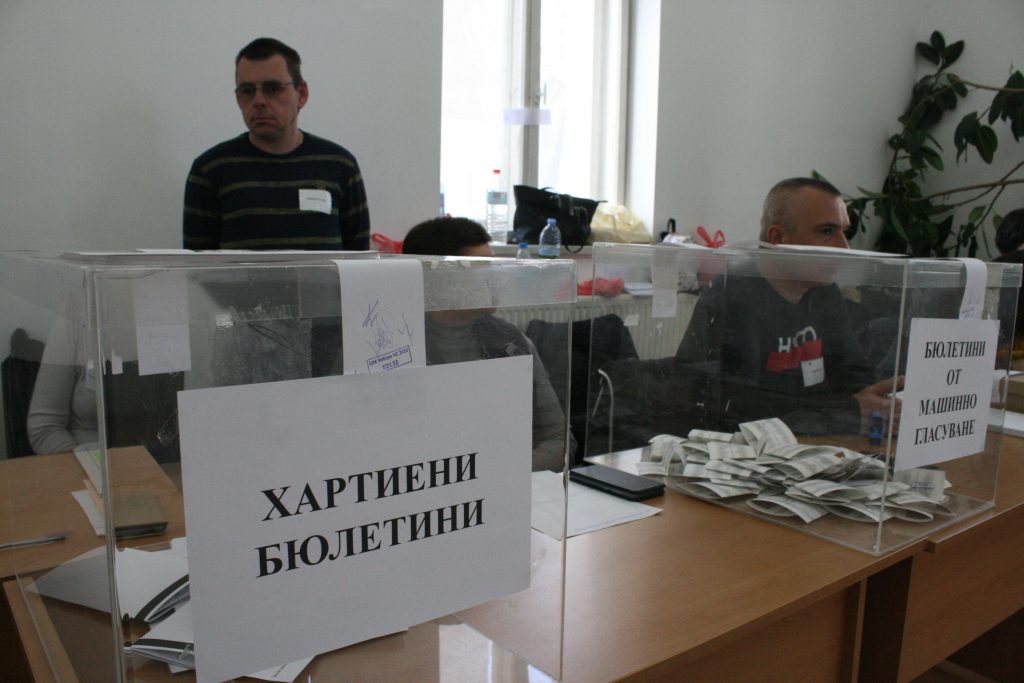
Just under 12%, the GERB-SDF coalition leads “Prodaljavame promianata – Democratic Bulgaria” in the Gabrovo region after yesterday’s snap parliamentary elections. However, with the highest growth in support compared to the elections in October last year, “Vazrazhdane” is the party.
This is shown by the results with 100% processed protocols from the section election commissions in the region.
33.98% of those who went to the sections in the region voted for GERB-SDF yesterday, while 22.11% did so for PP-DB. With this result, GERB is categorically positioned as the first political force in the region. However, there is one detail – although first,
GERB-SDF continue to report a decline in support.
In April 2021, when the series of snap parliamentary elections began, Borisov’s party registered almost 16 thousand votes in its favor. Two years later, we subtract 3 thousand from them. votes – that is how many fewer GERB-SDF voters have been, which, as it became clear, is not an obstacle to maintaining their place as the first political force in the region.
The reason for this leadership is hardly the result of approval from GERB’s policies alone. It is important to note that employees in municipal administrations and local structures in the two largest municipalities – Gabrovo and Sevlievo – have been selected and appointed by GERB mayors for ten years now. A significant number of these people do not have the qualifications for the positions they are appointed to on a party basis, but their loyalty is the key to keeping their jobs. If we add to them the members of their families and their close circle of friends, it is not at all difficult to explain the continued support for the party with each successive vote.
The leader of the GERB list in Gabrovo was Tomislav Donchev – former mayor of Gabrovo, and now deputy chairman of the party. However, this fact should not be taken as absolute, as a reason for GERB’s retained first position in Gabrovo. Donchev has long been a “foreigner” in the city, and has not made a clearly distinguishable contribution to its development for a long time.
Since “Prodaljavame promianata – Democratic Bulgaria” is a new coalition, a comparison with the previous elections in the fall of 2022 is not possible. However, if the votes from October of last year for each of the two parties are summed and compared to the result they received on April 2, it becomes evident that their support has decreased by 1,391 votes. In yesterday’s elections, 7,785 voters in the region cast their ballots for PP-DB. In the fall of 2022, the total result for PP and DB was 9,133 votes.
One possible reason for the weaker support for the PP-DB coalition compared to last autumn may lie in the selection of Yavor Bozhanov as their lead candidate.
Judging by comments on social media, the people of Gabrovo and the surrounding areas have not succeeded in recognizing Bozhanov as “their person.” However, it would be unfair to place the entire responsibility for the PP-DB result on Bozhanov. The second candidate on the list, Bogomil Petkov, also shares some of the blame.
Petkov was a deputy in the 48th National Assembly from Burgas, but he is originally from Sevlievo. As a local figure, he publicly demonstrates his commitment to local issues, primarily focusing on the water supply in Sevlievo—a problem that all candidates for power, whether parliamentary or municipal, traditionally address. However, this longstanding issue has not garnered sympathy from residents, and in this case, it has rather turned citizens of Sevlievo—who have suffered from systemic water shortages—against Bogomil Petkov. This is not because Petkov did not make efforts, but rather because he attempted to persuade the Sevlievo residents that he had solved their water crisis. In a region where people have gone for months without water for over 30 years, such statements have not been well received for a long time.
Despite PP-DB conducting a campaign aimed at reaching more voters, this did not translate into more ballots in their favor. While candidates of the young coalition traveled to towns and villages, GERB candidates neither heard nor seen. Their campaign was primarily conducted on social media, and the tactic they chose this time was that of a passive observer, executed with little visible effort or tension. There is no doubt that GERB relied on their electorate. The slow but steady erosion of this electorate likely indicates that what Borissov’s party achieves in Gabrovo could be the ceiling of its potential; however, this does not prevent them from maintaining their status as the leading political force.
Increasing Support for “Vazrazhdane” in Gabrovo
The growing support for “Vazrazhdane” in Gabrovo is a combination of Kostadin Kostadinov’s pro-Russian messages and the citizens’ anger towards the Euro, fueled by insinuations and the instillation of fear. This accounts for the increase in votes for “Vazrazhdane” from 4,550 voters on October 2, 2022, to 6,090 on April 2, 2023. This rise in approval comes despite the completely unpopular leader of the party’s list, Daniel Petrov, but can be understood in the context of the petitions “for the preservation of the Bulgarian lev,” which “Vazrazhdane” positioned in kiosks and stalls, openly playing into the fears of the people.
“I Have Such a People” is another party that surprisingly marked an increase in support, albeit a negligible one. In the fall of last year, the party received 1,493 votes; now, it has garnered 1,523. No one in Gabrovo knows how this happened, as “I Have Such a People” did not conduct a visible electoral campaign and somehow remained in the shadows of the other candidates.
All other parties received fewer votes.
Trust in the socialists has nearly halved compared to the start of the election marathon in April 2021. The BSP received the support of 3,369 voters yesterday, compared to 3,785 in October 2022, and nearly 8,000 votes in April 2021.
“Bulgarians Rise” received 1,341 votes on October 2 of last year, while only 1,017 voters supported them yesterday.
DPS Receives Less Than 1,500 Votes in Gabrovo: A Decline in Support
DPS has now garnered fewer than 1,500 votes, receiving support from 1,473 voters on April 2, 2023, down from 1,792 in October 2022. Given that nearly 40% of the votes from abroad were for DPS, it raises the question of whether the party will manage to secure a parliamentary deputy from Gabrovo with such a negligible and absolutely unrepresentative result. Interestingly, it is surprising that DPS is reporting a decline in support. Previously, it was believed that Karaday’s party had a steadfast electorate in the region, typically around 1,800 to 1,900 votes, primarily originating from specific villages in Sevlievo municipality with a concentrated Turkish population. What went wrong this time, and whether the fact that the lead candidate attempted to evade justice by placing personal interests above those of the judiciary, as inferred by the Gabrovo District Court, has influenced this outcome is more of a speculation, but it is not without basis.
The latest data on voter turnout in the Gabrovo region indicates that participation was 27.14%, which is nearly a percent higher compared to the elections on October 2 of last year. The most active voters in the late afternoon were from the municipality of Dryanovo (28.82%), while the lowest turnout was observed in Sevlievo (25.23%).
The seventh Gabrovo electoral district sends four deputies to the National Assembly. According to calculations by “For the Truth,” it is possible that GERB will secure two mandates, potentially regaining their positions in Gabrovo from before the series of extraordinary parliamentary elections commenced. However, this remains to be seen.