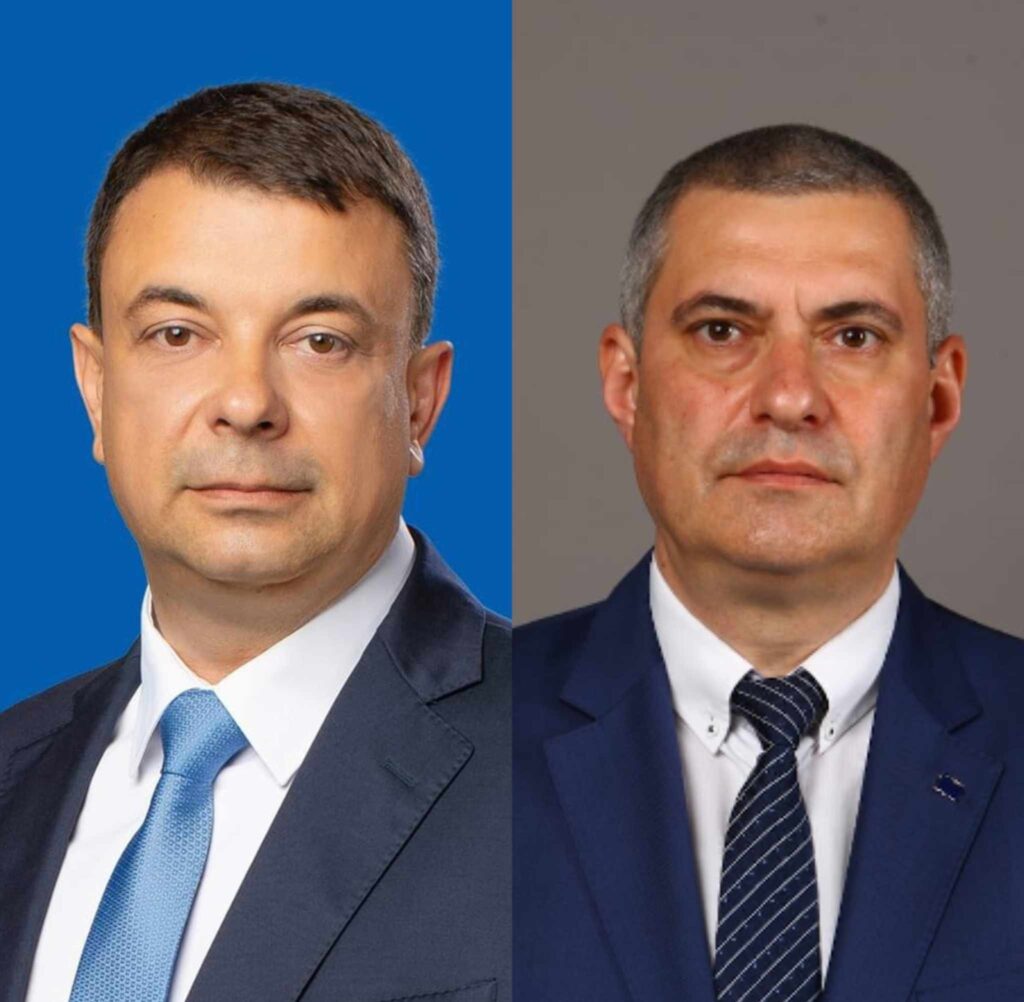
Silistra is among the municipalities that could not elect a mayor in the first round of the local elections last Sunday (October 29), which is why a runoff is scheduled for Sunday.
Out of five candidates in the race, only two remain – GERB’s deputy Ivailin Statev and independent businessman Alexander Sabanov.
Expectations were indeed for a runoff between the two, and they came to pass. However, the surprise came from Alexander Sabanov’s substantial lead over the representative of the party that recently governed the municipality. Sabanov received 8,388 votes, which accounts for 46.67% of the total 18,561 citizens who voted, while Statev garnered 6,383 votes, or 35.52%.
The 10% difference between the two candidates amounts to about 2,000 votes, which remains uncertain whether can be compensated. However, visible support from certain political parties for the losing candidate suggests that efforts are being made in this regard for the second round.
Candidates Overview
The leading candidate so far, Alexander Sabanov, is a former deputy from the 44th National Assembly, representing the citizens’ quota of VMRO. This is his third time running for mayor; he has previously been supported by various parties and coalitions but has lost in two runoffs.
Support for Sabanov remains significant, with a wide coalition backing him this time, which includes “The Citizens’ Alternative,” BSP, ITN, Bulgarian Rise, NDSV, New Time, and others. This support, combined with Sabanov’s high pre-election activity, clearly helped mobilize votes in the first round.
On the other hand, GERB candidate and deputy Ivailin Statev was formally nominated by party members and primarily relied on support from the party and local residents who wish to maintain the status quo or, for some reason, do not favor the other candidate. However, this support has so far proven insufficient.
Main Differences Between the Candidates
Sabanov is an entrepreneur primarily involved in investments in trade, agriculture, and construction, having acquired ownership and construction rights on key plots in Silistra over the years. Therefore, his campaign emphasizes attracting investors to the municipality, with a cause focused on building an industrial park.
Ivailin Statev has held administrative positions, such as director of the Regional Directorate of the Ministry of Interior, secretary to the regional governor, and regional governor before becoming a deputy. Logically, he emphasizes improving administrative services for citizens in his campaign messages.
Organizationally, the difference between them lies in Sabanov’s relative independence, coupled with influence through the local coalition of municipal councilors “Citizens’ Alternative,” which positions him to impact decision-making processes and governance (even for his own interests). In contrast, Statev tends to be a figure through whom the influence of the party that nominated him is exercised, indicating a more structured organizational affiliation. His close ties to the party’s regional coordinator, Todor Todorov, are also known.
In addition to the mayoral election, the support for the mayor from the members of the municipal council is also significant for future governance. Following the elections held on Sunday, the composition of the new local parliament is now known.
The New Municipal Council of Silistra
The new council includes representatives from 10 different political groups, which is unprecedented. From this perspective, it can be said that the citizens are proportionally well represented in the local parliament.
However, this representation may be illusory and depends on how the councilors will group themselves afterward, as no single group will hold a majority.
GERB remains the largest group but has three fewer deputies compared to the previous council, decreasing from 11 to 8. The second largest group is “Sabanov’s Group” – “The Citizens’ Alternative,” which grew from 4 members in the previous council to 6 in the current one. If these two groups end up opposing each other, they will need to form majorities with smaller groups, some of which previously supported GERB, while others were in opposition.
“We Continue the Change” and “Democratic Bulgaria” together managed to secure 2 representatives—matching the number that only the Democratic Bulgaria coalition managed to achieve in the previous local elections. These include lawyer Zlatko Kurtev and the coalition’s mayoral candidate, architect Maria Ilcheva. The coalition has already issued a statement supporting Sabanov in the second round.
A new aspect of the council is the participation of “Vazrajdane,” which succeeded in electing two councilors—Marin Nikolov, the head of the party’s local structure and a teacher, and civic activist Svilin Dimitrov. They position themselves as an opposition to the existing model dominated by GERB and had their own mayoral candidate in the first round, but have not officially announced whether they support any of the candidates in the runoff.
Another development is that GERB’s national coalition partner, SDS, will also have two representatives in the local parliament. SDS supports GERB’s candidate in the second round and is expected to continue this support in the municipal council’s future activities.
From the “Left” coalition, two representatives were elected. Once again, Stoil Stoychev, the manager of “SBA” stores in the region, and Iliyana Miteva, who was a municipal councilor and chair of a commission in the previous council, are stepping in as councilors. These representatives were part of the “Movement 21” group in the previous council and were three in total, but now, one of them, Galen Eneev, entered with preferences through the SDS list. The “Left” has also firmly backed Sabanov in the runoff.
From the BSP, which also supports mayoral candidate Alexander Sabanov, they managed to elect three councilors. In contrast to the local elections in 2019, when they had six councilors, their numbers are now halved.
One of the previous BSP councilors is Dimitar Todorov. He is also entering the council but will be part of the “Citizens for the Municipality” group, the core of which is formed by “ABV.” The other member is the outgoing deputy chair of the municipal council, Ivanka Tasheva. The coalition “Citizens for the Municipality” supports the GERB candidate in the second round.
The “Social Democratic Party” is once again represented in the municipal council, supporting GERB and their candidate in both rounds. Led locally by Ganche Nedelchev, the party has been a significant support for the majority around GERB and is sending three representatives, the same number as in the previous council. The party also managed to elect its own mayor in the municipality of Yordanovo – the outgoing mayor Vedat Sali. That village became the subject of a series of complaints to the Municipal Election Commission, primarily due to the voting method—using pre-filled ballots. Although the municipal election commission found no violations in this case, the results protocols indicate that the village overwhelmingly voted for a single party—DPS—for their municipal councilors.
Despite this, the representatives of DPS in the Silistra municipal council remain two, the same number as in the previous council.
Interestingly, the results from the village of Yordanovo, which serves as a litmus test for controlled voting, indicate that DPS voters, who overwhelmingly supported the GERB candidate for mayor in the last elections, now predominantly voted for the opposition candidate Sabanov in the first round. However, for the second round, DPS has aligned with his opponent, Statev, and the voting decisions of their supporters could prove decisive in the upcoming runoff on Sunday.