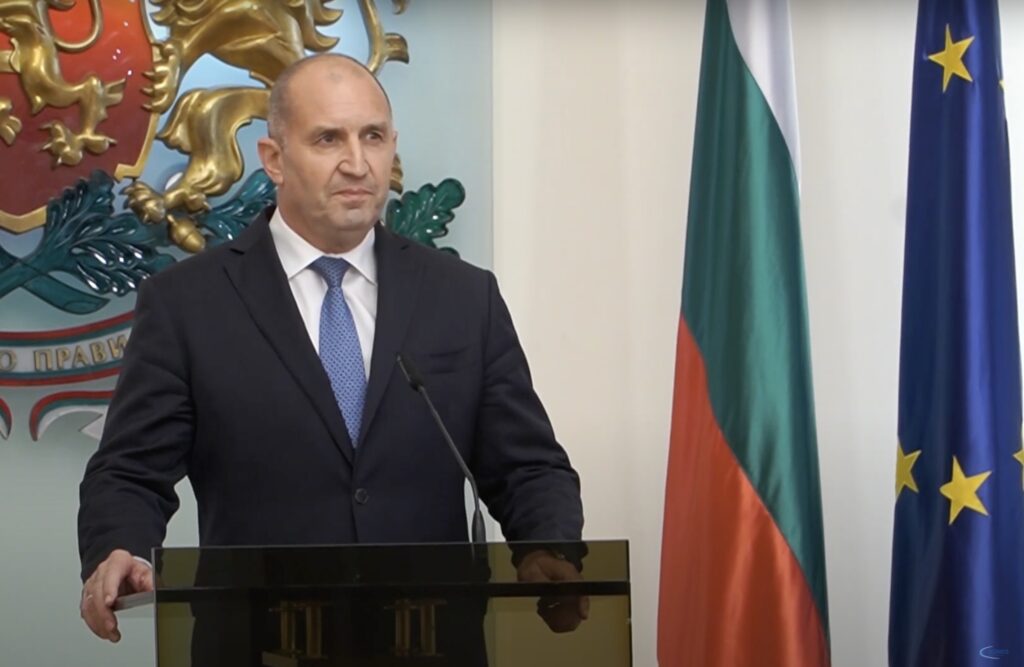
On Europe Day, President Rumen Radev Called for a referendum on the euro, which is equivalent to a “rising East” command, and openly challenged European leaders discussing Bulgaria’s readiness to join the eurozone.
Without attending the parade in Moscow, NATO general Rumen Radev demonstrated his loyalty to the Kremlin, whose master continues to see Bulgaria as a protectorate and openly aims to reverse the country’s geopolitical orientation.
For Putin, Bulgaria’s entry into NATO and the construction of military bases on our and Romanian territory is a bold move that must be punished, and for which we must pay. This is also one of the reasons Bulgaria is included on Russia’s list of enemy states.
Does the Bulgarian president realize that the referendum he advocates for—claiming it is “the right of every Bulgarian citizen to decide about their money, their well-being, and their future”—is doomed, especially after the Constitutional Court’s ruling on this matter?
Yes, of course, and most likely without seeking approval for his intentions from legitimate and competent institutions and authorities. This is why Krum Zarkov, the presidential legal secretary, announced he will resign on Monday, because he disagrees and cannot support the president’s unconstitutional decision.
Rumen Radev joined the nationalist chorus of Euroskeptics and stabbed the state in the back,
as Svetoslav Malinov expressed. And this happened right at the final stretch, when an EU Commission report is expected, which should conclude the long process of Bulgaria’s accession to the common European currency.
The president’s decision, of course, is neither spontaneous nor recent. It’s not out of the question that even the timing was suggested by an embassy, for which we are regarded as a “province beyond the Danube.” It was precisely with its help and active cooperation that Rumen Radev was supported by the BSP and elected as head of state. And this is not forgotten by anyone. But even without foreign advice, it’s clear how well the current socio-political situation in Bulgaria suits Radev to once again take on the role of a people’s tribune:
The National Assembly, with only 13% public trust, is trembling from scandals and is not passing laws. Meanwhile, populist parties are doing everything possible to block its work and seek reasons for a vote of no confidence in the cabinet.
The government of Zelinsky is a minority government following the withdrawal of DPS support from Dogan.
And his life, hanging by a thread, now depends solely on the shadows behind the scenes, masked as a “new beginning.”
If tomorrow his representative in the National Assembly raises a hand with a thumbs down, the coalition’s bobsled cannot be stopped. Borisov has long ceased to be a leader. He is weak, scared, and uncertain how long Delyan Peevski will keep him safe and silent.
His wounded ego drives him to make mistakes, such as repeating that the “Zheliazkov” cabinet is not his, but on the other hand, he claims he will bring us into the Eurozone, just as he brought us into Schengen. The latest sharp slap came from the European People’s Party, which did not choose Maria Gabriel as one of its vice chairs.
The unending military conflict between Russia and Ukraine, the emerging conflict between India and Pakistan, the contradictions between the US and Europe, and the looming new financial crisis in the EU—which, according to Germany’s new chancellor Friedrich Merz, will be a state debt crisis—undoubtedly impact Bulgaria’s socio-political situation. They also influence citizens’ moods, who are worried about how the adoption of the euro will affect their income and standard of living.
These fears are fueled both in parliament and on social media by populists and Euroskeptics. The escalation reached a peak on February 22nd this year, when “Vazrazhdane” organized a riot at the European Parliament building in Sofia. Recently, they also signed an agreement for joint cooperation and equal partnership with Putin’s ruling party, “United Russia.”
Bulgarians are disgusted with Borisov’s long rule and Peevski’s declaration to take his place. They are looking for a new leader, and the president is stepping into that role at just the right time. He currently has a 49% approval rating, exactly twice as high as Boyko Borisov’s.
Whether Rumen Radev will come out of the presidency for a second time with a raised fist to lead protests organized by parties like “Vazrazhdane” against the adoption of the euro, or whether he will announce a new project to re-enter active politics, is only a matter of time.
A more realistic scenario also appears possible—that he will step down calm and confident, leaving Iliyana Yotova at “Dondukov” 2 until new presidential elections are held. However, the final decision will not be made at this address.