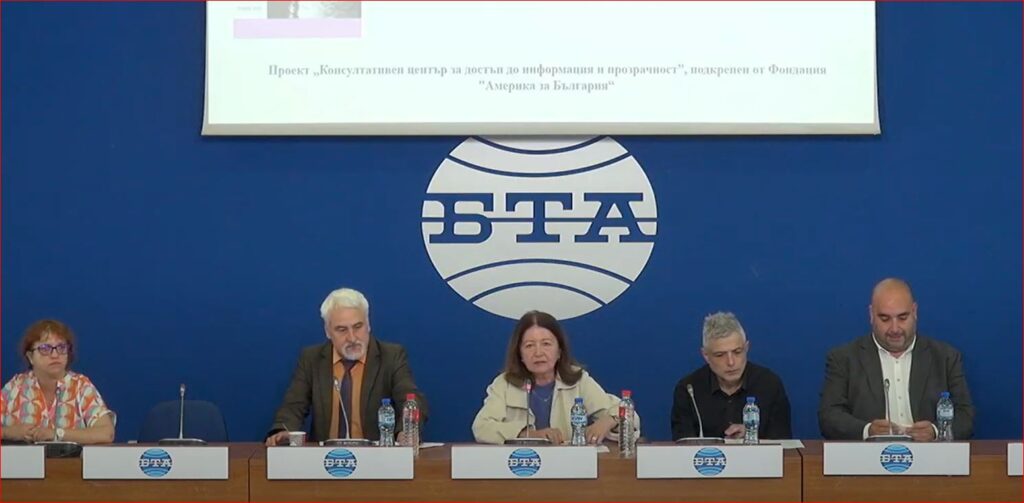
Screenshot: “For the Truth”.
Journalists, representatives of the non-governmental sector, and civil activists actively use the right of access to information to expose irregularities and protect the public interest, but they often become the subject of lawsuits aimed at intimidating and discouraging them.
Expected legislative reforms to protect freedom of speech are being delayed for no apparent reason. There is also a risk of the environment deteriorating if the supreme courts recognize the right of legal entities to sue for non-pecuniary damages from publications.
Against this backdrop, the Revival Party continues its attempts to introduce a law on “foreign agents,” which is yet another threat to free expression. Another worrying sign of restrictions on freedom of speech is the prosecutor’s request to exclude sensitive public information from the scope of the Access to Public Information Act (APIA).
This is a summarized and greatly abbreviated version of the state of access to information in Bulgaria in 2024, presented in a report by the Access to Information Program (AIP). The authors of the report are Dr. Gergana Zhuleva, Alexander Kashamov, head of the AIP legal team, and lawyers Kiril Terziyski and Stefan Angelov. The text focuses on relevant events and processes in 2024 related to access to information and the right to information in a broader sense.
Threat to freedom of speech – can legal entities sue journalists for defamation?
The report focuses on the question examined in 2024 by the Supreme Court of Cassation and the Supreme Administrative Court on whether legal entities are entitled to claim so-called “non-pecuniary damages,” i.e., whether commercial companies and state institutions have the right to sue journalists and media outlets for defamation, damage to reputation, or emotional distress.
The AIP presented its opinion in an open court hearing, noting that if this were allowed, hundreds of thousands of companies and state institutions would be able to sue journalists and media outlets for critical publications, even when there is neither falsehood nor defamation.
Although legal entities cannot currently claim non-pecuniary damages against media outlets and journalists, there have been such claims – the case of Lev Ins against Mediapool for the scandalous sum of BGN 1 million, Kozloduy NPP against Natalia Stancheva for BGN 500,000, Eurohold v. Bivol for BGN 50,000, Veselin Marevski and companies associated with him v. Valya Ahchieva et al.
Judicial reform is needed – the European Court of Human Rights has ruled on two important cases against Bulgaria
Journalist Rosen Boshev from Capital was convicted of defamation after publicly criticizing the chairman of the Financial Supervision Commission, Stoyan Mavrodiev, even though the judge in the case, Petya Krancheva, rejected the journalist’s request to recuse herself on the grounds that she had been the subject of his critical articles, stating that she had not read them.
In 2024, the European Court of Human Rights (ECHR) ruled on the case of Boshev v. Bulgaria. The case, according to the AIP report, is of significant importance and reveals systemic problems in the existing environment.
The fact that, despite doubts about her impartiality in the eyes of the public, she did not recuse herself and at the same time upheld the sanction against the journalist who had written critical articles about her was accepted by the European Court of Human Rights as a violation of both Boshev’s freedom of speech and the requirement for a fair trial.
Girginova v. Bulgaria: Classified information does not mean complete concealment from the public
Galina Girginova is a journalist for the website “Court Reports” and in 2015 she requested access under the Access to Public Information Act to the grounds for the acquittal by the Sofia City Court (SCC) of former Interior Minister Tsvetan Tsvetanov and other officials accused of failing to exercise control over the use of special intelligence means.
The SCC refused to provide a copy of the grounds or part thereof, citing classified information. Girginova appealed the refusal with the help of the AIP before the Sofia City Administrative Court (SCAC), which rejected the appeal. This decision was also appealed before the Supreme Administrative Court, which in 2017 finally ruled that access to the grounds was not due, as the procedure under the Access to Public Information Act was not applicable and disclosure of the classified information contained therein would enable the appellant to learn how the secret surveillance system works.
In a decision from March 2025, the ECHR reaffirmed its practice that access to information that is relevant to public debate falls within the scope of freedom of expression. The decision emphasizes the general importance of the publicity of court decisions for a democratic society and adds that even if the restriction of the right to information related to national security and classified information is legitimate, concealing the entire content from the public is not justified.
A positive development in 2024 was that the Access to Public Information Act was not amended, nor were any such initiatives registered. However, this did not prevent
other legal means from being sought to undermine its effectiveness, according to the authors of the report.
In 2024, AIP continued to pursue its case against the political party Vazrazhdane for publishing the personal identification numbers of over 800 members of the bodies of companies, foundations, and associations designated by the party itself as “foreign agents.” The case is pending on appeal before the Supreme Administrative Court.
A favorite part of the AIP report are the stories behind some of the cases the foundation is pursuing, as well as information on all court cases initiated due to refused or partially provided information by institutions.
Recommendations related to legislation on the provision of public information are also presented.