



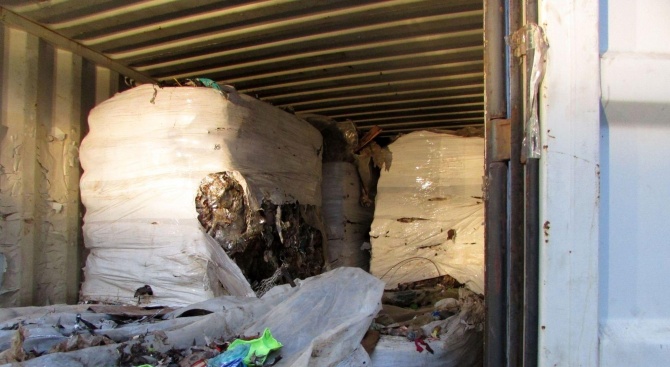
The association “Za Zemyata – Access to Justice” has appealed to the Minister of Environment and Water against the decision of the director of RIEW Stara Zagora not to conduct an environmental assessment and compatibility assessment with the objectives of protecting the designated areas for the partial amendment of the General Spatial Plan of the Municipality of Galabovo.
The request for a change in the designation of numerous properties in the territories of the village of Obrouchishte and Galabovo has been made by the assignors—the municipality and the limited liability company “Sistek Invest” OOD.
The same decision from the environmental inspection is being contested by Toma Belev—co-chairman of the Green Movement—and Stefan Nikolov—a former municipal councilor and civic activist from Galabovo. The appeals highlight the flaws in the issued permit.
In submitting the notification for conducting the environmental assessment, the assignors omitted to disclose that the Process Plan envisages a change in the designation of agricultural land for the construction of an incinerator for burning RDF fuel and accompanying infrastructure.
This circumstance is clarified by a decision from the Municipal Council of Galabovo adopted at the January session this year. It grants preliminary consent for the change in designation of agricultural land for the construction of a thermal power plant that will use municipal solid waste (RDF) as its main fuel, along with related industrial production and technical infrastructure to connect the plant to the transmission network.
In for evaluation, it is stated that “there are no production activities near the properties subject to the change of the General Spatial Plan (GSP) that could lead to air pollution in the area. The future activities to be carried out after the regulation of the properties also do not imply the release of emissions above legally permissible levels. This determines the absence of factors that would pollute the air in the area.”
This assertion is an outright lie, as it is widely known that the municipality of Galabovo hosts four thermal power plants that burn Eastern Maritsa coal with high sulfur and ash content.
The decision of RIEW in Stara Zagora was issued in violation of the Regulation for Compatibility Assessment. Its provisions (Article 2, Paragraph 1, Item 2) stipulate that when the territory of the process plan falls entirely or partially within the borders of protected areas, as is the case with the protected area BG0000427 “River Ovcharitsa,” a compatibility assessment procedure must be conducted concerning the objectives of the protected areas.
In the complaint from the association “Za Zemyata – Access to Justice,” it is indicated that “the decision of the director of RIEW Stara Zagora is unfounded and issued under unclear factual circumstances,” without taking into account facts known to the inspection regarding the regular air pollution in the municipality, which necessitates an assessment of the cumulative effect of the activities proposed in the process plan and the existing polluting operations.
Publicly Known Facts About the Future RDF Burning Plant
It will be constructed by the limited liability company “Sistek Invest,” registered on July 12 of this year. “Sistek Energy” LLC owns 60 percent of it with a capital of 3,000 BGN, while the remaining 40 percent belongs to the municipality of Galabovo with a capital of 2,000 BGN.
The manager of the company, registered in Galabovo, is Bistra Vasileva. “Sistek Energy,” owned by Cenk Karakaya from Germany, was established on April 10 of this year. Its address is in Sofia Municipality, Triaditsa District, Vitosha Blvd. 66, where 529 other companies are also registered.
A detailed review of the affiliated parties shows that Bistra Vasileva, along with Michael Chokan from Germany, jointly manages the limited liability company “Basalt Fibers Bulgaria,” registered on April 10 this year at the same address in Sofia Municipality. Its owners are “Sistek Technology Bulgaria” of Cenk Karakaya, registered on April 4, 2023, and “Premium Basalt” LLC—a trading representation of a foreign legal entity from Uzbekistan, registered under the Investment Promotion Act based on a decision by the Bulgarian Chamber of Commerce and Industry on July 19, 2024, and managed by Alisher Turgunovich Kuchkunov from Uzbekistan.
The remaining information we have about the future plant comes from the municipality’s mayor Nikolay Tonev. He explained to “Za Istinata” that, at the level of “intention,” he had traveled to Germany alongside 17 others from the municipality to observe how an incinerator operates, the technology of which he intends to apply in the future plant in Galabovo: “It neither smells nor produces dust; it’s unique. Nothing comes out of the plant—zero waste; the slag is solid, mixed with sand and cement to make curbs.” According to Tonev, who has been governing the municipality for six consecutive terms, both the designers and the contractors will be from Germany. The plant is expected to create 700 jobs, and there would be no problems, as is the case in Germany or Vienna, for example. Galabovo is destined to become a “diamond” municipality.
We asked Nikolay Tonev who Cenk Karakaya is, the person he claims is ready to invest 360 million euros in the project. The mayor extended an invitation to our media for a meeting in his office, stating that this was not a conversation for the phone.
He was adamant that he would provide all the documentation that “Za Istinata” would request under the Access to Public Information Act.
We sought information about the German investor from the Agency for Foreign Investments, but they responded that not every investor is required to go through the Agency for certification. They refused to answer our other questions related to Karakaya, explaining that they could not provide such information.
The Supreme Administrative Court (SAC) halted the intentions of the former ruling party GERB in Sofia to build an incinerator for burning waste at the Sofia Thermal Power Plant for energy production. The SAC confirmed the annulment of the decision by the director of RIEW-Sofia from 2015, which approved the construction of a facility for the utilization of RDF fuel at the “Toplofikatsiya” site. The new mayor, Vasil Terziev, announced that he would seek other ways to manage municipal waste in the capital, as constructing a plant just 3 km from the city is unacceptable.
Europe is planning a transition to a circular economy—carbon-neutral, environmentally sustainable, and free from pollutants. The recyclability of waste is increasing, and in some countries such as Germany, the Netherlands, Sweden, and the United Kingdom, there is overcapacity for processing it. This leads to a competition for every ton of waste among operators of such facilities, which has altered the market and resulted in the transportation of household waste between countries or from areas distant from the plants. This generates additional greenhouse gas emissions, which is why some countries have introduced fees for waste incineration.
It is evident that manufacturers of incinerator equipment are seeking new markets and are increasingly turning to Eastern European countries that rely on funding from EU funds and programs.
In this context, it seems strange who would invest 360 million euros without secure guarantees for the return on investment and profit, especially in a municipality with just over 10,000 residents.
Even if the plant were to burn waste from the entire Stara Zagora region, it is unlikely that it would fully utilize its capacity.
We do not know what the capacities will be, what volume of RDF will be burned daily, whether it will operate during the day or around the clock, or what the burning technology will be, among many other things associated with the future facility.
Answers to all these questions should have been provided to the municipal councilors in Galabovo before they voted on the preliminary consent for the change of designation of agricultural land and the construction of the incinerator.
At the end of July, “Za Zemyata” presented a new report titled “Burning Waste in Bulgaria Behind the Scenes.”
The report outlines the generated pollutants and specifics associated with the burning of RDF. In addition to carbon monoxide and dioxide, sulfur and nitrogen oxides, furans, and hydrogen chloride, mercury and other heavy metals such as cadmium, lead, and arsenic— which are highly toxic and can accumulate in the environment and biological systems—are also released. The report also analyzes the additional health risks posed to humans.
“In recent years, waste incineration is often proposed as a quick solution to the increasing amounts of household waste and diminishing space in regional landfills. The method is presented as a ‘green solution,’ using terms like recovery, disposal, gasification, and others. In reality, incineration does not solve waste problems but creates a series of health and environmental risks, hindering the development of municipal systems for greater recycling and composting,” states the report by “Za Zemyata.”






