



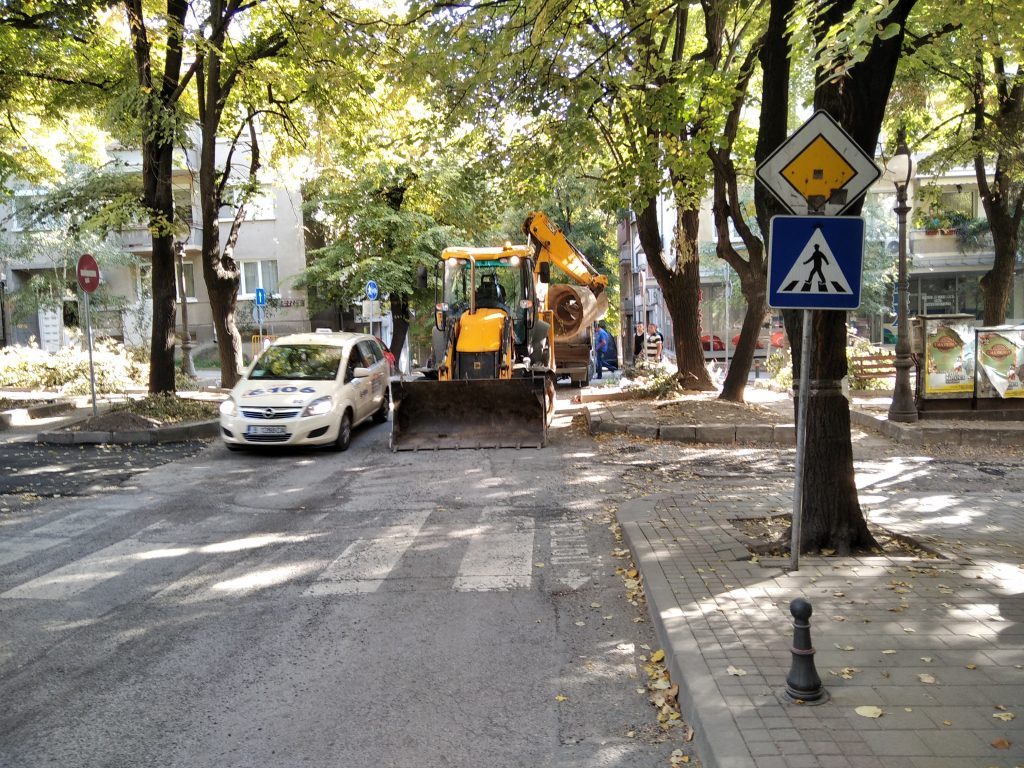
The summer heat has subsided, but the dust that blankets Stara Zagora remains, along with the hardships that citizens have to endure daily in their dig-up city—the dirt, water supply interruptions and its deteriorating quality, broken and closed streets, massive traffic congestion, the inability to park their personal vehicles, and a host of other inconveniences of a domestic, transport, and environmental nature.
And all of this is in the name of our bright future regarding the water supply and sewage systems that awaits us after the implementation of a project under the “Environment” program (2014-2020) worth 122 million leva. The funding comes from the EU Cohesion Fund, the national budget, and the water supply company’s own funds. With this money, 100 km of water supply and sewage systems in the area are to be replaced.
Of course, this project is significant because the water pipes in the central part of Stara Zagora are over 60 years old. The implementation of this project will halt the leaks of drinking water, which we have recently been paying for at a considerably higher price. However, the project’s implementation only began in March of this year and is expected to be completed by October 2023. According to engineer Rumen Raykov—the manager of the water supply company with an unclear status due to constant changes—this deadline, albeit short, can still be met if no new archaeological finds arise during the excavation work, as investigation and conservation of such findings would delay construction activities.
They are carried out by DZZD Water Supply Stara Zagora—with a 60.4% share held by Trace Group Hold AD and 39.6% by DK Infra Invest—and “Hydrostroy” AD from Sofia.
However,
the companies that usually win public procurement contracts in Bulgaria
hire subcontractors to carry out the main construction and installation activities. According to engineer Raykov, their prices, established at the signing of the contracts, are no longer valid. Over the course of a year and a half, they have doubled, which is why the companies expect them to be updated and the project to be additionally financed.
Otherwise, it may turn out that the city will remain excavated—unknown for how long—with the streets left unpaved.
The citizens express their dissatisfaction on social media and wonder why the previously announced plan for closing and excavating the streets is not being followed; why work is not being done in phases and only starting another section once one is completed, resulting in the central part of Stara Zagora resembling a Ukrainian
city recently hit by rockets.
In a Facebook post on the topic, architect Veselin Berov raises the question of whether the documentation submitted to the Municipality of Stara Zagora included a project for the organization of construction, or as it is professionally termed, a Safety and Health Plan? This plan provides guidelines for organizing the construction site, approaches for construction machinery, and the use of public spaces when necessary, and is usually combined with a Temporary Traffic Organization Plan if it is required to temporarily close part of an adjacent street for the placement of concrete mixers and other equipment.
The mayor of Stara Zagora, Zhivko Todorov, responded to a question from “Za Istinata” (For the Truth) stating that the municipality received all the necessary documentation for issuing a building permit. According to him, the issues arise from the fact that
that water projects with European funding started at the last minute, which the water supply holding company explained with various procedures and appeals.
Therefore, if the broad center of Stara Zagora is currently being excavated slowly and in phases, the realization of the project will require not one, but several years that the contractors do not have. This is why they are hurrying and simultaneously closing a lot of sections.
They propose the traffic organization, which the Municipality simply approves: “We are faced with a fait accompli,” justifies the apparent inaction of the local authorities by the mayor, who forecasts that the project will not be executed with quality. All this despite the fact that
“crazy money”
is being paid for construction supervision and for the project leaders.
The director of the Regional Directorate for National Construction Control (RDNSC) in Stara Zagora, architect Yordan Danev, views the execution of this project as another example of poor practice in the country but asserts that all questions related to it should be directed towards the Municipality.
The most pressing issue remains the constant air pollution.
This threatens the health of all citizens of Stara Zagora, especially those who live in the excavated central city area.
The contractors propose the traffic organization, which the Municipality simply approves: “We are faced with a fait accompli,” the mayor justifies the apparent inaction of the local authorities and predicts that the project will not be executed with quality. This is all despite the fact that “crazy money” is being paid for construction supervision and for the project leaders.
The director of the Regional Directorate for National Construction Control (RDNSC) in Stara Zagora, architect Yordan Danev, sees the execution of this project as yet another example of poor practice in the country, but asserts that all questions related to it should be directed to the Municipality.
The most pressing issue remains the constant air pollution.
This poses a threat to the health of all citizens of Stara Zagora, particularly those living in the excavated central city area.
One wonders – whom the citizens of Stara Zagora should trust – the data from the automatic station of the Executive Environment Agency or their own senses? And what has cleaned the city’s air over the past two years, considering that in 2020, Stara Zagora topped the rankings for mortality in Europe caused by poor air quality, according to the CE-Delft Report by the European Public Health Alliance?
We asked Dora Kalcheva—the head of the regional laboratory of the Executive Environment Agency in Stara Zagora, located in one of the most ventilated areas of the city, the so-called “Green Wedge”—if she expects that a Stara Zagorian will accept these data at face value. Or will the majority of people rather reinforce their belief that the data are manipulated? The station is 15 years old but was last calibrated in August. It is located in close proximity to “Kaufland,” where construction activities related to the project are currently underway, and
the dust is visible to the naked eye.
However, the analyzed fractions do not report elevated levels of fine particulate matter of 10 and 2.5 mg/m³, which penetrate the respiratory system and lead to tissue damage in the lungs.
Ms. Kalcheva explained that the station does not measure larger particles, which are presumably predominant in the air. However, even without an understanding of the laws of gravity, one can surmise that larger particles are heavier and, therefore, it is logical for finer particles to remain suspended in the air, right?
In Stara Zagora, there are also two more automatic stations provided to the local authority through a project aimed at improving air quality in six municipalities, which is being implemented with the support of the EU’s LIFE Program. The monitoring is supposed to assess the impact of various sources of emissions of fine particulate matter, particularly those from household heating with wood and coal. One station is located in the “Zheleznik” neighborhood, and the other in the southwestern pre-industrial part of the city.
These two stations, which are under the supervision and control of the municipality, also do not report any exceedances of fine particulate matter. While they are indeed distanced from the construction activities taking place in the central city area, at least one of them should reflect the overall background of air pollution.
The lie we live in
must finally be refuted.
First—the automatic station of the Executive Environment Agency should be moved from the “Green Wedge” and relocated to another site. Mayor Zhivko Todorov should present to the public the request for this, if such exists at all, and any refusal from the Regional Inspectorate for Environment and Water (RIEW), as he stated to our media regarding another previous inquiry. Because, according to Dora Kalcheva, if a well-argued proposal has been submitted by the local authorities, it should not be rejected. Apart from the mayor, the relocation of the automatic station can also be requested by any other entity—non-governmental organizations, a group of citizens, etc.
Second—the Executive Environment Agency should install at least two more automatic stations in the city at different critical points.
Third—the sanitation contractor should begin washing the city’s streets regularly, not just a few times a year as stipulated in the contract with the municipality, but on a regular basis. And not with sprinklers that scatter water like fine rain, but with tankers and hoses that deliver a strong jet and pressure. The funds should be renegotiated at the expense of winter street maintenance, as winters here are becoming increasingly warmer and the snow cover barely lasts. If necessary, the citizens will accept higher waste fees in the name of their health. Let’s not forget that exactly a year from now there will be other elections, and the citizens of Stara Zagora will remember all these issues then.






