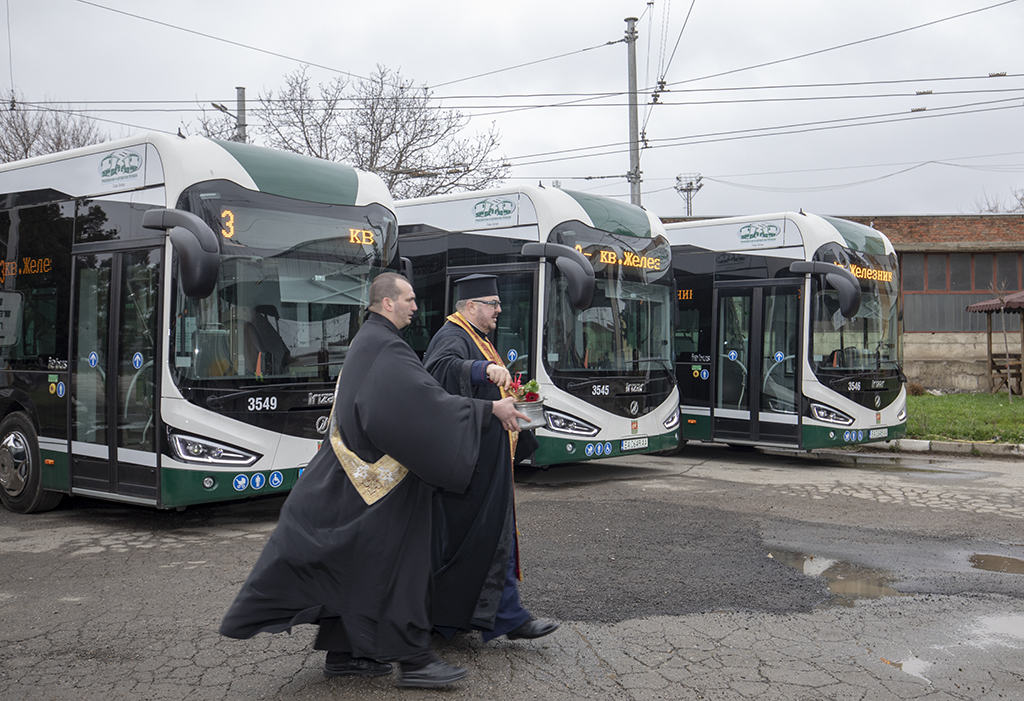
In Stara Zagora, the new electric buses were ceremoniously launched. However, it turned out that due to a poorly prepared assignment for the public procurement, the batteries of the buses do not sustain a full route on the city lines.
For now, they will only operate on two of the public transport lines – No. 3 and No. 8. The reason, according to Georgi Stanchev, the manager of “Trolleybus and Bus Transport,” is that he did not want to run them on the streets damaged during the implementation of the water supply and sewage project. Additionally, it has not been easy to find drivers willing to operate them, as they would have to pay out of pocket for even a scratch on the brand-new electric buses.
The order was for 33 buses, and the first 18 have arrived in Stara Zagora, while the remaining ones will be delivered in phases over the coming months.
The public procurement for their delivery was won by “El Bus Track and Coach” Ltd., competing against 13 companies, eight of which were disqualified by the committee based on Article 107 of the Public Procurement Act. The same company, established before the Christmas holidays at the end of 2019, also won the public procurement for the delivery of electric buses of the same brand in Burgas.
Even during the initial courses of the seemingly luxurious new buses, it became evident that
with a full battery charge, an electric bus cannot complete the full-day route
on line No. 3. Drivers claim that when the battery drops to 20 percent, an emergency mode activates, requiring them to return the electric bus to the company’s parking garage. Another bus then has to take over for the next shift on the line.
If the public procurement had specified an engine power of 160 kW instead of 180 kW, as proposed in the offers from some candidates, then perhaps the buses could have achieved a longer range on a single charge of their four-module batteries.
Moreover, there are no steep inclines to overcome in the terrain of Stara Zagora. It is also unclear whether with this engine power of 180 kW, six-module batteries, like those used in the buses in Burgas, would have been more suitable.
And since the municipality’s leadership ranks Stara Zagora alongside capitals such as Paris and London in the use of modern electric buses, it would be beneficial to examine how these buses have been integrated into the transport schemes of major cities in Europe, Asia, and other continents.
Passengers who have traveled on the new electric buses claim that the temperature, especially during the recent cold days, does not match the
loudly advertised comfort
within them. Clearly, with the short distances between stops in the city, frequent stopping, and the opening of doors, heat is lost, and increasing the temperature in the electric buses would lead to quicker battery depletion. However, the manager of the municipal transport company asserts that he traveled on line 3 wearing just a jacket in a temperature of 19 degrees.
Complaints on social media emerged within the first few days after the electric buses were launched on the lines, particularly from individuals with disabilities. According to Georgi Stanchev, drivers are supposed to activate the accessibility system for citizens with reduced mobility at every stop before opening the doors, but they have not yet developed the habit of doing so.
We won’t comment on the qualities of the seats, which the manager referred to as “ergometric” instead of “ergonomic,” nor on the number of seating places or the features in the last-generation buses. Nor on the fact that they are extremely environmentally friendly.
Of course, the new electric buses and charging stations will still be subject to expert evaluation after the arrival of all 33 units and after covering a certain mileage in various atmospheric conditions.
It remains to be seen whether the electronic fare collection system for passengers, which has been non-operational in the other buses and trolleys for four years, will be successfully implemented. Fortunately, the company continues to rely on conductors; otherwise, it would likely have gone bankrupt by now.
Manager Stanchev attempted to explain to “For the Truth” the multitude of issues within the system, which are being resolved through software, as well as problems with the ticket printing devices in the buses and trolleys, which frequently break down and, moreover, are designed such that they do not provide change. So far, only 1-2 percent of passengers have used mobile applications to purchase tickets, but Stanchev asserts that the municipal company he leads offers the most flexible tariff policy and that he is currently exploring offers for payments through all types of bank cards.
Many Unknowns
Reviews of the electric buses are positive, but in much larger cities than Stara Zagora. It remains unclear what energy consumption is required for a range of 100 km. It would be beneficial if the municipality funded the long-standing idea from the “People’s Union” for establishing its own photovoltaic power plant to supply electricity to the 18 charging stations for the electric buses. However, the plot intended for this purpose, which is state-owned, has not yet been transferred to the municipality, and there is no project for the power plant, commented municipal councilor from Democratic Bulgaria, Dimitar Chorbajiev, to “For the Truth.”
There is also a lack of clarity on how “Trolleybus and Bus Transport” will manage its remaining buses. To service all the lines in Stara Zagora, around 36 buses are needed, Chorbajiev asserts, while the company has over 80. They are paying insurance and other expenses for all of them, even though they are not in operation.
In 2015, with savings from the Operational Program “Regional Development,” the municipality of Stara Zagora purchased 55 diesel buses at a suspiciously high price. Now, these buses are accounted for as costing a significant amount, but it will be difficult to sell them. They were once a point of pride for Mayor Todorov and his team.
After eight years, which is the warranty period for the batteries of the new electric buses, when it will be necessary to replace various components after a certain mileage, their maintenance is likely to become expensive. Will the company have the financial means for this? Probably not, because while it currently has no debts, it also has no realized profits.
The case is closed – forget about it!
At the end of November 2021, employees from the Directorate for Combating Corruption of the Anti-Corruption Commission (KPKONPI) began an investigation into the two public procurements for the delivery of diesel buses and electric buses.
In early January 2022, the Commission for Combating Corruption and the Forfeiture of Illegally Acquired Property sent the results of the investigation to the District Prosecutor’s Office in Stara Zagora.
In response to a question from “For the Truth” regarding whether a pre-trial proceeding has been initiated and whether charges have been filed against officials from the Municipality of Stara Zagora in connection with abuses of European funds related to the two public procurements, District Prosecutor Dicho Atanasov stated that in July 2022, a prosecutor from the district prosecutor’s office refused to initiate a pre-trial proceeding due to a lack of sufficient evidence to substantiate a crime.
The refusal has been confirmed by the Appellate Prosecutor’s Office in Plovdiv. However, the District Prosecutor of Stara Zagora declined to name his colleague who dismissed the case sent by the Anti-Corruption Commission.
Of course, hardly anyone expected the loudly announced operation by the Commission, then led by Sotir Tsatsarov, to conclude with an indictment from the prosecution. And yet, how banal!