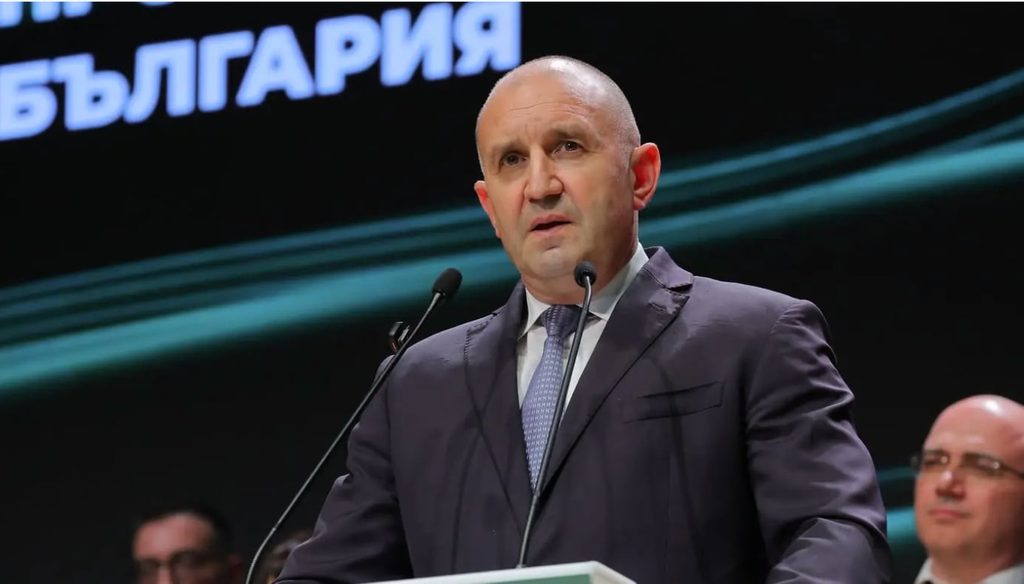
The electoral victory of “Progressive Bulgaria” cleared the political landscape for the former president and general, as well as for his chosen candidates in the National Assembly. His results are the best since 1997, when the United Democratic Forces and their leader, Ivan Kostov, secured 137 seats with a voter turnout of 62.4%—a figure that remains a record in Bulgaria’s modern history since 1990.
Rumen Radev’s success was met with mixed reactions, both domestically and abroad. His stances on key international issues—as a head of state nominated by a party of Russophile socialists—have cast him as a moderate Eurosceptic who keeps one eye on Brussels and Washington, and the other on Moscow. He tends to say one thing during meetings in Europe, yet something else when in Bulgaria.
Consequently, reactions to his victory in the Western press and among European leaders have been notably cool—in stark contrast to the Kremlin’s undisguised satisfaction with Radev’s stated intention to maintain pragmatic relations with Russia.
The Fall of the BSP: A Turning Point in Bulgaria’s Transition
For the first time since 1990, the Bulgarian Socialist Party (BSP) has been excluded from the National Assembly. However, this does not mean that the families of the high-ranking communist nomenklatura—who, in collusion with State Security, created the “shadow establishment” (zadkulisieto) and the oligarchs—have been pushed out of the game. On the contrary, the opposite is true. Just as they orchestrated the transformation of the country’s economy—shifting from a state-planned system to a market-oligarchic one—they also required a new form of political legitimacy.
The Bulgarian Socialist Party, which inherited the Bulgarian Communist Party (BCP) along with its entire criminal past, served as the matrix from which many of the political entities that emerged after 1990 were born. Yet, this “centenarian” party proved ill-suited to represent the new elites—elites created by those very same families within a post-totalitarian society as it navigated the path toward democratization.
Several generations from these families have now been educated at prestigious Western universities; they currently hold high-ranking positions within the state administration, manage successful businesses, and are fluent in multiple languages. For them, the BSP serves only as a reminder of a shameful political past—a past they desperately wish to forget and erase from their biographies—much like the tsarvuli (peasant footwear) found in the homes of bankers and factory owners following the communist coup of September 9, 1944, served as a stark reminder of the origins and mentality of the new occupants.
Radev’s victory was logical and expected.
It followed a prolonged parliamentary crisis, characterized by fragmented and dysfunctional National Assemblies and a series of snap parliamentary elections over the past five years—all occurring against the backdrop of the COVID-19 pandemic, the ongoing war in Ukraine (now in its fourth year), and persistent military conflicts in the Middle East. “Progressive Bulgaria” secured an absolute majority in the elections, driven by this convergence of circumstances and processes both within and beyond the country’s borders. Above all, it was because GERB—the party associated with the former bodyguard of Todor Zhivkov and Simeon Saxe-Coburg-Gotha, which had governed the country (either alone or in coalitions) for over 15 years—had completely exhausted the trust placed in it by the electorate.
The party had not merely accumulated discontent; it had fostered outright revulsion due to its gluttonous overreach of power, the misuse of public funds (particularly in public procurement), and corruption within the executive and judicial branches. Most significant, however, was its blatant collusion with Delyan Peevski—the odious face of the “shadow establishment” (zadkulisieto) and its associated oligarchs.
From the very beginning of Rumen Radev’s second presidential term, it was clear that he intended to continue his political career—specifically within the executive branch. He could have stepped down from his position as head of state earlier—for instance, when he emerged from the Presidency to join the protesters in the “Triangle of Power,” his fist raised in defiance. Instead, he waited for a more opportune moment. And it was not long in coming: once it became clear that there would be no referendum on the euro—and that the currency would enter circulation as of January 1st of this year—prices began to gallop, and inflation surged as a result of profiteering. The mounting tension and the outbreak of the December protests created a favorable psychological climate for Radev’s decision to engage in a direct confrontation with the corrupt political clique.
Metaphorically speaking, the ace boarded the plane and took off under the most favorable atmospheric conditions, while the acceleration propelled him to great heights.
There were many eager to come aboard with him, but many were left disappointed, as seats were limited. As for the lucky ones, they felt their heads spin upon finding themselves among the clouds—yet they were also gripped by the fear of falling from such a great height. Over a million Bulgarians chose Radev—but why?
Sociologists have yet to present their analyses regarding the profile of the former president’s voters. Even now, however, it is clear that over a million voters bet on the “Radev” card—rather than on his future party, which will undoubtedly be centered around a single leader, much like most other parties (with the exception of the BSP). Therefore, it would be simplistic and inaccurate to claim that these supporters come exclusively from the ranks of the “green socks” (a term used to describe the military—specifically reserve officers and sergeants), or that they are predominantly older, left-leaning individuals with lower levels of education and social status. It would be accurate, however, to say that all the Russophiles in Bulgaria—and there are clearly many—rallied behind Radev’s uniform. Furthermore, one must not forget that Bulgarians have a penchant for siding with those in power. Consequently, they abandon those who are losing—much like rats fleeing a sinking ship. It is a scenario that is both tedious and painfully familiar. When deciding whom to support, many people—including the young and the educated—opted for the “safe bet” rather than risking the waste of their votes. They show little concern for the policies Radev might pursue in areas such as the economy, education, healthcare, or social affairs; nor do they seem to care whether Bulgaria remains a predictable and reliable EU partner or transforms into a Trojan horse for the Kremlin. Yet, they ought to care—unless they want a “façade democracy” to become firmly entrenched in the country, with a “soft dictatorship” lurking just behind it. Instead, they expect the
former president, first and foremost, to rein in the relentless rise in prices and the inflation that is eroding their savings. This is their primary concern, as it directly impacts everyone’s daily life. They also want roads that do not pose a threat to their lives, a quality education for their children, and a dignified old age for their parents. They seek security for their businesses and a reduction in state regulation. Furthermore, they have high expectations that Radev will sweep Borissov and Peevski from power and purge the judicial system of the corrupt influences and dependencies they have fostered. Radev’s voters no longer wish to see the faces of these two men—who, in their eyes, embody a “mafioso-style” state—on their television screens. And they are not alone in this; it was also the demand of the hundreds of thousands of citizens who took to the squares across the country to march against the “Borissov–Peevski” model. However, corruption in Bulgaria is neither a recent phenomenon nor the exclusive trademark of GERB and “DPS – The New Beginning”; rather, it is embedded in the Bulgarian mentality, dating all the way back to the era of the Sublime Porte.
Does Rumen Radev have the capacity to take the helm of the state?
Governing a country is not the same as piloting a fighter jet or issuing orders as a general. Yet, this is not the first time in Bulgaria that someone without prior experience will occupy the highest position in the executive branch. For instance, the “Tsar” (Simeon Saxe-Coburg-Gotha) found himself playing the role of Prime Minister in a parliamentary republic; by the time he got his bearings, his “800 days” had already elapsed. Sergei Stanishev also became Prime Minister without having spent a single day working outside of politics or academia. Boyko Borissov, by contrast, brought with him experience not only in “putting out fires” (literally and figuratively) but also from his time as a law enforcement official—serving as Chief Secretary of the Ministry of Interior—and later as Mayor of the capital.
The Members of Parliament from “Progressive Bulgaria” must also possess the capacity to draft sound legislation. However, the vast majority of them will be entering the parliamentary chamber for the very first time—which is, in itself, a problem. But the selection of ministers for the “Radev” cabinet will be of particular importance. Thus, we can already say: we shall know him by his ministers.
We already know who his advisors are—at least those who are in the public eye—as well as the individuals in his innermost circle.
Throughout the entire campaign, Rumen Radev repeatedly stated that his first order of business would be to dismantle the “Borissov-Peevski” model and to tackle corruption and the oligarchy. It remains to be seen whether our former head of state fully grasps the implications of what he has promised. Perhaps, from the vantage point of the position he held, this might have seemed easy. But, figuratively speaking, it entails wiping the state’s hard drive—clearing out the spam and reinstalling the operating system—as a radical solution to a software glitch or a malware infection. Yet, before doing so, one must back up the most critical files, as the state apparatus cannot simply start from scratch.
Rumen Radev entered politics in a manner reminiscent of the return of the exiled monarch—brought back to Bulgaria by the “shadow establishment” (Zadkulisie) specifically to prevent Ivan Kostov and the UDF (ODS) from securing a second term. A quarter of a century after Simeon Saxe-Coburg-Gotha, Rumen Radev has likewise assembled a coalition comprising three political entities—one of which is a “serial mandate-holder” (a party that exists solely to host coalitions), and another linked to the TIM business conglomerate—to contest the parliamentary elections.
Only time will tell whether the former president and general will act independently in his decision-making. At this stage, one cannot definitively claim that he is beholden to specific business interests or oligarchic circles within the current “shadow establishment.” However, the funds for his exorbitantly expensive campaign—which certainly could not have been covered by his savings from his time as head of state—will eventually need to be recouped. And, once again, this will not be done through Radev’s salary as Prime Minister, but rather through public procurement contracts, the financing of projects under European programs, and other such schemes—all hallmarks of the “Borissov-Peevski” model, which Radev claims he intends to dismantle. In this context, Radev’s promises to deal with the oligarchs seem, to put it mildly, strange; perhaps it would be more accurate to say that they will simply be replaced by new ones—following, for instance, the Putin model in Russia. But all the important developments are yet to come.