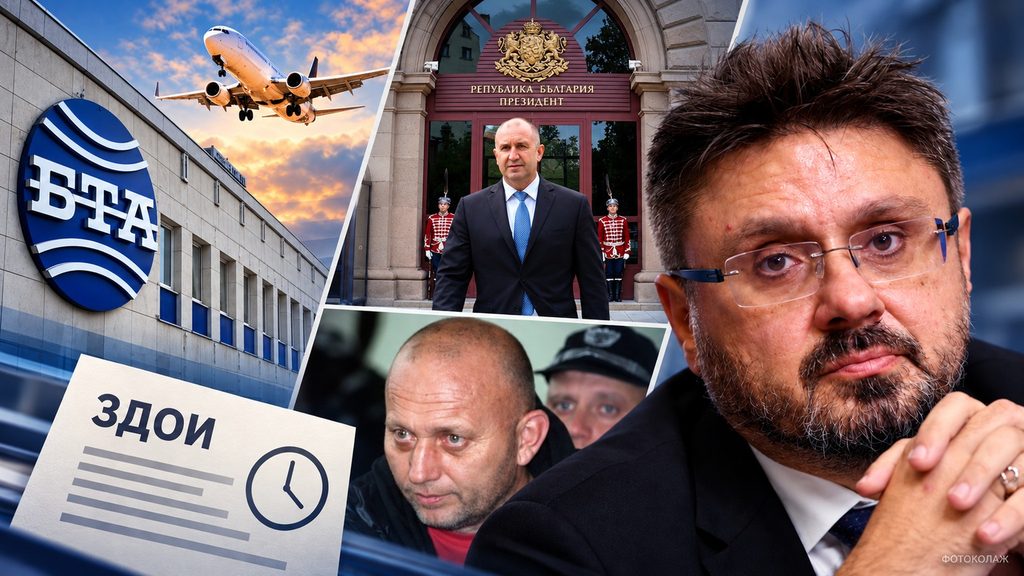
The scandal surrounding the pardon of Ognyan Atanasov—known as the “Escobar of Petrich”—by Vice President Iliana Yotova has emerged as one of the most contentious issues in the presidential campaign. Yet, beyond this specific case lies a broader problem:
to what extent are institutions that hold public information prepared to disclose it to citizens when it concerns decisions of significant public importance?
For this reason, “Za Istinata” (For the Truth) requested access from the Office of the President to information regarding all individuals granted a pardon who had been sentenced to more than 10 years of imprisonment—including those convicted of drug possession and distribution. In the formal request, submitted on September 11 under the Access to Public Information Act (APIA), I asked not only for a brief description of the crimes, the original sentence, and the time already served, but also for:
the date of the pardon and the number of the Vice President’s decree;
the reasoning provided in the recommendation by the Pardons Commission;
medical and other expert reports, where available;
the documentation accompanying the decree;
the extent of the sentence remitted and the portion remaining at the time of the pardon;
whether the convicted individual was serving their sentence at the time of the pardon, and in which correctional facility—in cases where this information is publicly available. On September 25, I received a letter signed by the President’s Chief Secretary, Margarita Vucheva, informing me that the deadline for a response was being extended due to the “large volume of information” and the need for additional time to gather it. Three days later—following a public post I made on the subject on social media—I received the official response. It indicated that the Presidency was directing me to the “Register of Pardoned Individuals for the Period 2017–2025,” published on its official website, as well as to the annual reports for 2017–2025 and the consolidated four-month summaries regarding the work of the Pardons Commission.
In the register, out of all those pardoned, only four individuals had received sentences exceeding 10 years for serious criminal offenses. One of them was Ognyan Atanasov—the aforementioned “Escobar of Petrich.” For each of these cases, the individual’s age, the specific article of the Penal Code, the sentence, the grounds for the pardon, and the relevant circumstances were listed. However, the remainder of the requested documentation was not provided. After consulting with lawyer Alexander Kashumov, Director of the Access to Information Programme, I requested a supplementary response pursuant to Article 22 of the Access to Public Information Act (APIA). My request was specific: that the pardons and the grounds for them be provided in the same detailed, tabular format used for the data published on the Presidency’s website for the 2002–2011 period. The response dated October 23 was unequivocal: the additional information “was not created and is not stored” in a table format. Furthermore, according to established case law under the Access to Public Information Act (APIA), the obligation to provide access extends only to information and documents that already exist.
This, however, raises a key question: why did the very same institution publish significantly more detailed information regarding pardons granted between 2002 and 2011, yet now provide a far less comprehensive picture?
Lawyer Kashamov pointed out several significant differences between the old and the new register:
In the case of recent pardons, the legal classification of the crime is not always specified.
Data regarding the portion of the sentence already served—and the remaining portion for which the individual was pardoned—is frequently missing.
In some instances where pardons were granted for health-related reasons, there is almost no specific detail provided, even though the individuals themselves cannot be identified.
In the register covering 2017–2026, the first 11 cases are described in detail; however, for 19 out of the 30 total pardons, the stated grounds are either extremely brief—almost telegraphic—or entirely absent.
The tabular format used during the terms of Georgi Parvanov and Rosen Plevneliev made it possible to verify whether complete information had been provided for each case. Current practice creates the opposite impression: while some cases include details, others contain only the most generic formulations. Yet, this is far from a mere technical detail. When the grounds for a pardon are reduced to “humanitarian reasons”—while information regarding the portion of the sentence already served and the remainder of the penalty is absent—the public cannot assess whether the decision is well-founded.
Yet, transparency is the sole mechanism through which citizens can exercise oversight over one of the Head of State’s most personal prerogatives—one that is least subject to judicial review.
Case No. 29 from the 2017–2026 register serves as a telling example. It is described as follows: a 51-year-old woman with a university degree, convicted under Article 302, Paragraph 1, Items 1 and 4 of the Penal Code and sentenced to six years of imprisonment, was granted a pardon for the remainder of her sentence via Decree 158 of July 28, 2025—cited as being “for humanitarian reasons.”
It remains unclear how much of the sentence she had already served, what the remaining duration was, and what specific circumstances prompted the Vice President to terminate her punishment.
It is important to emphasize that my request does not seek the names of the members of the Pardons Commission—unlike requests made by other media outlets. I am asking only for the reasons—the specific circumstances that justify why an individual convicted of a serious crime is granted freedom before the completion of their sentence.
A comparison between the two registers leads to an unsettling conclusion: that Instead of transparency being expanded, it has been reduced to the selective publication of information. And when a state institution provides details about certain cases while offering almost nothing regarding others, this does not constitute neutral administrative practice; rather, it restricts the right of citizens to form an informed opinion.
……………..
“Za Istinata” is also awaiting a response from the Bulgarian News Agency (BTA) regarding a request filed under the Access to Public Information Act (APIA). The request concerns the foreign business trips taken by the agency’s Director General, Kiril Valchev—who is also a candidate for Vice President, running alongside Iliyana Yotova—during the 2021–2026 period.
On October 13, the BTA requested clarification regarding the inquiry, stating that a new 14-day period—as stipulated by the APIA—would begin only after this clarification is provided. Furthermore, they extended the procedure by an additional ten days, citing the need to gather a large volume of information. The objective is clear: to prevent the public from learning—prior to the two rounds of the presidential election—how much public funding Valchev has spent over the course of nearly six years. Yet, citizens have a right to know how budget funds are being spent—especially when it concerns the state news agency and a candidate for the second-highest office in the country. “Za Istinata” will publish the response and the accompanying documents as soon as they are received.