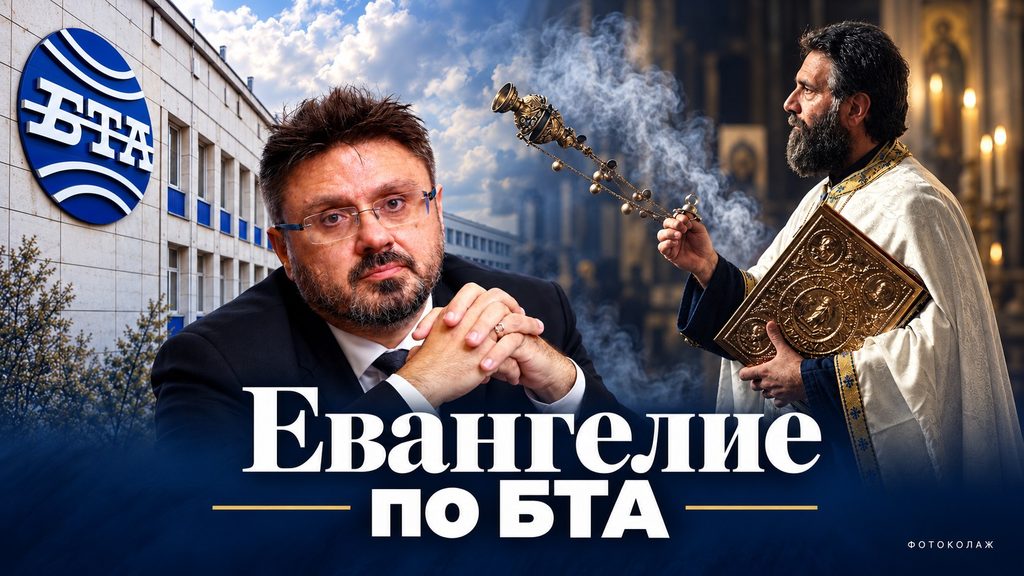
While the Director General of the Bulgarian News Agency (BTA) is on unpaid leave—running as a vice-presidential candidate in the upcoming elections—his managerial legacy within the media outlet continues to function like a well-oiled machine for religious propaganda. Kiril Valchev has turned the Sunday coverage of sermons into a routine task for the agency’s entire network of correspondents. He makes no secret of this—from his statement upon beginning a second term (received with the blessing of Patriarch Daniil) to his official reports as Director General of BTA for 2024 and 2025.
Although Bulgaria is a democratic and secular state, BTA’s public resources are being used to favor Eastern Orthodoxy. Meanwhile, editorial independence has become a mere façade for the personal preferences of the Director, who is shaping the national news agency according to his own private convictions.
What this policy looks like in practice:
A cursory review of BTA’s news feed for just October 18, 2026, reveals content more typical of a church bulletin than a national news agency. At 14:11, a report from Veliko Tarnovo states that Christ is coming to deliver us from death and offer hope for resurrection—citing Father Petar from the “Resurrection of Christ” church. A bit earlier, at 12:42, a report from Targovishte features a call from Father Anatoli Todorov, urging Christians to stand firm in their faith and not renounce Christ. In Dobrich, Father Krasimir Pavlov conveys the message that when we are sincere in our sorrow, God provides for us. In Yambol, the focus is on prayer and repentance, while in Pleven, Father Hristo offers reassurance that sorrow should not be an expression of despair.
The reports abound with terms such as “Sunday sermon,” “Divine Liturgy,” “Father said,” “salvation,” “repentance,” “God’s grace,” “salvation of the soul,” “spiritual renewal,” “the Word of God,” “the Christian faith,” “the Kingdom of God,” “hope for resurrection,” “love for one’s neighbor,” and “humility, meekness, and the ability to forgive.” However, the frequent citation of biblical texts and interpretations of liturgical books by local clergy does not constitute news; rather, it is religious activity presented as journalistic content.
An Admission from Management
Who, how, and why turned this into the norm? The answer is provided by Kiril Valchev himself in a BTA publication dated January 27, 2026, titled “Patriarch Daniil Blesses Kiril Valchev on the First Day of His New Term.” It explicitly states that “correspondents in 33 cities across the country began systematically covering sermons delivered on Sundays and major religious holidays.”
In the Director General’s 2024 report (p. 30), this is described as the “initiation of systematic coverage of church life on Sundays.” The stated rationale is that “the Eastern Orthodox faith is a traditional religion under the Constitution.” In the 2025 report (p. 27), Valchev links this activity directly to an increase in staffing resources: “Thanks to the appointment of additional correspondents in regional centers, the BTA has continued the systematic coverage begun in 2024…”
Journalism or Stenography?
According to the BTA Act, the mandate of correspondents in the 33 cities is to cover “the economic, social, political, and cultural life of the regions, providing accurate and objective information.” By their very nature, sermons are interpretations of religious texts and dogmas. They are matters of faith and moral instruction, rather than objective facts subject to journalistic verification.
The fact that a priest has delivered a sermon does not automatically make it a piece of current news of public interest. Valchev argues that this serves to showcase the regional life of local communities. However, the promotion of national traditions is not a sufficient justification for exempting any given publication from the requirement of having a specific, newsworthy trigger. Turning calls for repentance into a permanent fixture of news broadcasts replaces the agency’s informational function with a doctrinal one, effectively reducing its correspondents to mere chroniclers of the Bulgarian Orthodox Church.
A Double Standard Funded by Taxpayers
The management decision to incorporate Sunday sermons as a regular element of the national news flow relies on Article 13, Paragraph 3 of the Constitution, which states: “The traditional religion in the Republic of Bulgaria is Eastern Orthodox Christianity.” This provision, however, is taken out of context. In its Decision No. 12 of 2003, the Constitutional Court explicitly clarified that designating Orthodoxy as a “traditional religion” carries historical and descriptive significance, rather than normative force. The Constitution does not obligate state institutions—including the BTA—to serve the Church using public funds.
Furthermore, Article 6, Paragraph 2 of the Constitution mandates equality and prohibits privileges based on religion. Bulgaria’s taxpayers hold a wide variety of beliefs—they include Orthodox Christians, Muslims, Protestants, Catholics, atheists, and agnostics. The use of taxpayers’ money—allocated via the state budget to fund a second correspondent in BTA’s domestic bureaus, as well as editors and technical infrastructure dedicated to the systematic journalistic coverage of a single religious institution—unequivocally constitutes such a privilege.
According to BTA’s own annual reports, the life of the Orthodox Church is covered every Sunday, whereas for other religious denominations, coverage is reserved only for “significant holidays and events.” This is an admission of a double standard: one group receives regular coverage, while the others require a special occasion to be featured.
Global Standards and the BTA Anomaly
When comparing BTA’s editorial policy with the standards of leading global news agencies—such as Reuters, Agence France-Presse (AFP), and Deutsche Presse-Agentur (DPA)—the contrast is striking. The principles of these international agencies share a common foundation: religion is covered strictly as a social, political, and cultural phenomenon, rather than as a platform for the systematic dissemination of religious doctrine.
Under Reuters’ “Trust Principles,” journalists are prohibited from taking sides on religious matters, and the agency’s network is not used to report on routine religious services. Quoting a religious leader is permitted only as an exception—specifically when the statement contains a significant political or social message. The charter of the French agency AFP, shaped by the tradition of a secular state, treats religious institutions strictly as subjects of journalistic observation. An AFP reporter would never be sent to a local parish to relay a priest’s words regarding the “salvation of the soul.” Similarly, the leading German news agency, DPA, covers church life exclusively at the level of major institutional or public events.
Against the backdrop of these established global practices, transforming the pulpit into a constant source of national news represents an unprecedented anomaly for a publicly funded media outlet. No major international news agency allocates dedicated staff resources with the explicitly stated purpose of serving the rituals of a specific church. This has nothing to do with the standards of modern wire-service journalism; rather, it constitutes the imposition of religious doctrine through the mechanisms of a state-funded media organization.
Sources
January 27, 2026: Patriarch Daniil blesses Kiril Valchev on the first day of his new term as Director General of the BTA (Bulgarian News Agency).
Articles from the BTA for the month of October of the current year. October 19, 2026 – Metropolitan Seraphim: The feast of Saint John of Rila is a sign of hope for the unity of the Orthodox world.
October 18, 2026 – Christ comes to deliver us from death and to offer hope for resurrection, said Father Petar from the “Resurrection of Christ” Church in Veliko Tarnovo.
October 18, 2026 – A miracle is a call to strong faith, humility, and patient prayer, said Metropolitan Gavriil of Lovech.
October 18, 2026 – Christians must stand firm in their faith and not renounce Christ out of fear or social discomfort, said Father Anatoli Todorov in Targovishte.
October 18, 2026 – When we are sincere in our love and our sorrow, God grants us what we need, said Father Krasimir Pavlov during his Sunday sermon at the “Holy Trinity” Church in Dobrich.
October 18, 2026 – The unity of the Church is a grace-filled gift of the Holy Spirit, rooted in truth and love, said Patriarch Daniil.
October 18, 2026 – The sermon at the oldest Orthodox church in Yambol—the “Holy Trinity” Church—focused on the power of faith, prayer, and repentance.
October 18, 2026 – Father Krasimir spoke to the faithful in Shumen about Saint Luke the Evangelist.
October 18, 2026 – Our sorrow should not be inconsolable, nor should it be an expression of despair, said Father Hristo from the “Saint…” Church in Pleven. Nikolay“
October 18, 2026 Veneration of the saints makes us partakers in their grace and calls us …but rather towards unity, Patriarch Daniil told journalists.
October 17, 2026 – The monastic community on Mount Athos is a living school of faith and a spiritual center for the entire world, said Bulgarian Patriarch Daniil.
October 17, 2026 – Orthodoxy is light and truth, and Mount Athos serves as a safeguard against secular trends, said Ecumenical Patriarch Bartholomew.
October 17, 2026 – We bring God’s peace and love to preserve the unity of the entire Orthodox world, said Ecumenical Patriarch Bartholomew.
October 14, 2026 – Metropolitan Gavriil of Lovech wished the laity in Troyan the protection and blessing of Saint Paraskeva (Petka).
October 14, 2026 – The example of Saint Petka teaches us how to raise our children in virtue, said Metropolitan Arseniy of Sliven in his sermon on the feast day of Saint Petka.
October 11, 2026 – We must move forward carrying the Cross of Christ, not idols, for the latter would be ruinous to our souls, said Metropolitan Pahomiy of Vidin.
October 11, 2026 – God’s grace cleanses the human heart, said Archimandrite Samuil in Vidin.
October 11, 2026 – Father Biser Hristov urged the laity in Targovishte to safeguard the Word of God and remain faithful to the Christian faith.
October 11, 2026 – In his sermon at a church in Shumen, Father Ivan spoke about the Holy Fathers of the Seventh Ecumenical Council and the Parable of the Sower. “The Three Holy Hierarchs”
11.10.2026 Father Ivan reflected on the Gospel parable of the sower and the Word of God at the Cathedral of St. Bessarion of Smolyan.
11.10.2026 It is the duty of every Orthodox Christian to sow the good seed of their faith, said Father Stoyan from the Church of St. George the Victorious in Yambol.
11.10.2026 We must bridle our tongues so as not to sin with them, said Father Milen from the Church of St. Paraskeva in Pleven.
07.10.2026 In times of division, the message must be one of unity in faith and love, stated Bulgarian Patriarch Daniel in Stara Zagora.
04.10.2026 Christ says that the Kingdom of God, for which we yearn, must first be found within us, noted Father Ivan Marinski in Smolyan.
04.10.2026 Failing to forgive is one of the gravest sins, for it stems from pride, said Father Evgeni from the Church of St. Demetrius of Thessaloniki in Sliven.
04.10.2026 Love for one’s enemies is the highest form of virtue, said Father Emanuil from the Church of the Holy Trinity in Dobrich.
04.10.2026 “Do unto others as you would have them do unto you,” said Father Ivan from the Church of the Holy Trinity in Pleven.
04.10.2026 Mercy saves and bestows. An opportunity to be pure before God, said Father Ivan at the “Three Holy Hierarchs” Church in Shumen
04.10.2026 True Christian strength lies in love that expects nothing in return, said Father Anatoli Todorov from Targovishte
04.10.2026 Be merciful and show love for your neighbor, urged Father Georgi at the “St. Nicholas the Wonderworker” Cathedral in Yambol