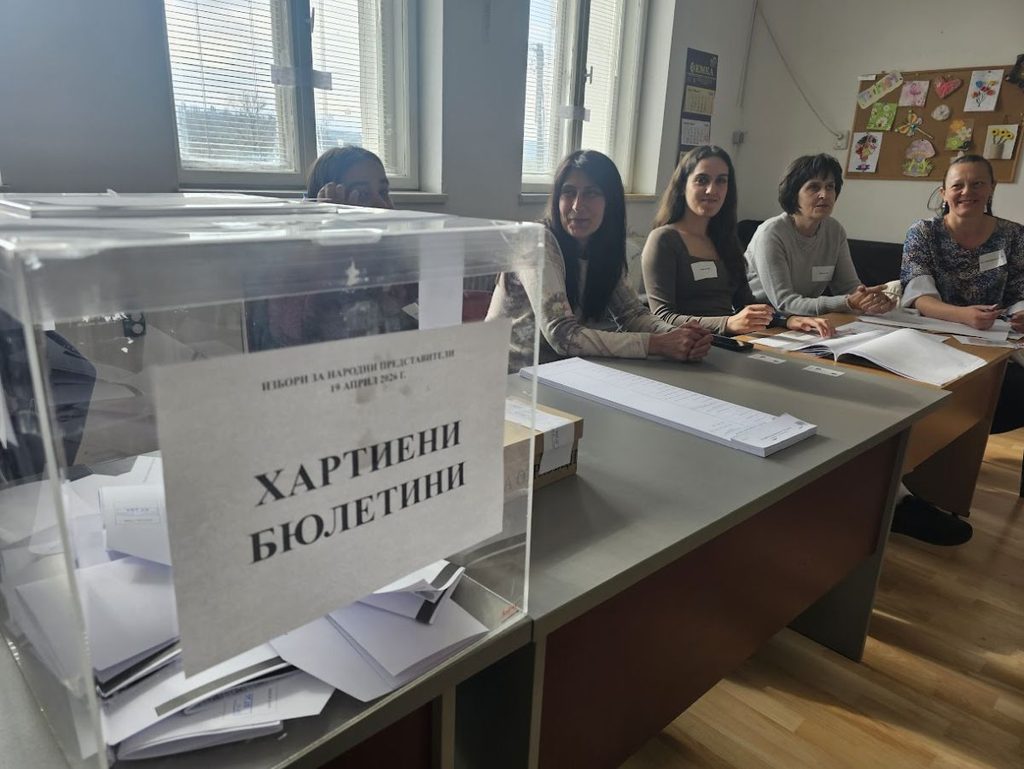
Rumen Radev’s political formation, “Progressive Bulgaria,” is almost certain to secure two of the four seats in the 7th Gabrovo Electoral District.
This is indicated by the results from the District Election Commission (DEC) in Gabrovo, following the processing of 100% of the polling station protocols.
To get two mandates out of a total of four for the electoral region has so far been achieved only by GERB, and three consecutive times – in 2014, 2017 and 2021, with the culmination of electoral support being on March 26, 2017. Then GERB in Gabrovo received a little over 23 thousand votes, which ensured it half of the mandates in the four-mandate region.
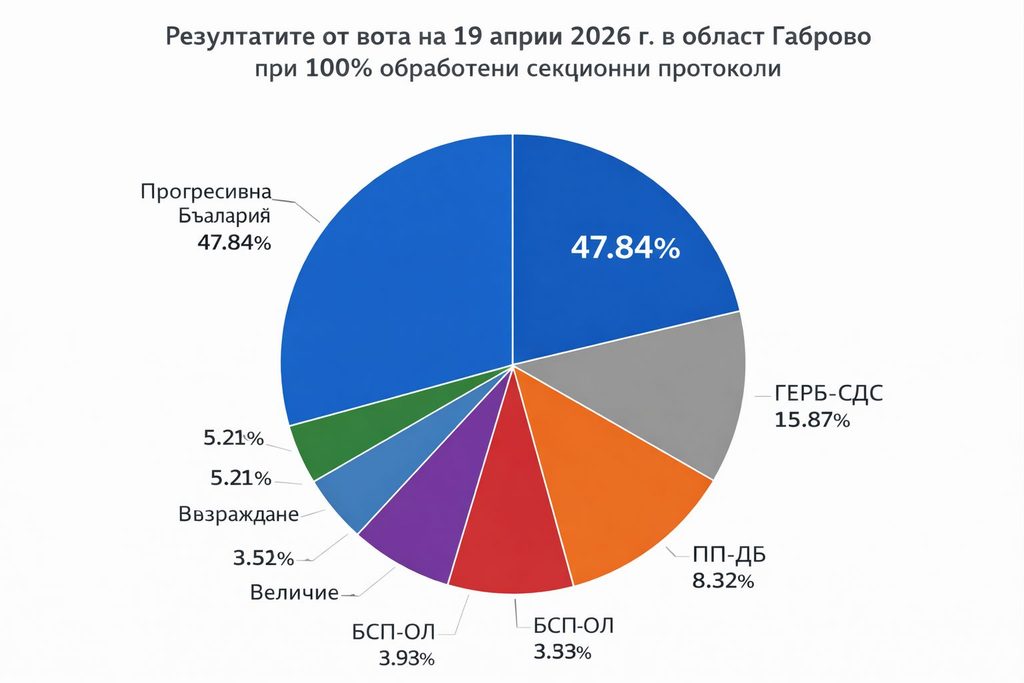
On April 19, 2026, Rumen Radev’s coalition repeated this success, securing just over 22,000 votes—amounting to nearly 48% of the total in the Gabrovo region.
GERB falls to second place
There is, however, a notable detail: since 2021, GERB’s election results in Gabrovo have been steadily and consistently declining, ultimately plummeting to just under 7,400 votes last Sunday. This figure is one-third of what they achieved during their peak, and there is little doubt that a significant portion of those votes shifted to Rumen Radev’s political formation in the spring of 2026.
A detailed breakdown of the voting by polling station confirms this. Polling stations where GERB traditionally performed well are now dominated by votes for “Progressive Bulgaria.”
Consequently, Borissov’s camp has slipped to the position of the second-largest political force in Gabrovo—even though GERB still holds local power in three of the region’s four municipalities: Gabrovo, Sevlievo, and Tryavna. With local elections just a year away, this development should not be underestimated—especially given the mounting public dissatisfaction with the local administrations run by GERB.
Radev also drew support away from “Vazrazhdane”
Following the previous elections in October 2024, “Vazrazhdane” had held second place; however, after April 19, Kostadinov’s party may well fail to secure a parliamentary seat from the Gabrovo region. Support for the party plummeted from 5,655 to 2,425 votes, relegating it to the position of the fourth-largest political force in the region—with just over 5% of the vote cast—and knocking it out of second place.
PP-DB remain in third place with a nearly identical vote count.
“We Continue the Change – Democratic Bulgaria” (PP-DB) finished third, securing just over 8% of the vote; in terms of the actual number of votes, they maintained roughly the same level of support they received in the autumn of 2024. Their share of the vote (15.87%) guarantees them one parliamentary seat.
An analysis of the election results in Gabrovo reveals several notable points. The “Siyanie” [Radiance] coalition—spearheaded by the father of the late Siyana—received a vote count (1,633) comparable to that of MECH (1,641) and the BSP-United Left (1,851).
The BSP has nowhere left to fall.
This marks the lowest result for the Left in Gabrovo in recent history. There is no doubt that the causes lie not only within the party itself but also with a new political entity that has captured a significant portion of the support previously held by the BSP. In the region, it is even suggested that the faction aligned with President Radev has effectively followed the BSP’s own playbook from previous election campaigns. This claim is not without merit, given that the top two candidates on the “Progressive Bulgaria” list are a current and a former municipal councilor—both of whom were originally part of the BSP’s “civil quota” (non-party candidate slots).
Dogan and Peevski failed to match the performance of the original DPS.
Undoubtedly, the votes for Radev came from both the DPS and the “Alliance for Rights and Freedoms” (APS). Neither faction managed to secure the level of support in the region that the DPS enjoyed prior to its split. It is also worth noting that, in the past, the DPS could secure a parliamentary seat with fewer than two thousand votes—a scenario that is no longer possible, though nothing is certain until the final allocation of mandates is announced.
Hamid Hamid—whom no one saw in Gabrovo during the election campaign—received 372 votes, while the candidate for the APS (Alliance for Rights and Freedoms) received 865. Neither candidate garnered more votes than “Progressive Bulgaria,” even in villages with an almost entirely ethnic Turkish population; this leaves no doubt as to how their support has shifted.
In fact, “Velichie” (“Greatness”) received more votes than both the DPS (Movement for Rights and Freedoms) and the APS, making Ivelin Mihaylov’s party the fifth-largest political force in the Gabrovo region.
As of April 19, 2026, “Progressive Bulgaria” holds a commanding lead, securing nearly half of the votes in the Gabrovo Province. At present, this represents a strong concentration of support centered around a clear leader—a significant factor, given that local elections are just over a year away. It is too early, however, to speculate on how this result will impact the local vote; first, we must see what the party accomplishes on the national stage.
Among the remaining parties, only GERB-SDS reached a double-digit result. Yet, given their continued dominance in local government, it is still premature to label the coalition an “opposition” force.