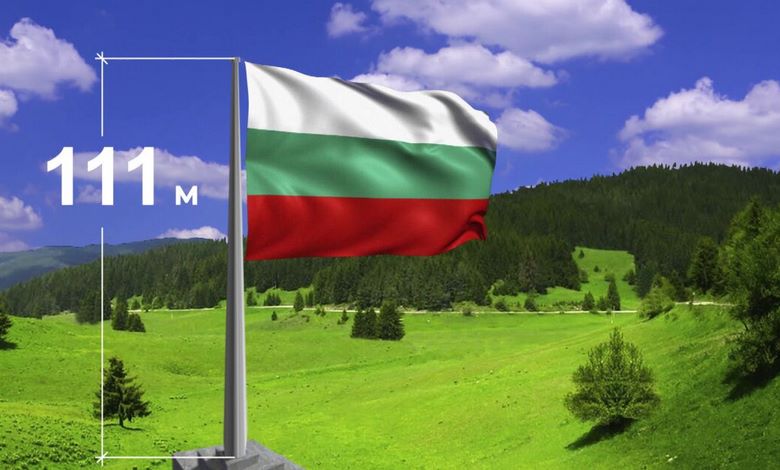
The initiative by the “Heritage for the Future” Foundation to erect the 111-meter “Rozhen” pole, which will display the highest national flag in the European Union, has become a symbol of division in our society.
The paradox is that this pole claims to be a “Monument of Unity,” as continuously asserted by Simeon Karakolev, the founder and chairman of the foundation, whose patron is President Rumen Radev.
According to Karakolev, the “Rozhen” pole embodies the Bulgarian spirit, traditions, and patriotism—an “inspiration for the nation” that will encourage foreigners to speak of Bulgaria with respect and admiration.
He argues that the pole will instill a sense of pride in Bulgarians, highlighted by the fact that our flag will compete for the title of the highest raised national flag. The Bulgarian flag will fly at an altitude of 1,430 meters, while Finland’s, despite its 100-meter pole, will only be at 608 meters.
The Bulgarian flag “wins” the competition in height against the national flags of Tajikistan, North Korea, Iran, Egypt, Turkmenistan, and Jordan, proudly claimed by the Heritage for the Future Foundation, conveniently overlooking the fact that comparing Bulgaria with countries under totalitarian and authoritarian regimes does not evoke a sense of pride.
National Complexes vs. European Values
According to psychologist Dr. Lyubomir Kanov, the idea of the “Rozhen” pole is a grandiose nonsense— a heroic attempt at grandeur in the wrong way. He argues that it is not only un-aesthetic and absurd in the beautiful nature of the Rhodopes but also fails to elevate anyone or anything. In contrast, Angel Mandzhukov from Smolyan believes that the Rozhen area does not hold exceptional natural significance. Those against the construction of the pole are described as “opponents of the Bulgarian spirit and anti-Bulgarian mercenary circles.”
“The damage to nature from this pole is certain. A huge amount of concrete and iron, plowed meadows for the road leading to it,” believes former Minister of Ecology Borislav Sandov. He also emphasizes another point – that this area was once the border with the Ottoman Empire before World War I. “Massive poles with the national flag are placed in significant locations (notable battles, historically important sites), in the administrative capital, or at the state border,” explains Sandov.
The tallest flag in the EU will not change the fact that we have the lowest incomes in the EU. It will not make people “speak of Bulgaria with respect and admiration,” believes MP Ivaylo Mirchev.
It’s Important for the Flag to Fly, the Law is a Detail
The land on which the pole is being built belongs to the “Rozhen – Heritage for the Future” Association. In April 2023, the association granted it for temporary use for three years, free of charge, to another non-governmental organization – the “Heritage for the Future” Foundation. Both are controlled by Simeon Karakolev, a well-known representative of several sheep breeders’ associations.
The chief architect of Smolyan Municipality has issued two permits for the installation of the “Rozhen” pole, according to a response from the local administration to inquiries from “Otzvuk.BG.” This has circumvented the provision of Article 56 of the Territorial Development Act. The permits were issued based on a decision and opinion from the Regional Directorate of Agriculture in Smolyan. One permit is for the pole to be considered a movable object, while the other is for the construction of a concrete foundation or underground construction of the facility on agricultural land.
This pole is illegal; it cannot be considered a movable object under the Territorial Development Act because it is permanently attached to the foundation and is intended for permanent use over time, claims architect Borislav Ignatov, chairman of the Management Board of the Bulgarian Chamber of Architects.
Judicial practice is unequivocal on this matter, raising suspicions of pressure from the caretaker government of President Rumen Radev to issue the construction permits.
These suspicions seem justified, especially since the “Rozhen” pole is being erected under the patronage of the President of Bulgaria, and the caretaker Minister of Innovation, Alexander Pulev, presented the project as a “state initiative” in a letter to the cabinet ministers sent on February 6, 2023.
This would imply that constructions, both agricultural and residential, could be built on agricultural land with minimal restrictions through two permits—one for the concrete foundation and the other for movable structures.
Funding for the Pole – Questionable Financing and State Money
The funds needed for the construction of the pole, according to the “Heritage for the Future” Foundation’s estimates, amount to a round sum of 1 million BGN. Whether it actually costs that much is hard to determine since its fabrication was commissioned in Turkey. In its initial press releases, the foundation assured that collected funds, along with the names of donors, would be published weekly. However, this information has disappeared from the website, replaced by a “404 error” message, after it became known that the main donors are state-owned companies.
In the letter dated February 6, 2023, Minister Pulev urged ministers from the caretaker cabinet formed by President Rumen Radev, with Prime Minister Galab Donev, to donate money “both in their capacity as ministers and personally.” The Bulgarian Development Bank, which is under the management of the Minister of Innovation, donated 15,000 BGN, while the state forestry enterprises contributed 120,000 BGN.
Both the Regional Directorate of Agriculture and the state forestry enterprises are under the control of another minister close to President Radev – Yavor Gechev, who has publicly expressed his support for the pole project. The municipalities of Zlatograd and Devin in the Smolyan region also donated 15,000 BGN each.
As of now, it is known that the state has “donated” at least 175,000 BGN for the 111-meter “Rozhen” pole.
What portion of the total estimated cost of one million BGN has been provided by the state and municipalities remains unknown to this day. Simeon Karakolev promised to BNT that before the pole’s erection, an international auditing company would conduct an audit, which would be made public.
The pole is set to be inaugurated on July 13, the day before the National Assembly of Folk Creativity and Animal Breeding. It will soon become clear whether Karakolev will fulfill his promise.