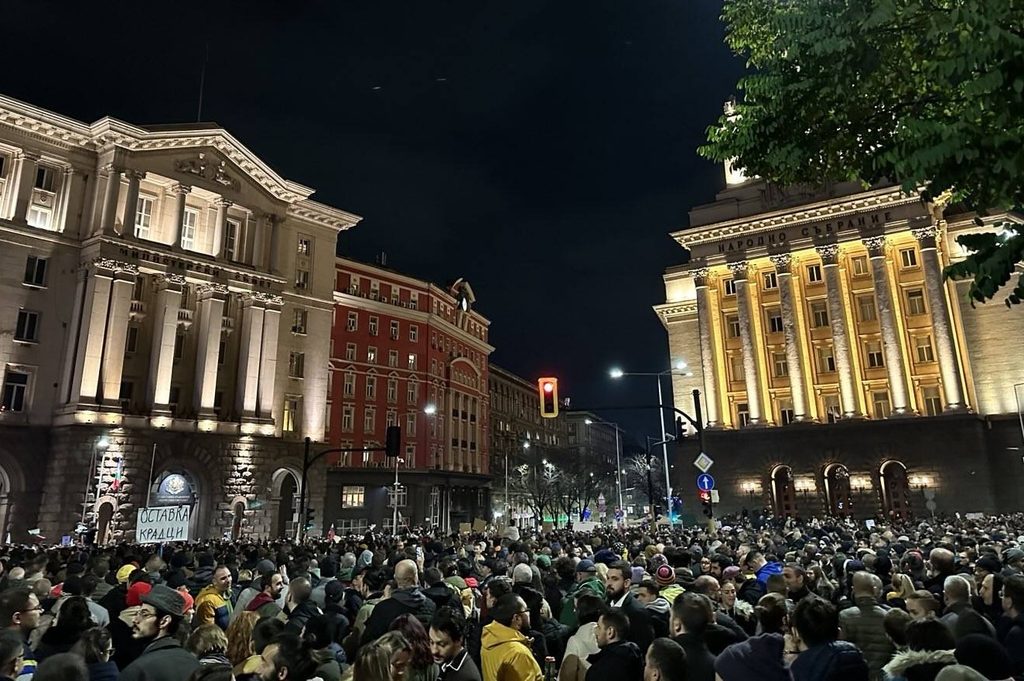
If someone had told me 20 years ago that armed officers from the National Security Service (NSO) would storm a parliamentary committee meeting, I would not have believed them. If someone had told me 10 years ago that Delyan Peevski would attempt to rape Bulgaria’s democracy, however much of it is merely a façade, I would have taken the warning seriously. Even then, one of our most odious MPs was already showing signs of the arrogance, impudence and brutality of which he was capable.
And at the beginning of the transition
we could hardly have imagined that it would take 40 years—the same amount of time Moses needed to lead his people through the desert in search of the Promised Land—to build a new state with a new social order and democratic institutions. Had we believed it would take so long, we might have used those years to dismantle the totalitarian system and its repressive apparatus, sparing ourselves illusions and the disappointments that followed.
Instead, we squandered our energy and emotions in the squares, while the communist elite quietly prepared for the transition from the failed centrally planned economy to a form of capitalism of the most predatory kind—a process that, as it turned out, had begun well before 10 November 1989.
Within this new socio-economic order, former Bulgarian Communist Party nomenklatura officials and their erstwhile servants reinvented themselves as major business owners, bankers, insurance executives and other nouveaux riches. The new elites emerged quite naturally from their ranks.
To make this possible, people’s savings were plundered. Individuals were placed at the helm of leading enterprises inherited from the socialist era, only to strip them of their assets, while the money disappeared into the offshore accounts and companies of major technology, manufacturing and trading businesses. One example was the former DZU electronics plant in Stara Zagora.
How that money was subsequently distributed—in figurative terms, and perhaps literally, in suitcases handed to the right people—is now common knowledge. These stories are no longer even part of urban folklore.
The blueprint for the survival of the communist nomenklatura and its repressive services
Today, few people from the generations born and raised under the former regime would question the existence of such a blueprint. According to publicly available information, the strategy behind what was known as perestroika forms part of “Operation Golgotha”, a controversial and mysterious plan attributed to Yuri Andropov—the only senior KGB officer before Vladimir Putin to lead the Soviet Union, which he headed from 1982 to 1984.
Under this alleged strategy, the communist system was to be gradually dismantled and replaced by a savage, brutal and predatory form of capitalism. The aim, according to this account, was to disgust people with the new order, fuel nostalgia for the old regime and eventually restore it in the guise of a “new socialism” modelled on the Scandinavian countries.
In Bulgaria, the transition did not begin as it did in neighbouring Romania, with a revolution that claimed the lives of dictator Nicolae Ceaușescu and his wife. Nor did it follow the German model. Germany was the first country in Europe to adopt an effective law allowing the opening of the archives of the communist secret police, the Stasi, and imposing lustration measures on its former collaborators after reunification. The law established procedures for vetting certain categories of people, including civil servants and elected officials. Amendments adopted by the German Bundestag in 2019 also made it possible to extend the validity of the Stasi Records Act until 2030.
Lustration laws were also adopted in other countries, including Poland, Czechoslovakia—whose legislation was later extended to cover the Czech Republic and Slovakia—Hungary and Estonia. Bulgaria, however, never adopted such a law. In addition, Institutes of National Remembrance were established to preserve the archives of the repressive secret services in countries formerly belonging to the Soviet bloc, along with other documents from that period, making them available to historians and other researchers.
The Round Table and the flawed birth of Bulgarian democracy
Bulgarian democracy was conceived in sin at the so-called Round Table talks. Historians and political analysts remain divided to this day over the benefits and drawbacks of the opposition’s negotiations with the communists.
What is beyond dispute, however, is that the Bulgarian Communist Party (BCP) bought itself time—time it needed to begin purging the State Security archives, retain its political power and set the transformation of the economy in motion. It also paved the way for the registration of the Movement for Rights and Freedoms (DPS), established with the blessing of Andrey Lukanov and the assistance of State Security, and allowed Ahmed Dogan to join the Round Table talks.
The party then went on to organise the first elections for the Grand National Assembly, win them and use its majority to adopt Bulgaria’s new Constitution.
The naive opposition leaders, many of them still wearing their hand-knitted sweaters, had no idea what plans the communists were hatching. They were flattered, too, to sit alongside their gauleiters. Others, who had restored the opposition parties banned after the coup of 9 September 1944, knew that doing business with the communists was impossible. Yet they chose to remain at the table alongside individuals from the State Security service who had infiltrated their ranks.
It was the communists who also preferred Bulgaria’s first democratically elected president to be Zhelyu Zhelev. In short, everything that happened in the first years after the transition played to their tune—even the creation of the opposition trade union Podkrepa, whose chairman, Dr Konstantin Trenchev, was among the participants in the Round Table talks.
Who has ruled Bulgaria during the transition?
In the 36 years since the beginning of Bulgaria’s transition, there have been only two governments led by democratic forces. The first, headed by Filip Dimitrov, lasted a year before being brought down by the Movement for Rights and Freedoms (DPS), acting on a signal from the very shadowy power structures that had helped bring it into being. The second, led by Ivan Kostov, completed its full term. But the same behind-the-scenes establishment, alarmed by the prospect that he might serve another, played its most suitable trump card: Simeon Saxe-Coburg-Gotha, making a second term impossible.
All the other governments, even those that included right-wing parties, were dominated by parties created from the old system’s mould, with prime ministers selected by the shadow establishment. After Zhelyu Zhelev, Bulgaria had only one more president from the political right: Petar Stoyanov.
Meanwhile, former communists and socialists have spent decades reinventing themselves as successful businesspeople, supported by the new elites. From their ranks emerged the clientelist companies through which, first Ahmed Dogan and now Peevski, distribute slices of the state’s economic pie. The same circles that spawned the so-called mutri—the powerful figures associated with the early post-communist underworld—gave rise to private security and insurance companies, and later to the oligarchs and the mafia.
Today, the octopus has extended its tentacles to steal any business and crush anyone who stands in its way. It can have anyone it chooses arrested or imprisoned because it is everywhere: in the police, the courts and the prosecution service, in the security agencies—in every corner of the state. Anyone it decides is an obstacle can be targeted.
The European Union flag serves to cover its shame, while elections are used as a mechanism to legitimise its criminal grip on power. Without the façade of democracy, it would lose access to European funds—and there is a great deal of money at stake. Without that money, it could no longer bankroll the state administration and its business clientele, buy off magistrates, media outlets and journalists, or purchase the votes of marginalised groups at elections. In short, it would lose the means to reproduce itself indefinitely.
The end of the octopus
The octopus likes to instil fear, to borrow Delyan Peevski’s own expression, but it is afraid, too. Its greatest fears concern the exposure of its crimes and the street protests, whose echoes continue to ring in its ears even in their sleep.
That is why Peevski has cast himself as the people’s protector, much like the bosses of the mafia, while Boyko likes to play the capo di tutti capi—Italian for “boss of all bosses”.
Thirty-six years ago, the streets rang with the chant “The time is ours”. It turned out to be an illusion. Back then, those filling the streets belonged to generations born and raised in bondage. We wanted to be free, but we lacked the courage and strength to fight for our freedom. Our children grew ashamed of us and scattered across the world.
Today, generations who were neither conceived nor born under dictatorship refuse to accept the shamelessness of those in power and the unrestrained behaviour of the political thugs and courtesans elevated to the highest offices in the state. They are not afraid to take to the streets and shout in their faces that they will no longer allow them to trample on their dignity as citizens who want a future for themselves and their children here in Bulgaria. They are our hope, because the time belongs to them!