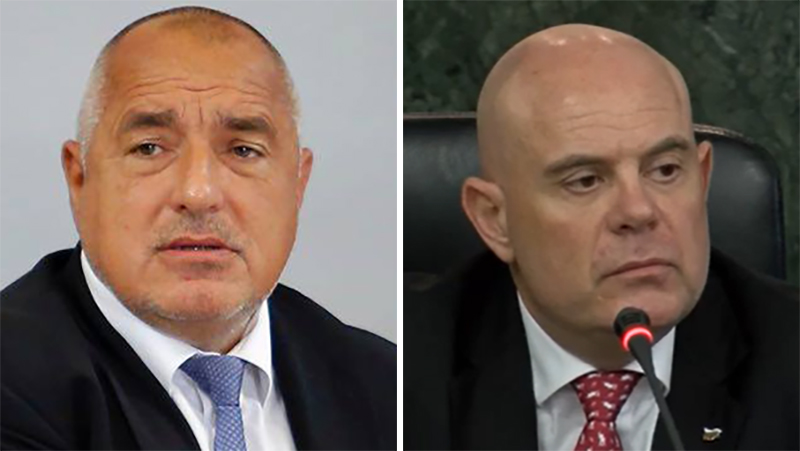
The Battle Between Ivan Geshev and Boyko Borissov: A Clash of Titans or a Mutual Destruction? Ivan Geshev anticipated the expected counterattack from Boyko Borissov, responding predictably to the criticisms directed at him. However, his theatrical statement in the Court Palace, delivered in a dramatic style, marks merely the beginning of a conflict that might not be epic but will almost certainly conclude with a fiasco for one or perhaps both parties involved.
Perhaps the real aim of the advisors surrounding both Borissov and Geshev is to ensure that they mutually (self)disclose and disarm each other. In this ongoing battle, many masks will fall, revealing faces and connections linked to the behind-the-scenes dealings and mafia influences in Bulgaria—potentially a single, overarching octopus. It cannot be ruled out that some individuals may face bullets in the back or handcuffs for others. Or perhaps these scenarios are merely fanciful ideas. In any case, this duel, which could evolve into a multi-faceted conflict, promises to be intriguing and beneficial for cleansing the judicial system of its dependencies.
In his remarks, Geshev specifically named several individuals. He prominently mentioned Boyko Borissov, who allegedly contacted him with offers for a diplomatic position or a political career, hoping to persuade him to resign from his position as chief prosecutor. Borissov implied threats regarding Geshev’s family, though he intentionally left the specifics vague, likely allowing the public to speculate. This tactic suggests that Borissov may have framed the conversation to indicate that such prospects would be preferable for Geshev’s loved ones than living in constant fear of a potential assassination attempt.
Geshev expressed surprise that the Movement for Rights and Freedoms (DPS)—a party that has historically thrived under the protection of the prosecution—has joined the campaign against him. Notable figures within the party, such as Ahmed Dogan and Delyan Peevski, have benefited from prosecutions that have spared local mayors engaging in vote-buying for the DPS in regions with no ethnic Turks or Muslims.
This unfolding drama reveals the intricate web of political maneuvering and corruption interwoven in Bulgarian governance, suggesting that the battle between Geshev and Borissov may expose deeper systemic issues that require urgent attention.
A Tumultuous Showdown: Ivan Geshev’s Confrontation with Boris Sarafov and Media Entanglements
In his lengthy remarks, Chief Prosecutor Ivan Geshev didn’t shy away from criticizing the media, insinuating that the interview of Silvia Velikova with Boris Sarafov was arranged by someone—a name Geshev conveniently withheld.
In a dramatic response to his superior’s statement, Boris Sarafov called for Geshev’s resignation, expressing regret that instead of fulfilling their professional duties, they were preoccupying the public by airing their dirty laundry in the media. “I never wanted it to come to this,” he stated.
Following President Rumen Radev’s remarks, which labeled Geshev’s demand for dismissal as a “delayed enlightenment and sudden catharsis,” Sarafov echoed the need for “deep catharsis,” claiming that the rot within the prosecution must be excised. He also requested protection from the Minister of Justice, citing a personal connection with Geshev and expressing fears for his safety, referencing the fate of the slain military prosecutor Nikolai Kolev—an unprecedented admission in the history of the Bulgarian prosecution since November 10, 1989.
The questions regarding who the “rotten apples” are within the prosecution, who will identify them, and more importantly, how they will be cleaned out remain intriguing yet unanswered. It is evident that neither Ivan Geshev nor Boris Sarafov is likely to take such actions. Both are seen as integral components of the corrupt governance that has enmeshed the Bulgarian prosecution in various dependencies.
Geshev characterized the plot against him as an assassination attempt. His repeated desires to be heroically compared to Giovanni Falcone—the Italian prosecutor murdered by the mafia—come off as pitiful. Ultimately, Geshev will always be regarded as a puppet positioned in a high-ranking government role, not to fight the octopus of corruption but to further the interests of the shadowy networks.
Notably, Geshev “declared war” on Boyko Borissov on the very day President Rumen Radev handed the mandate for cabinet formation to GERB’s candidate for Prime Minister, Maria Gabriel. This shift in focus from the courtroom to the political arena effectively shifted attention away from other significant developments.
The unfolding narrative within the prosecution and the Supreme Judicial Council (SJC) is of paramount importance, especially if a government fails to materialize and the deep political and inter-institutional crisis exacerbates further. The outcome of these developments could decisively influence the future of justice and governance in Bulgaria.
The silver lining, if we can use such a term here, is that this situation reveals crimes, illegal collusion between magistrates and politicians, stalled investigations against high-level officials, and other behind-the-scenes dealings of the state prosecution office that the Chief Prosecutor and his deputy have publicly disclosed. This amounts to a damning confession of how deeply corrupted Bulgaria’s prosecution system is and underscores the urgent need for judicial reform—not merely a reshuffling of faces and roles within it.