



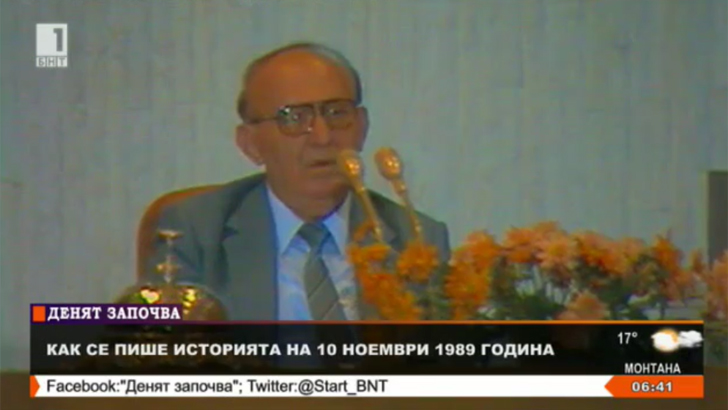
Yes, today is November 10th. Until 20 years ago, we celebrated this date with great enthusiasm. We marked it as the end of a regime that took away from the “former people,” as the communists referred to them, their lives, land, factories, and property; it shattered their families by separating them or exiling them to remote provinces and forced the nation’s elite—manufacturers, bankers, officers, doctors, teachers, priests, and others—to earn their livelihood through hard and unbearable labor.
We celebrated November 10th with naïve faith that the time of the high and middle nomenclature of the totalitarian state and the repressive agencies that supported it had come to an end. We believed that we had liberated ourselves forever from these people and that they would never again have access to the management of the state and its resources. We were convinced that those responsible for organizing the People’s Court, for the murder of thousands in communist camps; for betraying our national interests, for the destruction of the economy, the plundering of state enterprises, and the export of vast capital abroad; for the pogrom against the Bulgarian Turks during the so-called “Revival Process” and their expulsion from the homeland, and for other serious crimes against the people would receive their just desserts. Yes, at the beginning of the so-called transition, we were ready to swear that it was the end for the communist elite.
Three decades later, there are hardly any illusions about what happened on November 10, 1989. Today, anyone you stop on the street will tell you that on this date, an internal party coup was carried out with the blessing of the reformist Gorbachev, who dethroned Todor Zhivkov to prevent the violent overthrow of his regime. Today, anyone following the political events in the country will tell you that a clan from the communist elite executed a perfect scenario for transforming their political power into economic power. Surely today, every Bulgarian knows from which circles the new business elites emerged and with whose money they established their firms and companies.
The generations born after November 10, 1989 know little or almost nothing about the history of the 45-year totalitarian Bulgarian state. This is because no political consensus was achieved in the country to reveal the truth about this regime without sentimentality, falsifications, and lies. Bulgaria dramatically lagged behind in opening the files of the former State Security, a portion of which were cleansed immediately after November 10, while others served as initial capital for officers, some of whom became prominent businessmen.
Many countries in the former Soviet bloc condemned communism and carried out lustration, and the files of the secret communist services were declassified and handed over to special institutes for national memory, accessible to historians and researchers. In our case, lustration did not occur, which determined the nature of our entire transition; the Law on the Files became a source of contention in several national assemblies. Thus, in practice, the files were opened in batches, the topic lost its urgency, and interest in it remained only academic, while the most diligent informers and heads of the State Security continued to be in the spotlight, presenting themselves as analysts, mentors, and even members of parliament.
Today, many of the anti-communists and the few dissidents in Bulgaria are already deceased, while the remaining ones have fallen into silence out of shame for allowing the democratic parties and organizations formed at the beginning of the transition, briefly united, to be dismantled by the infiltrated agents of State Security and power-hungry careerists.
Thus, it is not surprising that anti-communists are now viewed as political dinosaurs, while the right-wing parties built on anti-communist ideology struggle not to govern but to enter parliament. At the same time, populist parties are multiplying, with one of them—disguised as a European People’s Party—having governed us for the past ten years.
Its leader wrote today in a Facebook post:
“For me, as a democrat at heart, the greatest achievement of November 10th is the freedom of choice!”
Borisov is as much a democrat at heart as the hero of Hristo Botev’s poem of the same name is a patriot. However, his democratic governance has poisoned the social environment, sunk into corruption, alienated citizens from the state and its institutions, and repulsed everyone in this country with basic integrity. This administration has morally devalued, lost both domestic and international support, and will leave us a heavy legacy. Yet, he plans to govern again, which will not be a surprise in the state that Bulgaria has become over these 31 years.





