On its page, the Ministry of Environment and Water (MOEW) reports that from the beginning of September to October 16, experts from all regional inspections across the country, along with the Stara Zagora Regional Inspectorate of Environment and Waters (RIOSV), conducted over 48 extraordinary checks on major combustion installations in the “Maritsa East” complex.
As a result of identified administrative violations of the conditions outlined in the environmental permits of TPP “Brikel,” 13 citations have been issued, along with one citation each for the state-owned “TPP Maritsa East 2” and “AES-Galabovo.” Administrative penalty orders are expected to be issued within the timeframe established by law. For operators of installations—legal entities—the law stipulates fines ranging from 10,000 to 500,000 leva, depending on the severity of the violation and its impact on the environment.
During a meeting on Monday with representatives from the four power plants, Deputy Minister of Environment and Water Reneta Koleva insisted that in the event of unfavorable data from the early warning system, urgent action must be taken to prevent and reduce air pollution related to sulfur dioxide levels.
Here are the measures from the Ministry of Environment and Water (MOEW):
The Regional Environmental Inspectorate in Stara Zagora has issued directives to all operators of the power plants in the “Maritsa East” complex to take action and prevent the deterioration of air quality.
The Regional Inspectorate will resume intensive ongoing monitoring of the combustion installations regarding all conditions outlined in the issued environmental permits.
The Executive Environmental Agency (EEA) has established an additional mobile automatic station in the territory of Galabovo.
A working meeting is set to take place between representatives of the Ministry of Environment, its regional inspection, the regional governor of Stara Zagora, and the Municipality of Galabovo to outline joint institutional measures for the upcoming heating season.
What will result from this activity?
First, if an early warning system at the Regional Environmental Inspectorate in Stara Zagora were functioning properly, the operators of the power plants should have responded immediately to the blanket directives issued by the inspectorate, preventing more than a one-time exceedance of sulfur dioxide or other harmful emissions in the atmosphere. However, reducing plant output is not within their authority but rather falls under the purview of the Energy System Operator (ESO). It is unlikely that the ESO would disrupt the balance in the system in such cases to prevent pollution in Galabovo or elsewhere in the country.
Second, what measures can the operators take to prevent air pollution, aside from those that fall within the technological capabilities of the plant? When the boilers are as outdated as those in TPP “Brikel” and no investments have been made in environmental measures, what miracle do they expect from the Ministry of Environment and Water?
Third, the very same regulatory institutions issued the last environmental permit for “Brikel” with a full understanding that the plant could not meet the conditions outlined in it.
Fourth, any citizen can access the website of the Executive Environment Agency and view the exceedances of harmful emissions standards in the atmosphere, as measured by the agency’s automatic stations. For example, from October 10 to 19, the automatic station in Galabovo recorded five exceedances of sulfur dioxide standards—five times in ten days. How many exceedances have there been since the beginning of the year?
And the scheduled meeting with the regional governor of Stara Zagora—one today, another tomorrow—is pointless, just like the inaction and indifference of the institutions—which remain unchanged.
Thus, this latest diversion from the Ministry of Environment will have no effect. Political will is necessary to resolve the issues with Hristo Kovachki’s power plant.
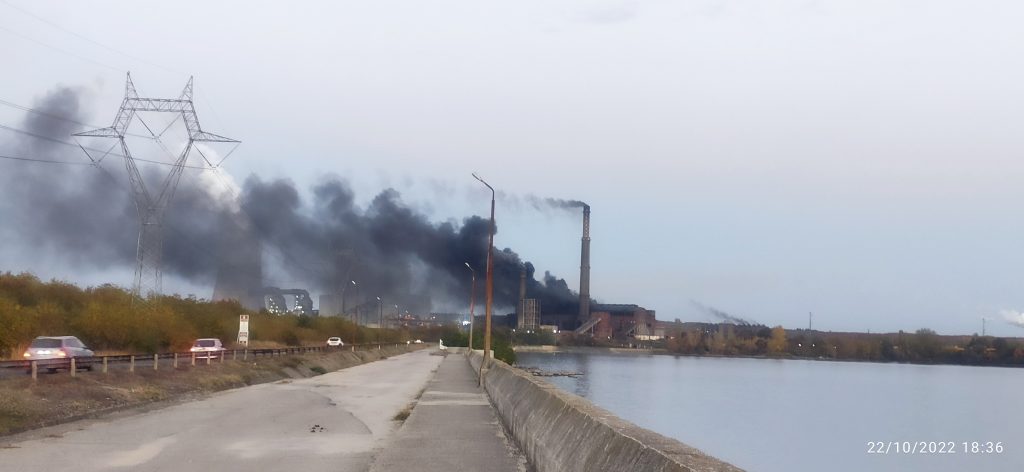
Now the court is involved, and the case may drag on for years if it reaches the Supreme Administrative Court. In the meantime, the power plant will continue to be a source of air pollution in Galabovo, which the automatic stations of the Ministry of Environment will fail to report. This is similar to what occurred on October 22, when thick black clouds from TPP “Brikel” darkened the sky over the city. The Ministry of Environment disseminated information on its official website…
On the Emergence of an Emergency at TPP “Brikel”
At around 5 PM, an emergency occurred in Boiler 2 of the plant, leading to its operation being suspended. The automatic measuring station of the Executive Environment Agency in the city did not report any exceedances of the monitored air quality indicators.
The suspension of boiler operations and the relighting of others, which results in the release of unorganized emissions, is a practice at the plant that experts comment on as being possible only on paper.
Inspections at TPP “Brikel” will evidently continue, at least during the term of the current caretaker minister, Rositsa Karamfilova, who signed the last environmental permit for the plant. However, her policy of swapping directors of environmental inspections around the country has raised questions.
Shortly after being appointed as the director of the regional environmental inspectorate in Stara Zagora and issuing an order to close the plant linked to oligarch Hristo Kovachki, Diana Ikreva was transferred to lead the Regional Inspectorate of Environment and Waters in Plovdiv. Meanwhile, the head of the Plovdiv inspectorate, Ivaylo Yotkov, was sent by the minister to Stara Zagora. What was meant to be a one-week transfer has now lasted over a month.
In a television appearance, Rositsa Karamfilova stated that she applies this approach to directors whom she is investigating for conflicts of interest. If she has achieved results and gathered evidence for any dependencies concerning Diana Ikreva, she should provide and publicly disclose it. Otherwise, the minister will leave the impression that she herself is dependent on certain interests and has removed the director of the environmental inspectorate in Stara Zagora during a period when intensive daily checks were being conducted on large combustion installations in the “Maritsa East” complex.