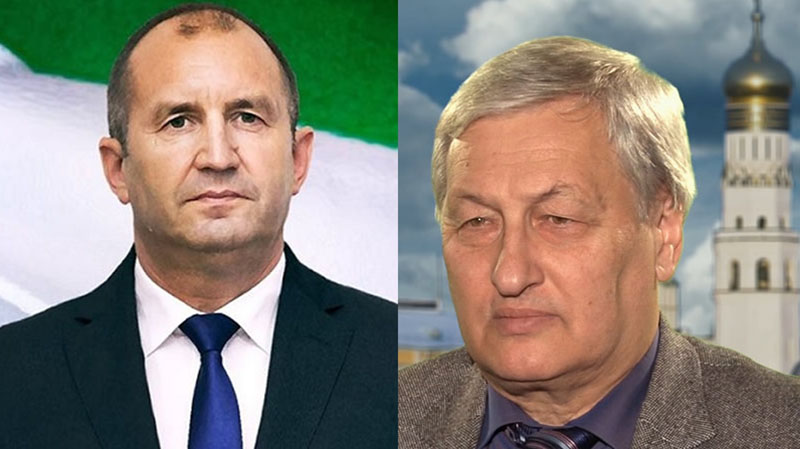
During his seven-day visit to Bulgaria, Volodymyr Zelensky exposed the political hypocrisy present in the country.
The facade of NATO general for President Rumen Radev also fell, as he faced criticism from a Russian intelligence general, Leonid Reshetnikov, who had predicted in a 2016 interview with Georgi Koritarov that Radev could play a remarkable role in guiding Bulgaria towards an independent path, outside of NATO and the European Union.
The occupant of “Dondukov” 2 not only opposed the official government stance on military support for Ukraine but also behaved arrogantly and condescendingly towards his Ukrainian counterpart, adopting a patronizing tone. The breach of protocol was the least of the issues, as the atmosphere in the reception hall during the meeting was charged with tension and barely restrained emotions. Even without hearing the exact words exchanged between the Bulgarian head of state and his colleague, it was enough to observe the faces of the guests, the shifting expressions, and their reactions while listening to the speech of the “peacemaker”—which was pitiful and humiliating for a president who came to respectfully seek support for his army, which does not want to be sent into battle against Russian aggressors without proper equipment and armament. Radev’s words were degrading not only for Zelensky but for all Bulgarians who embrace and support the cause of the Ukrainian people as their own.
Foreign media also took note of the behavior of the Bulgarian president, who will now surely be regarded differently by our NATO and EU partners, despite his pro-Kremlin positions that he has demonstrated on various occasions, especially when discussing sanctions against Russia.
The primary argument of the president against military assistance for Ukraine is that, by providing it, Bulgaria becomes part of the conflict (as Radev refers to the war), which, instead of being resolved through peaceful negotiations, is expected to deepen with the continuous arming of the Ukrainian army. In this context, it is interesting to consider what position he would take as the Supreme Commander if the war were to spill over beyond the borders of Ukraine, and Russia attacked our country or at the very least attempted to strike facilities used jointly with the US on our territory with missiles.
So far, we have not heard Radev once deny the propagandistic rumors about an impending mobilization in our country or the deployment of Bulgarian troops to the front. These rumors in social media are fueled by posts from Bulgarian politicians like Kostadin Kostadinov, who continues to publicly call for a shift in Bulgaria’s geopolitical orientation. Such fears are also instilled by the socialists among their electorate, part of which is already disoriented and misinformed about the true reasons and course of the war in Ukraine.
What did Rumen Radev propose to Volodymyr Zelensky in the Hall of Heraldry, surrounded by his silent advisors? He suggested peace negotiations, which, translated into plain language, means that Ukraine should lay down its arms, raise the white flag, and sit at the negotiating table as a defeated country obliged to accept all the terms of the usurper.
Such cynicism needs no further comment.
The president continues to emphasize one of his key arguments against providing military aid to Ukraine, namely that it would reduce the combat readiness of our army. However, Defense Minister Todor Tagarev countered this claim, stating that assistance to Ukraine does not violate any of our stockpiling regulations or the ability to ensure the training and combat preparation of the Bulgarian army.
“Bulgaria is one of the few countries in NATO with significant reserves of ammunition for the old Soviet armaments, which are still in use in NATO.”
These reserves, whose resources are depleting, are currently essential for the Ukrainian army, and Bulgaria will be financially compensated for them through various mechanisms, explained the defense minister.
Rumen Radev’s “concern” for the state of the Bulgarian army seems odd, as he has not demonstrated that the problems of the military and defense are priorities for him during either of his two terms. In fact, the delay in the rearmament and modernization of our army has rendered it non-combat ready and uncompetitive compared to the new weaponry of countries from the former Soviet bloc, a gap that the war in Ukraine has accelerated. As of 2023, Bulgaria ranks fifth in military strength in the Southeast European region and 59th out of 145 countries worldwide, according to Global Firepower (GFP) data, based on military budget, number of troops, and armament.
There are many questions surrounding our defense capabilities and the lost years during the governance of GERB and the three Borisov cabinets. Rumen Radev shares the responsibility for this with the political leadership of the Ministry of Defense and the general staff as the Supreme Commander of the Bulgarian Army.
To illustrate our current defense capabilities: of the eight Bulgarian pilots training in the US to operate F-16 fighter jets, only two have completed the basic course. According to the agreement with the United States, 14 pilots are supposed to finish the course. It wouldn’t be surprising if the assembly of the fighter jets and their delivery to the country occurs before we have trained pilots ready to operate them. Therefore, it would be beneficial for the former commander of the Bulgarian Air Force and current head of state to be constructive in this sector and allow our foreign policy to be determined by the executive branch.