The “Velichie” Party Gathers Over 100,000 Votes and Joins the 50th National Assembly
The new political formation “Velichie,” led by Ivelin Mihaylov and Nikolai Markov, has amassed over 100,000 votes and is now part of the 50th National Assembly. Who truly stands behind it remains a matter of speculation in light of the context—namely, that the party was established in Varna, where nothing can transpire without the blessing of the TIM group. The seaside capital also launched two other projects—”Vola” and “Vazrazhdane.”
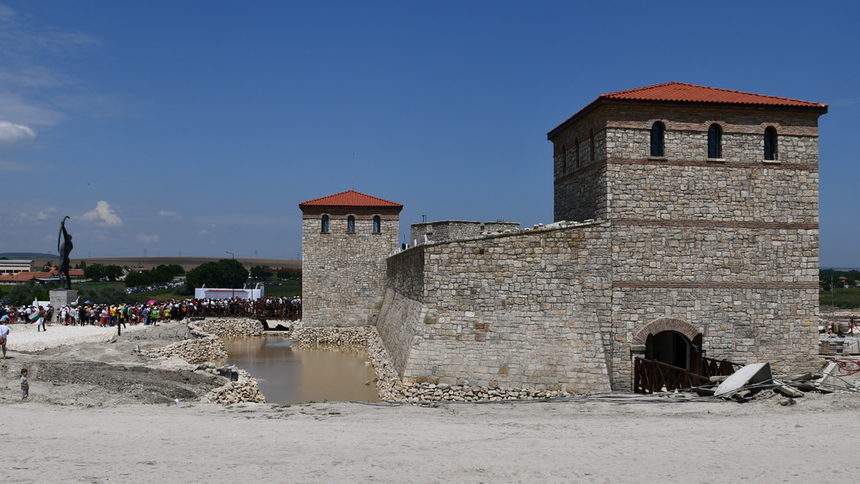
In the Varna village of Neofit Rilski, Ivelin Mihaylov attracts followers who settle there permanently, as the philosophy of living in a community with like-minded individuals becomes increasingly appealing in the post-modern individualistic Western world. The residents around the Historical Park are young people with successful careers, having returned from abroad or relocated from the capital and other major cities in Bulgaria.
There is nothing wrong with their pursuit of a nature-friendly lifestyle and the desire to raise their children and produce food in a clean environment. It is not reproachable, but rather commendable, that they choose to forgo the food from large chain stores, as well as prefer herbal remedies over the chemical products of the pharmaceutical industry. Up to this point, everything appears normal and acceptable.
But what exactly does Ivelin Mihaylov offer, whose book “The Creator” serves as a unique bible for the community or rather the sect?
From the limited public information about the new party and a report by bTV, it becomes clear that these individuals have found in the Historical Park a kind of time capsule. However, this is not the time capsule of Georgi Gospodinov, whose character Gaustin recreates the atmosphere of various decades of the 20th century in a clinic for elderly people with dementia, providing an opportunity to revive their memories and serving as a cozy final refuge in their lives.
Ivelin Mihaylov presents to his followers a theatrical time capsule set in a distant past they barely know from history, a past wrapped in the cellophane of the greatness of the Bulgarian tribe and its leaders.
“The Creator” sells houses, built in medieval or revival styles, to financially capable individuals. He also offers reenactments and practices from the past—archery, horseback riding, sword fighting—the community has its own rituals and invocations, etc.
One might ask how people from a digital generation live in two parallel realities? And how they entrust their savings to a person who claims to manage assets and projects worth billions while actually having significant debts to the state treasury, with the National Revenue Agency already blocking some of his companies?
After the Agency began investigations into the dozens of companies associated with Mihaylov, the businessman publicly stated that he could close all of them, along with the jobs they provided, to cover his debts to the treasury. However, he did not mention how he would settle accounts with the people who entrusted him with managing their savings.
The man who daydreams in broad daylight about restoring the glory of Great Bulgaria does not shy away from collaborating with companies that he lists on the website of the tourist attraction “Historical Park” as his partners. Among them are tour operators, the resort “St. St. Constantine and Helena,” wellness and spa complexes, hotels, guesthouses, agencies, and photography studios. At the top of the partners’ page is “Nevskaya Palitra”—a factory for high-quality artistic paints from Saint Petersburg.
Access to the tourist attraction is ticketed, with prices starting at 25 leva for children, seniors, and people with disabilities, a standard ticket priced at 50 leva, and a family ticket at 105 leva.
If Ivelin Mihaylov is the “Creator” and the inspiration behind the establishment of “Velichie,” then Nikolai Mihaylov serves as its informal leader and spokesperson.
But what is the ideology of this new political formation?
From the previous interviews over the years of the former State National Security Service (NSO) employee, available on YouTube, this remains unclear.
Markov speaks to the grievances of the dissatisfied masses disillusioned with the corrupt and sellout elite, which is a typical tactic of any populist. However, he lacks answers to important social, economic, and political questions. Populism is neither left nor right; it does not offer a worldview and lacks a core set of values.
Bulgaria is not among the countries in Europe where populist parties enjoy significant public support, although this support has increased in recent years. The behind-the-scenes operatives have created more than one or two populist projects that quickly exhausted their potential and faded into history. Who remembers today George Ganchev’s “Bulgarian Business Block,” Yane Yanev’s “Order, Law, and Justice,” or Nikolai Barekov’s “Reload Bulgaria”? Similarly, “Volya” by Veselin Mareshki, “National Front for the Salvation of Bulgaria” by Valeri Simeonov, and “Attack” by Volen Siderov have also become part of the archives of the Bulgarian transition. The same goes for NDSV, which dissolved after Simeon Saxe-Coburg Gotha left power.
Such, most likely, will be the fate of “Velichie.”
But until then, it will need to fulfill the role for which it was created.