In This Election Campaign, There Is No Clash of Ideas, No Political Debate, No Excitement
The pre-election campaign has been marked by a lack of confrontation over ideas and policies, leaving a sense of apathy rather than enthusiasm. Memories of the rallies from the early days of the transition provoke only bitter smiles on the faces of those who devoted their energy and enthusiasm to advocating for change over the past 35 years.
Today, things are different. Stara Zagora is shrouded in dust from ongoing repairs that have persisted for years without enhancing the city’s beauty; on the contrary, it now appears aged and dirty, and increasingly desolate. Its name has not emerged among the best cities to live in the country, which typically attract internal migration. The reasons for this are not solely tied to the grim outlook of shutting down the large coal-fired power plants in the Maritsa East complex, leading to the loss of many well-paying jobs—a fate that is inevitable for all EU countries.
There is also a lack of long-term vision for the city, which would make it attractive to investors and support the development of modern and eco-friendly technologies, as well as for young, educated individuals who might wish to settle down permanently. A stark example is the local government’s desire to eliminate the city’s airport. What is a modern city without an airport? The plan to convert the land into part of the “Zagore” industrial zone will primarily benefit those who have established businesses close to the runways and have purchased neighboring plots over the years, anticipating massive profits from their future sale.
Parties Do Not Particularly Favor Stara Zagora as an Electoral District
Since the beginning of the transition, attractive names, even those with negative connotations like Emilia Maslarova, have rarely appeared among the leading candidates in this electoral district. Maslarova was consistently at the forefront of the BSP list for many years. Ivan Ivanov from the Democratic Sector Union (DSB) left a good impression on the people of Stara Zagora and was respected as a representative. Meanwhile, psychiatrist and theologian Nikolai Mihailov—also a deputy from Ivan Kostov’s party—became a favorite among a few intellectuals but remained largely misunderstood by the majority.
Among the more notable figures representing Stara Zagora in parliament was Lyutvi Mestan, and we cannot overlook the entertainer Slavi Trifonov, who traditionally led the list of “There is Such a People” without ever intending to bend to a parliamentary seat, even from the front row of the National Assembly. Delian Peevski also opted for Stara Zagora over Pazardzhik in 2014, when he was one of the most despised politicians in the country following the mass street protests against the #WHO model.
Unfortunately, throughout all these years, parties have not sought leaders for their lists among individuals with leadership qualities, authority, expertise, and moral integrity from the local elite.
Atanas Slavov was the leader of the list for PP-DB during the brief tenure of one of the last parliaments, but he is a Stara Zagora native only by descent. Similarly, Krasimir Valchev from GERB can be recognized as someone who grew up and studied in Galabovo until the eighth grade, evident from his soft-spoken manner.
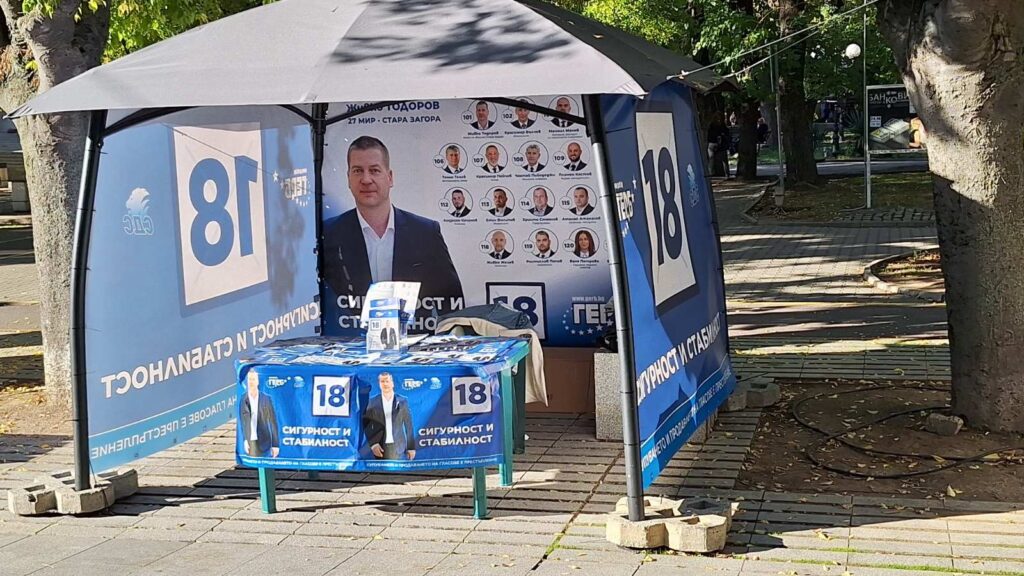
In recent years, Stara Zagora has been regarded as one of GERB’s strongholds. However, the fact that Borisov has been unable to form either a one-party or coalition government for the past three years—despite his cadre being deeply entrenched in power at all levels—has cooled the ambitions of careerists and thinned the party’s reserve bench. Dramatically! This situation forced the leader of the Citizens for European Development of Bulgaria to include the mayors of Burgas and Stara Zagora in the electoral race with the prior agreement that they would not become deputies. It is evident that neither of them is particularly enthusiastic about this decision from Borisov.
Zivko Todorov even tried to frame it as a deal, solidified with signatures, assuring that the future GERB cabinet would finance local government projects.
However, this maneuver is an outright and recognized deception of the electorate, and there are no guarantees that the party list will receive the same strong support that Zivko Todorov garnered in the local elections.
Moreover, the charisma of the mayor no longer holds the same allure as it did a decade ago, and the people of Stara Zagora are tired and frustrated by the never-ending excavation of their city. Just when they think, “Ah, it seems like it’s coming to an end,” the excavators return once more beneath their windows.
With the sole aim of turning over money, as simply explained by a worker from the company currently digging on Metodi Kusev Boulevard in the stretch between the Drama Theater and Radio Stara Zagora, supposedly to reinforce the street’s foundation before they re-lay the cobblestones.
Connections, Dependencies, Controlled and Bought Votes
The connections and dependencies are best illuminated by tracing the flow of money. However, these trails are usually difficult to uncover. Tatyana Doncheva, with her “Movement 21,” has publicly stated several times to various media that the lists contain individuals known for their ties to Delian Peevski. She specifically mentioned two names—Dragomir Stoynev and Kiril Dobrev.
Stoynev is once again leading the Stara Zagora list for the left-wing coalition in this election. However, the party activists in the town have silently swallowed his name, not uttering a word about Georgi Gyokov, former Minister of Labor and Social Policy and leader of the Socialist list in previous elections, according to local members of the century-old party. It’s worth reminding that Dragomir Stoynev served as Minister of Economy and Energy in Plamen Oresharski’s government, which was toppled by street protests against the election of Delian Peevski as head of the State Agency for National Security (DANS). In 2014, he led the BSP list again, while Delian Peevski led the DPS list; both became deputies from the 27th electoral district in the 43rd National Assembly.
GERB and “DPS – New Beginning” are not competitors in this campaign, not only because they do not attack each other. Krasimir Valchev, former Minister of Education and Science and second on GERB’s list, was invited by Nikolai Tonev and attended a campaign meeting for “DPS – New Beginning” in the village of Aprilovo (Valchev’s hometown). Whether Valchev was there as a member of one of the hunting clubs of the municipality of Galabovo, which Tonev gathered for the meeting as mayor and second on Peevski’s list, or in a personal capacity, is unclear, but it is a telling indicator of the warm ties between the parties of Boyko Borisov and Delian Peevski.
Evidence of a direct dependency of Zivko Todorov on Delian Peevski cannot be presented. However, individuals who helped establish the first structures of GERB in the region recall that Stara Zagora Mayor Vesselin Todorov, Zivko’s father, was linked to DPS during the years when he was involved in tobacco cultivation and served in the leadership of the Bulgarian tobacco producers’ organization.
For this reason, he refused to be one of the founders of Boyko Borisov’s party, instead proposing his son Zivko Todorov in his place.
From there, his political career began with the youth organization of GERB. Over the 13 years that Todorov has been mayor of the municipality, companies close to Delian Peevski have won public contracts worth millions of leva. A particularly striking example is the firm “Vodstroy,” which carried out repairs on Ayazmoto Park for 7 million leva without any experience in park construction, and the results vividly showcased this.
In Stara Zagora, there are still people who remember the four-hour meeting between Delian Peevski and Zivko Todorov held in the mayor’s office before the elections in 2014, when Peevski entered the National Assembly from the Stara Zagora DPS list.
Why, then, did he choose Stara Zagora as a quiet refuge after the mass protests against the #WHO model in 2013 and the fall of the Oresharski cabinet is an interesting question.
The answer, after 10 years, seems clear—because here, Peevski began to build his networks for buying votes in the Roma neighborhoods and ghettos in the region, unbothered by local authorities, police, and prosecutors. After ten years, he successfully used the purchased votes in the last parliamentary elections in 2023 and 2024 to send two deputies to parliament from a region that is not traditional for DPS. Peevski, before Borisov, introduced the practice of including mayors from the region in the party lists for parliamentary elections, such as Nikolai Tonev from Galabovo and Isa Besoğlu from Pavel Banya. In the previous early parliamentary elections, they ranked second and third; now Tonev is again second after the leader of the ‘DPS – New Beginning’ list, Khalil Letifov, and third is the deputy mayor of Pavel Banya, Shendoan Halit.
There is no doubt that the vote in these municipalities will be heavily controlled.
The election results will reflect this best, but in Galabovo, for instance, no other campaign poster can be seen aside from that of Nikolai Tonev, which is plastered on every tree and electric pole in the municipality.
He hopes that the “lesson” he imparted to the residents of Glavan, who dared to vote for his opponent in the local elections, will serve as a wake-up call to the other voters in the municipality. It would be naïve to expect people to easily overcome their fear in a feudal community. Workers at “Brikel” say that Kovachki is expected to support Peevski’s list to avoid experiencing the same fate as Rumen Gaitanski—the Wolf, who was arrested after the rift between Ahmed Dogan and his “son.”
If the people of Galabovo vote for ‘DPS – New Beginning,’ they will indirectly support Nikolai Tonev’s intention to build a waste-burning power plant, as if the oldest coal-fired power plant in Bulgaria, spewing toxic smoke, isn’t already enough for them.
Votes are Bought by Other Parties as Well, but Peevski’s DPS Relies Most Heavily on This Vote
Ahmed Dogan had no objections during the years when he left the organization of elections to Peevski, allowing purchased votes from Roma neighborhoods to be added to the Muslim votes for the party.
This was especially significant as the ethnic vote began to gradually decline. However, with the recent action against Djeihan Ibriamov—an issue that, according to Associate Professor Natalia Kisselova (a candidate for parliament in Sofia from the left coalition list), could lead to a conviction of Bulgaria in the European Court of Human Rights—Peevski attempted to discredit the vote for “DPS – Alliance for Rights and Freedoms” associated with Ahmed Dogan.
It is not out of the question that, if the results are unfavorable to him, he may even contest the election votes. It is complex to predict who will garner more votes in the Starozagorski region, the domain of Peevski. Furthermore, the Muslim community is isolated and does not share its sentiments, but internal tensions within it are escalating as the voting day approaches. Some say they are more likely not to vote at all than to “cast a ballot,” as they like to phrase it, for Peevski.
However, while the behavior of voters from the Muslim villages in Kazanlak and Pavel Banya municipalities can be somewhat predicted, it is impossible to make the same forecasts in the Roma neighborhoods and ghettos in Muglizh, Gurkovska, and Nikolaevo municipalities.
The publicized actions by the Ministry of Interior (MVR), loudly announced even before their commencement, are unlikely to intimidate voters and vote dealers or to thwart pre-election trading. Furthermore, the list of aliases for individuals from the criminal underworld, known as vote dealers, sent by PP-DB to the MVR and the prosecution will hardly be of any particular use. First, because the MVR is well aware of who organizes electoral trading locally; second, because the officers at the lowest levels know that it’s better not to engage with these people without special warning. Third, the heads of police departments can read the silence of mayors in larger municipalities regarding the issue of bought votes.
A separate topic is that the PP-DB list contains names of individuals who were once part of organized crime groups for purchasing votes. Now, some of them, like Stoicho Stoikov—known as Yoga from Gurkovo, are key witnesses against organizers of the bought vote, such as former mayor of the city, Mariyan Tsonev, and his son, Georgi Tsonev. For the courage to name them, Stoicho is now facing charges in a defamation case brought against him by Georgi Tsonev. Meanwhile, journalism investigations by Valya Ahchieva and “For the Truth,” revealing schemes for buying votes in the municipality—formerly a stronghold of Delian Peevski—have not been sufficient for the prosecution to file charges regarding the trading of money and influence by public officials. This is likely to be the case in these elections as well.