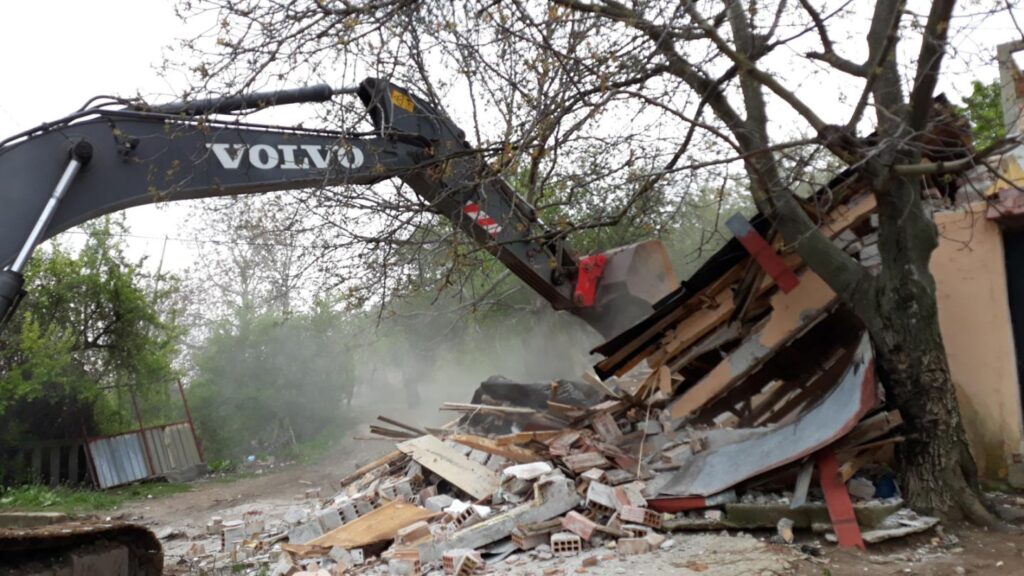
On August 25, summer is coming to an end, but the day is hot. It is even hotter for the hundreds of Roma families in the Lozenez neighborhood of Stara Zagora, who will remember this day when they were left without a roof over their heads. They have taken all their belongings outside or to neighbors and relatives because the demolition of their illegal houses has begun. The bulldozer starts moving and begins to tear down wall after wall, which in an instant turn into ruins. Now, unlike other similar actions to restore legality, there is no human chain, no screams and curses from elderly Roma women, no crying children. There are only police and many, many gendarmes silently guarding the operation. The scene is grim, with dozens of reporters, photographers, and cameramen documenting the event for posterity.
The municipality of Stara Zagora is not afraid to enforce the law, according to the mayor of the municipality, Zhivko Todorov: “For all those who will be exercising their rights on this issue, I would like to say that the procedure was initiated in January and was carried out in accordance with the law—all owners were notified, the police came, social services came to register all the people…”
Todorov reports that during his 14 years in office, 400 makeshift and solid illegal structures have been removed, and with the demolition of the last 151 houses, illegal construction has come to an end. Legalization of these houses is impossible after an amendment to the Spatial Planning Act in 2021. The land on which the Roma dwellings were built will be returned to the state forest fund.
And municipalities that are afraid to enforce the law will have big problems in years to come with the emergence of ghettos, warns the mayor – cheerful and smiling. He is visibly proud of his own determination, which has earned him popularity among that part of society that does not look down on the Roma.
According to Todorov, only six families among those left homeless have requested to be housed in municipal housing. If others come forward, they will go through the entire procedure for assessing their needs and only then will they receive housing, if they meet the conditions, of course, says the mayor of Stara Zagora. On the same day after the operation, however, numerous photos and video reports appeared on social media showing Roma families with small children left out in the open.
But the mayor did not say a word about what would happen to these people, let alone show any empathy on his part.
Years ago, during another operation to demolish illegal Roma buildings in the Zaychov Baiir area east of the Lozenets neighborhood, the mayor of Stara Zagora promised to provide municipal land that would be offered at certain prices to those wishing to build houses in accordance with the law. According to Todorov, the municipality had already prepared such land in May, but if it does not have the necessary infrastructure—water, electricity, and sewage—construction on it cannot be legal.
The mayor claims that the demolition of the last 150 houses put an end to illegal construction in the neighborhood. But is that really the case?
Architects explained to Za Istinata that some of the houses in Lozenets may have been photographed and appear in the cadastre, but that does not make them legal.
The most important question, however, remains: where were the local authorities when the law was being systematically violated right before their eyes? And why did they not react when these houses were still under construction? And why did it decide to apply the law with all its severity years later, when people had started families in these houses, had children there, and had created a community together with their neighbors? If Mayor Todorov’s administration had complied with the ruling of the European Court of Human Rights in Strasbourg (ECHR), which prohibits the demolition of buildings until the people living in them are provided with alternative housing, not a single family would now be left out in the open. It is not enough for the police and social services to come and register the people, as the mayor of Stara Zagora puts it. Because most of the Roma are illiterate, they fear repression, such as the seizure of their homes, even if they were built illegally.
“This requires mediators between them and the authorities, rather than simply applying the law formally,”
said Diana Dimova, chair of the Mission Wings Foundation, which works actively with the Roma community in the Lozenets neighborhood, to Za Istinata. A special statement published on the organization’s Facebook page says:
“For us, as people working with vulnerable groups, this is not simply a matter of removing illegal buildings. It is a human tragedy that leaves deep scars of pain and despair in the children and adults affected. These actions will not eliminate poverty, nor will they solve the social problems of the Roma community. Social policies cannot and should not be implemented with a bulldozer.”
Mission Wings calls for the development of a realistic and long-term housing policy for vulnerable families and for the effective participation of the Roma community in the development and implementation of policies that directly affect it.
The National Network for Children responded to the demolition of Roma houses in Stara Zagora with an open letter to the institutions.
“Housing is a human right. Bulgaria is committed to the European Child Guarantee, which requires that every child at risk of poverty or social exclusion has access to education, healthcare, and adequate housing,” the open letter states. Therefore, the NCN insists that:
– Shelter, care, and support be provided for children and families who have been left homeless
– Specialists trained to work in crisis situations be sent to the field
– Children’s rights be guaranteed, with priority given to their right to live with their families and their right to housing.
And they ask the institutions the following questions:
How many children are homeless and what is the municipality’s plan for them?
Is there a procedure in place to ensure that children do not remain on the streets, including through individual support plans?
What is the municipality’s long-term policy for ensuring decent living conditions for children without separating them from their families?
The local authorities owe answers to the questions posed by the two organizations. And as soon as possible. Otherwise, if they are addressed to European institutions and human rights organizations, it will be a bad reflection on the GERB administration in Stara Zagora and its mayor.
Exactly 20 years ago, Bulgaria became part of the large-scale international initiative “Decade of Roma Inclusion” (2005-2015), aimed at improving the conditions for education, healthcare, employment, and life of the Roma. At that time, Simeon Saxe-Coburg-Gotha’s government adopted a “National Action Plan” and over the next ten years, 18 million leva of state funds were spent. The decade passed, and another decade began and ended, but did Bulgarian institutions, in partnership with non-governmental organizations and foundations (mainly Roma), succeed in achieving the main goal of the initiative?
Have Bulgarian Roma become more educated, healthier, more successful, and economically independent? Has the state dealt with the ghettos and the illiteracy, poverty, and crime that are rampant in them? No, on the contrary. Not only is there a lack of adequate state policy for this minority, there is also no such policy on the part of local authorities.
Can Bulgarian Roma abroad clear land if they need to cut down trees and build houses? Anyone would laugh at such a question, simply because it is not possible. But why is it possible here? And who is to blame for this policy in our broken country—those who break the law or those who allow them to break it? And then they punish them exemplarily,
guided by the presumption that “if there is a house, there is a problem; if there is no house, there is no problem.”
However, reality shows the opposite – “if you have a house, you have problems; if you tear down a house, you create a new problem.” And then you don’t solve it, and everything repeats itself. Why and for how long? Will there be brave statesmen who will look the problem in the eye and solve it?
Together with the Roma, whose future is in their hands – together.
Hatred, segregation, and selective enforcement of the law will not lead us to shore; we are sinking into the swamp – slowly but surely.