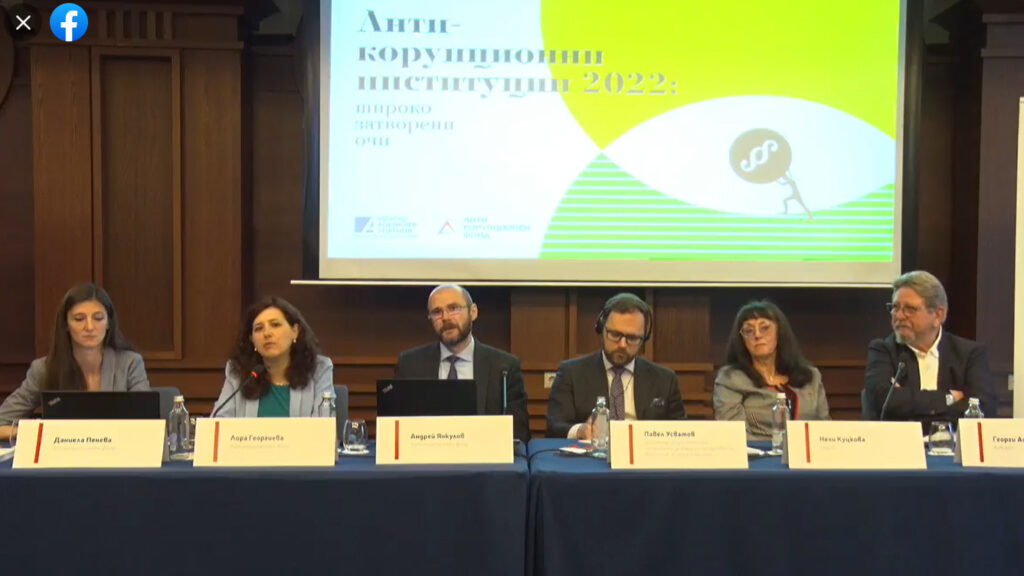
Results of the Fight Against Political Corruption in Bulgaria: A Stagnant Landscape. What are the outcomes of the struggle against political corruption in Bulgaria over the past seven years? How many politicians and high-ranking officials have been convicted of corruption charges? How many cases of conflict of interest have been established? These critical questions are addressed in the fifth annual report by the Anti-Corruption Fund (ACF) regarding the efficacy of state institutions in combating high-level corruption.
The title itself summarizes the findings: “Anti-Corruption Institutions 2022: Widespread Blind Eye.” The report reveals that the true extent of corruption at the highest echelons of power remains concealed from anti-corruption institutions, which are still far from demonstrating the systematic approach, professionalism, and independence required in the fight against corruption. These are the main conclusions drawn from the Annual Monitoring Report by AKF, authored this year by legal experts Andrey Yankulov and Daniela Peneva.
56 Key Investigations but No Accountability for Corruption
The report analyzes 56 key investigations into corruption conducted by the prosecutor’s office and the Commission for Counteracting Corruption and Forfeiture of Illegally Acquired Property (KPCONPI). The disheartening conclusion is that “the past year, 2022, did nothing to clarify the real picture of high-level corruption. Once again, the actions of the anti-corruption authorities failed to reflect the true state of corruption within high-level public sector positions,” stated report authors Andrey Yankulov and Daniela Peneva. They further commented, “If one judges by these actions, there are essentially no high-ranking officials guilty of corruption offenses.”
Disheartening Findings on Key Corruption Investigations in Bulgaria
Regarding the 56 key corruption investigations, the report from the Anti-Corruption Fund (AKF) reveals several alarming facts:
- For six years, there has been only a single new conviction with an effective prison sentence, which was handed down against a comparatively low-ranking public official: the mayor of a Sofia district, Desislava Ivancheva. “This conviction was inappropriately magnified by the prosecution’s leadership, as if the convicted individual represents the epitome of political corruption in the country, which is far from the reality,” commented Andrey Yankulov.
- This lone conviction does not alter the persistent trend that, in the cases of corruption observed, acquittals significantly outnumber convictions. To date, there have been 15 acquittals compared to only 4 convictions. In other words, the prosecution’s charges have a success rate of just over 20%, according to ACF.
This starkly contrasts the overall conviction rate in Bulgaria, which is nearly 100%, as well as the rate for all types of corruption offenses, standing close to 90%. Such discrepancies raise serious concerns about the effectiveness of the legal system in tackling high-level corruption and highlight a systemic issue that undermines accountability within the political landscape.
Worrisome Trends in Acquittals and the Limitations of Anti-Corruption Efforts
The report highlights that the vast majority of acquittals are based on non-criminal charges—actions that the court determines do not constitute crimes from the outset. This type of acquittal has steadily increased, with 13 out of the 15 acquittals in 2022 falling into this category. Such a trend underscores the weaknesses in the prosecution’s charges, as noted in the report.
The Magnitsky Test
Another litmus test for Bulgaria’s anti-corruption institutions came with the implementation of the first sanctions under the U.S. “Magnitsky Act” in 2021 against Bulgarian citizens. However, in 2022, Bulgarian anti-corruption agencies displayed neither the willingness nor the capability to pursue action regarding the corrupt activities of the vast majority of those sanctioned, as indicated by the ACF.
These findings raise critical concerns about the effectiveness and commitment of Bulgaria’s anti-corruption institutions, calling into question their ability to tackle corruption at high levels. The increasing prevalence of acquittals and the lack of proactive measures against sanctioned individuals reflect systemic flaws that undermine the fight against corruption in the country.
High-Level Corruption: A Failure of Accountability and Justice
“The most emblematic name among the sanctioned individuals—long-time politician and businessman Delyan Peevski—received what could be considered a form of indulgence from the Bulgarian prosecution in 2022,” noted Andrey Yankulov, author of the report section on “Criminal Prosecution of High-Level Corruption.” This came in the form of the prosecution’s refusal even to initiate a formal investigation against him, which was typically met with complete silence.
In 2022, the specialized court and prosecution were closed down. Regarding the fight against high-level corruption, specialized justice failed to achieve any notable results at either the central or local levels, according to the AKF.
At the central level, the specialized prosecution did not secure a single definitive conviction concerning the highest-ranking state officials. On the contrary, the initiation and progression of some investigations of significant public interest raised enough doubts about possible hidden extralegal objectives guiding these criminal proceedings, as highlighted by the authors of the report.
These circumstances contribute to a pervasive sense of impunity among high-ranking officials and drive public skepticism regarding the efficacy of anti-corruption measures in Bulgaria. The failure to adequately address corruption at higher echelons not only undermines public trust in institutions but also perpetuates a political culture resistant to accountability and reform.
A Formalistic Approach: Ineffectiveness of Bulgaria’s Anti-Corruption Commission
The picture does not differ significantly within the specialized anti-corruption body, the Commission for Counteracting Corruption and Forfeiture of Illegally Acquired Property (KPCONPI).
KPCONPI’s Formalistic Approach to Corruption
Analysis of publicly available information indicates that the commission has not demonstrated high effectiveness in establishing conflicts of interest and combating corruption. In 80% of its decisions in 2022, KPCONPI failed to identify any conflict of interest—of a total of 124 decisions, conflicts were found in only 25 cases, while 99 did not establish any conflict. The primary reason for the low percentage of identified conflicts is the prevailing formalistic approach to fact analysis and the conclusions drawn in KPCONPI’s decisions, as commented by the ACF.
Of the 25 decisions that identified conflicts of interest, 20 have been contested in court. Thus, out of all 124 cases, only five have become final and are not subject to challenge.
The vast majority of decisions made by the commission (88) pertain to individuals holding local public office. The remaining 36 decisions address individuals at the central level within the state administration, but many of these cases involve low public interest.
A notably small portion of KPCONPI’s activities is publicly accessible, resulting in a significant transparency issue regarding the commission’s operations and the outcomes of its investigations. This lack of transparency further undermines public trust in the institution’s ability to effectively address high-level corruption and conflicts of interest, leading to broader concerns about accountability within Bulgaria’s governance framework.
KPCONPI’s Focus on Asset Forfeiture: A Disconnect from Corruption Prosecution
According to KPCONPI’s annual report, decisions regarding asset forfeiture exceed the number of issued acts in nearly all of its other activities by at least tenfold. In other words, the commission primarily focuses on the confiscation of illegally acquired assets. However, judicial practice indicates a lack of connection between these proceedings and actual corruption offenses.
The summarized results of the activities of anti-corruption bodies further confirm that in 2022, the true picture of high-level corruption remains concealed, as analyzed by the ACF. “Statistics regarding cases concluded in 2022 clearly demonstrate that Bulgarian anti-corruption institutions are still far from exhibiting the systematic approach, professionalism, and independence required to combat corruption effectively,” summarizes investigative journalist and co-founder of AKF Nikolay Staikov in the report’s introduction.
This persistent disconnect highlights a critical issue within Bulgaria’s anti-corruption framework. By prioritizing asset forfeiture over substantive investigations into corruption, KPCONPI and other institutions may inadvertently obscure the systemic corruption that exists at the highest levels of power, thereby failing to address the root causes of the issue and maintain public accountability.