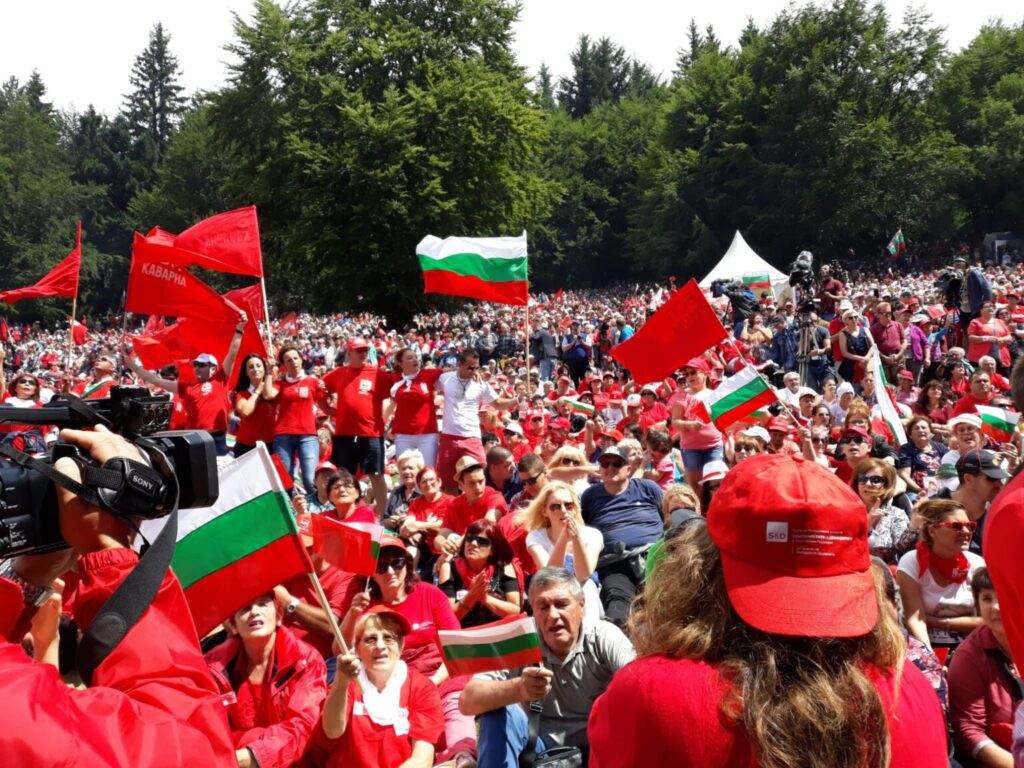
Archive photo: Venelina Popova.
I don’t know how many worshippers of the red five-pointed star gathered this Saturday on the meadow below Buzludzha Peak, which they call “historic.” Every year, they are counted by the Bulgarian Socialist Party, the police, and the media. But whether there were ten, twenty, or fifty thousand is no longer important. Simply because this party is not the one that, on November 10, 1989, at its plenum, dethroned Todor Zhivkov to prevent a bloody showdown with itself, and on April 3, 1990, declared itself socialist.
Today, this party has neither ideology nor ideologues. It has long been clientelist and serves only the interests of its leadership.
And it has long since ceased even to pretend to listen to the voices of its voters. But who actually votes for the BSP today is a topic for a separate and important analysis.
The BCP created the DS – the repressive apparatus of the former totalitarian regime, with whose help
Operation Golgotha – the KGB’s secret plan for the collapse of the USSR
and the planned economy during the so-called socialism and the transition to capitalist market relations – was carried out in Bulgaria. At that time, state assets passed into the hands of individuals and families from the communist elite, and citizens’ savings were stolen with the help of various financial instruments and schemes.
The Bulgarian Communist Party, whose successor is today’s Bulgarian Socialist Party, has never been a party of the socially disadvantaged classes in bourgeois Bulgaria, as it presents itself, just as the Bolshevik Party in Russia has never been a party of the proletariat and the landless peasants. And it could not legitimately represent the interests of these groups of the population, since after the adoption of the Law for the Protection of the State on January 23, 1924, the BCP was declared illegal. It went underground, organizing assassinations and armed resistance against the official authorities, which it still describes today as monarchist-fascist.
During the years of the so-called transition, the BSP proved that it had neither the vision nor the personnel to govern the country, and every time it attempted to do so, it failed.
In the current coalition configuration, the socialists do not feel comfortable, even though they repeat that they have agreed to participate in power solely for the sake of the stability of the state. They know that their voters feel betrayed, despite their clear awareness that GERB is a product of the second echelon of the BCP, and that Boyko Borisov is part of the staff serving the communist elite.
At his national conference in Stara Zagora the day before the congress, BSP leader Atanas Zafirov acknowledged the party’s achievements in power and called on his comrades to publicly promote the long-term prospects of this government. This is because it could consolidate the party’s position and its chances of performing better in the next parliamentary elections. According to Zafirov, a year ago the National Assembly’s approval rating was only 7 percent, while recent opinion polls have measured a twofold increase in approval of the legislative body, which the BSP leader attributes in part to the work of their parliamentary group.
However, Zafirov, Gutsanov, and the other BSP ministers in the government at the conference
silently ignored the topic of their coalition partners
and their relations in the Zhelyazkov cabinet and in the ruling majority in the National Assembly. Most likely because they cannot find a valid reason to make the shame of their “joining” GERB less embarrassing.
All the more so when this marriage of convenience with three parties in the marital bed is officiated by a deputy sanctioned under the Magnitsky Act who has opened his mouth to swallow the whole country.
A quarter of a century ago, Simeon Saxe-Coburg-Gotha was brought back from abroad by the same services that kept him alive so that he could fulfill the role they had assigned him in the history of the Bulgarian transition. During the NDSV government, the dethroned monarch stubbornly instilled in society the idea that political parties are harmful and that they are responsible for all the sins in the country.
After the king, the same scriptwriters of the Transition who created the mafia and the Backroom Dealers put the king’s bodyguard at the top of the state. And so they mocked both the monarch and their people, whom they despise. Thirty-five years after the totalitarian regime in Bulgaria collapsed, there is no party left, at least not among the mainstream ones,
that has not been suffocated in Boyko Borisov’s bear hug.
In the next parliamentary elections, whether they are regular or early, the BSP will neither unite left-wing people and organizations nor increase its electoral weight. And even if it manages to cross the 4 percent barrier to enter parliament, it will continue to be marginalized. And not because Bulgaria does not need a true social democratic party. And not because there are no people who profess this ideology. But because the BSP is not and cannot be that party. It bears the burden of all the crimes and sins of the BCP and the regime it created.
That is why this party is doomed to remain only in history.