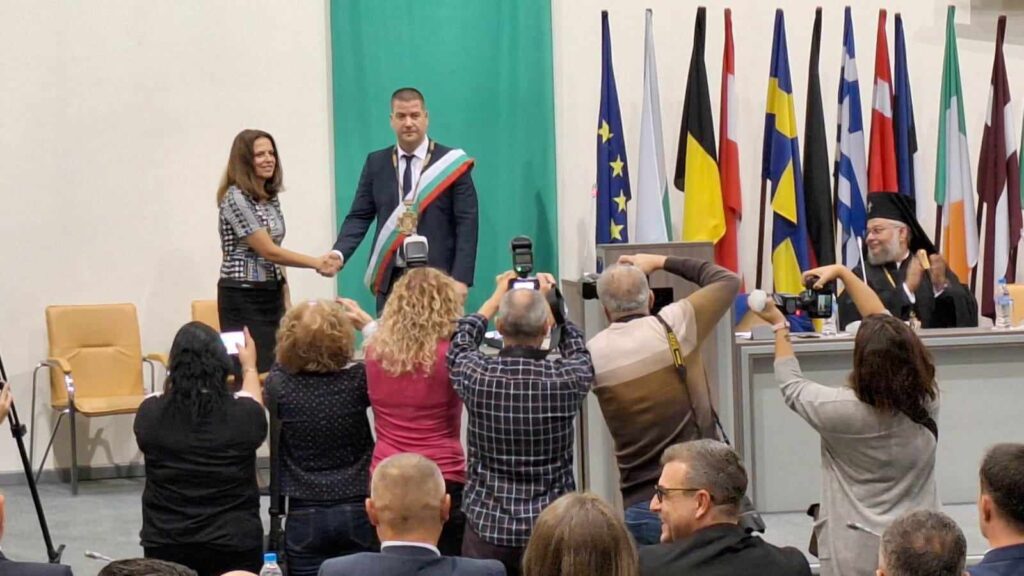
Jivko Todorov has begun his fourth term as mayor of Stara Zagora with a renewed and revitalized team. Two of the five deputy mayors—Pavlina Delcheva and Martin Paskalev—are new additions to his administration. Delcheva will be responsible for municipal property, economic policy, healthcare, and social activities, while Paskalev will oversee construction and spatial planning. Radostin Tanev will manage the new sectoral policy focused on the Green Transition. The new structure of the municipality will be presented at the next session of the Municipal Council.
Publicly, the mayor stated that he is not concerned about the fragmentation in the new municipal council, as it suggests greater transparency and democracy in decision-making processes.
This statement should imply that GERB, which holds the largest group, will not attempt to form a constant majority in the local parliament at all costs. However, nothing could be further from the truth—the new majority was established right during the election of the chairperson of the Municipal Council. And although the voting was secret, it was clear to everyone which groups the twenty-nine councilors who supported Iveta Lazarova from the local coalition “Alternative for Citizens – VMRO” belonged to. This majority’s permanence was further evident in the election of the heads of the standing committees.
This opportunistic alliance, based not on policies but on interests, outraged public opinion.
If Zivko Todorov were sincere about his dream for Stara Zagora and believed that his fourth term provides him with the opportunities to realize it, all municipal councilors should support his proposals for the benefit of the city and the local community, rather than relying on a constant majority. Therefore, we asked the mayor, who has the highest integrity index in the institutional ranking of “Transparency International” in the municipality, how honest the election of the chairperson of the local parliament was. He replied that he did not participate in any behind-the-scenes dealings. We received the same response from Emil Hristov—the municipal leader of GERB and chairperson of the party’s council group: “Our decision was for everyone to vote according to their conscience.”
If it is true that the 14 municipal councilors from GERB voted according to this decision, it suggests that the group possesses a collective “conscience.” Otherwise, how can we explain this unanimity in the election?
This is not at all about the qualities and expertise of Iveta Lazarova compared to those of the other two candidates put forward by the local coalition “Agricultural People’s Union” and the party “Vazrazhdane.” If the goal of this election was to stifle the vocal partner of the new chairwoman, with whom he cohabits, then how disappointing…
Or perhaps GERB was looking for a candidate with a very specific profile to fill this position, which the new chairwoman matches.
The fact that the leadership of the Stara Zagora municipal council was chosen without principles is also evidenced by the trust voted by the new majority (GERB, “Future for the Homeland,” “The Left,” “Alternative for Citizens – VMRO,” and DPS) in Boyan Kulev, who became one of the three vice-chairpersons of the council. The former councilor from “Volya” in the previous mandate is now in the group of the new party “Future for the Homeland” and is among those investigated for involvement in a secret conspiracy to buy votes, an audio recording of which leaked on social media.
The election of Kulev during the extraordinary session of the Municipal Council as vice-chairman of two of the 13 standing committees—on “Legality and Public Order” and on “Municipal Property and Economic Policy”—was a cynical mockery of the citizens of Stara Zagora.
The arrangement of councilors in the hall has always been made by the leadership of the Municipal Council to reflect the weight of the voters’ support, but that was not the case this time.
The second-largest group, the coalition “Agricultural People’s Union,” was pushed to the back row of the hall, while the two remaining councilors from “Alternative for Citizens – VMRO” and the two representatives from DPS sat at the front. The third DPS representative, Yusni Ibraym, left the group and became an independent councilor after a senior representative of Dogan’s party in the region told him that “a Roma cannot represent DPS.”
In a statement to “For the Truth,” Maria Dineva, the leader of the councilors from the “Agricultural People’s Union” group, which headed the Municipal Council in the previous mandate, emphasized that their voice would be heard in the hall even from the last row. Out of respect for the institution, she refused to comment on the election of the chairperson of the council, but did not hide that what she observed in the first two sessions was a “catastrophe.”
Dineva also pointed out that the committees were not structured as a result of prior consultations and consensus, which is why they secured only one chairmanship position—for the committee on sports and youth activities. After the Committee on Agriculture, Forestry, and Rural Development was renamed to the Committee on Agriculture, Forestry, and Environment, the agricultural group withdrew its candidate from it.
“Because the people living in the villages—around 23,000 individuals—clearly saw the attitude of the ruling majority towards them, and for that reason, in the next elections, they will show their stance towards these politicians,” said Maria Dineva.
We sought the opinion of lawyer Magdalena Ovcharova from the PP-DB group regarding the start of the new Municipal Council. She expressed her puzzlement at the fact that during the chairperson’s meetings, opinions on the discussed issues were predominantly voiced by Yanko Yankov (representing a group with three councilors, with only those of ITN and DPS being smaller), while the chairwoman Iveta Lazarova remained mostly silent.
“We will find it very difficult, and I don’t know if we will be able to promote the policies that we consider important, or if our efforts will be focused on illuminating their behind-the-scenes dealings,” commented Ovcharova.
When asked how she, as a lawyer, perceives the positions assigned to Boyan Kulev in the Municipal Council, she responded that PP-DB questions the integrity of every action taken by the “Future for the Homeland” party group even before Kulev’s election as vice-chairperson of the local parliament and on both standing committees.
With the commencement of the new Municipal Council and its initial decisions, the citizens of Stara Zagora are unlikely to feel optimistic about the future of their city, despite Mayor Todorov’s reassurances that his team and the entire administration have a lot of work ahead in this mandate.