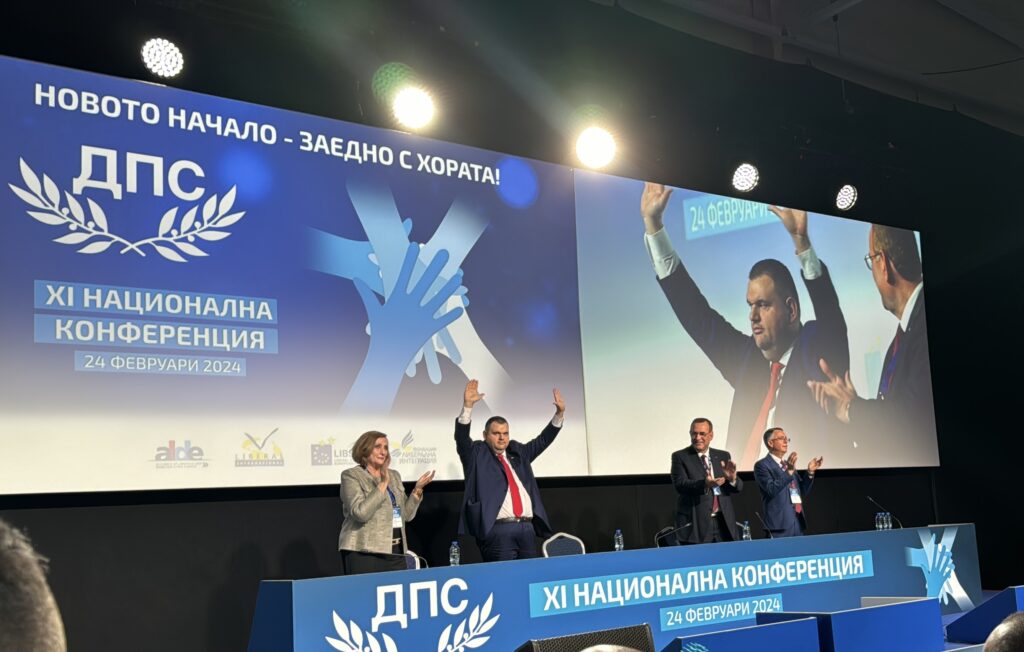
The national conference of DPS, like every other time, was devoid of intrigue. It was held merely as a smokescreen to legitimize the honorary chairman’s decisions as democratic. And although he was absent, as expected, Ahmed Dogan was once again at the center of the event.
This time, he sent a clear signal that he intends to change the party—its image, and perhaps even its ideology.
This is evident from the messages delivered by the honorary chairman to the delegates at the conference, whom he referred to as “dear DPS members.”
The forum was held under the motto “New Beginning – Together with the People.” A new beginning is necessary, Dogan stated in his address, because if “DPS does not revive and activate its model of working with real people and local party structures, as well as in solving the problems of the local population, it will become a boutique paid party.”
However, DPS has neither been conceived nor functioned as a classical type of party over these past few decades.
It is no secret that the former communists allowed the creation and registration of the ethnic party of Bulgarian Turks and Muslims with the blessing of the Kremlin.
Their goal was to maintain control over this population during the transition to democracy, with the active cooperation of their spiritual leaders, many of whom were also part of the agents of the former secret services. For this reason, they imposed the State Security agent Ahmed Dogan as the leader of DPS, creating an image of him as a dissident by sending him to the death row cells in Pazardzhik prison.
The True Dissidents Among Bulgarian Muslims Are Now Forgotten
The true dissidents from the ranks of Bulgarian Muslims are now fully forgotten. They are revived in the last film “State Secrets” by Malina Petrova, who could not complete it before departing from this world. She knew many secrets related to this party, conceived, carried, and born out of the shadows, but she took them with her to the afterlife.
DPS cannot become a boutique party, as this would imply being a small but modern party, which it is not and can never be.
Ahmed Dogan’s party exists on the backs of Bulgarian Muslims, exploiting their memories and feelings associated with the Revival Process. By maintaining the fears that all of this could happen again if they do not have their own party to represent them politically and defend their rights, DPS has secured its place over the years. The neglect of their voters and their issues by other parties in Bulgaria has also contributed to the party’s longevity.
DPS operates more as a feudal-corporate organization, where people from mixed regions resemble serfs with the right to vote, while the leader and the party elite are sustained by the state’s resources and the network of companies surrounding Dogan. He knows how to cultivate talent among the youth, educating them in civic and political matters, and providing career security at various levels of power—in ministries, agencies, the National Assembly, and the European Parliament—for the most reliable individuals. However, this support is entirely dependent on the honorary chairman of DPS and can always be revoked by him if he feels threatened or betrayed by these individuals.
Without being placed on a pedestal, Ahmed Dogan is the cornerstone of DPS and its visionary.
However, society and even those closest to him within the party do not always understand his reasoning, plans, and maneuvers. After being attacked—whether theatrically or not—by Oktay Enimehmedov 11 years ago, the honorary chairman retreated to his so-called sarai, rarely breaking his public silence since. Consequently, his “profound” addresses always become subjects of interest and analysis.
In his current address to the National Conference of DPS, Ahmed Dogan speaks of a new beginning because the party functionaries have become disconnected from the real problems of society. Yet he knows perfectly well that this disconnection has not arisen overnight and is hardly naïve enough to think that change will come easily.
The honorary chairman of the party is unlikely to harbor any illusions that if Delian Peevski and Jevdet Shakurov lead the party in tandem, its elite will turn towards the issues affecting their electorate, who in some regions of the country continue to live a century behind, fully marginalized.
As a result, a significant portion of the young voters for DPS, both among Turks and Roma, mostly work seasonally abroad to support their families.
What the philosopher, shaped as a valuable asset of the State Security (DS), aims to achieve in the longer term with this move is a matter of speculation. Perhaps the time has simply come for Peevski to settle his debts, as it is unlikely he could have become one of the most powerful oligarchs in Bulgaria without DPS.
It is possible that he himself requested this position from Dogan, hoping for public rehabilitation and to shake off the stigma of being a mafia figure. He may also wish to be removed from the “Magnitsky” list.
However, the price of this position is as high as the oligarch can afford to pay.
Peevski received the blessing of Dogan, but at the same time, the honorary chairman has set a trap for him. Under the oversight of Jevdet Shakurov, it will be difficult for him to maneuver, especially considering that ethnic Turks voted for him with great reluctance.
It’s also possible that Dogan is executing some scenario suggested by Moscow or Ankara.
But whatever his plan may be, it was not a problem for the participants at the National Conference to vote as always under dictation. Meanwhile, a journalist with access to the honorary chairman’s “saray” described this method of transferring power within DPS as “civilizational.”
Dogan has preemptively delineated the zones of influence for Delian Peevski and Jevdet Shakurov. He assigned Shakurov the responsibilities of working with voters in the regions and maintaining the party’s relationships with its external partners, while instructing Peevski to primarily focus on parliamentary activity and expanding the electoral presence of DPS.
The oligarch on the “Magnitsky” list has indeed succeeded in broadening the electoral peripheral of the party, but at the cost of “Roma-izing” the vote for it.
This has been the main reason why, in areas where DPS traditionally has little influence and few voters, there have been elected representatives, mayors, and municipal councilors over the last decade. However, the DPS functionaries only remember the people whose votes they rely on right before the elections, entering Roma neighborhoods with a carrot in one hand and a stick in the other. If any of them dare to raise their voice and act like a free person rather than a serf, they are immediately shown their place.
DPS mayors are reportedly acting with impunity, extorting Roma communities and threatening to enter the ghettos with bulldozers to demolish their illegal homes. They are destroying water pipelines (also illegally constructed) during the summer heat, risking the outbreak of epidemics, halting garbage collection, and street lighting, as if they are representatives of authority in a sultanate, rather than a parliamentary republic.
According to Dogan, the expansion of the electoral perimeter of DPS implies a renewal of its political image with adequate electoral representation. How the honorary chairman envisions this is unclear, but he may have realized that liberal ideas do not resonate with the culture and traditions of his party’s voters.
Therefore, it is not unlikely that he will make a sharp turn and change the ideology of DPS. This seems even more probable in the context of the crisis facing the liberal doctrine worldwide.
In his address, Dogan dedicates considerable space to the future of the world, the rampant militarization in the coming decade, and the fact that we are not prepared to radically change our perceptions of peace and the collective security provided by NATO, in light of changes in the global order. He states, “Our choice of Euro-Atlanticism will remain relevant, but with an apparent or subtle reshaping of responsibilities among member states, redefining the role of some of them for the overall security of Europe. This process is irreversible and does not depend on our will.”
“How Does Dogan Envision Bulgaria and the Balkans Amid a New Reading of the North Atlantic Treaty?”
Dogan refrains from explicitly stating how he envisions Bulgaria and the Balkans adapting to a redefined NATO, which appears inevitable regardless of the next U.S. president. However, he interprets Trump’s statement that every nation must “pay its share” for the security provided by the U.S. as a signal of pragmatism becoming a cornerstone of partnership within the Alliance.
These reflections by the honorary DPS leader raise significant questions. For example, which NATO country would guarantee Bulgaria’s security if military action escalates in the Black Sea region? Would it be the U.S., the UK, or Germany? Or Turkey, with one of the world’s largest and most well-equipped armies? The logical answer is evident, but such support would undoubtedly come at a cost.
Given Erdogan’s ambitions to position himself as a leader of the Muslim world and strategically expand Turkey’s influence and “geography of the heart,” it is imperative for Bulgarian statesmen—if such exist—to ponder the role Dogan’s party might play in this scenario and the weight its political voice could carry.