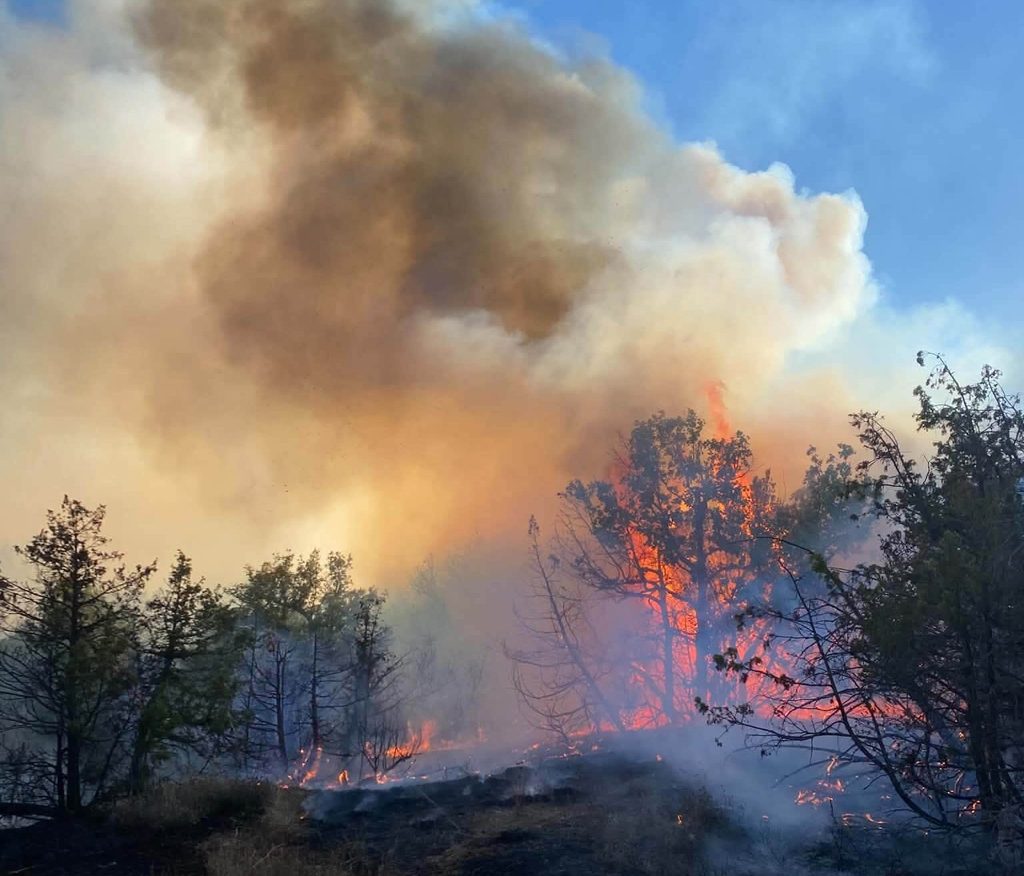
Climate change, higher average temperatures, and prolonged droughts are creating conditions for forest fires that are becoming increasingly frequent and harder to bring under control.
These can no longer be viewed merely as a seasonal issue; this means that the approach to such disasters must shift—moving away from a primary focus on reacting after a fire breaks out, toward much more rigorous planning and prevention.
Bulgaria is among the countries in the EU most affected.
According to data from the European Forest Fire Information System (EFFIS), Bulgaria ranks sixth in the European Union in terms of the proportion of its territory affected by fires.
In terms of the area affected within protected zones, the country ranks second, trailing only Portugal.
Behind these figures lies another fact: in over 90% of cases, the cause of the fires is human activity. More than 80% of these fires originate outside forest areas before spreading into them.
Crown fires are particularly dangerous; in such cases, the flames can leap across significant distances and spread extremely rapidly. Abandoned agricultural land also becomes a problem when large quantities of dry vegetation accumulate there.
The cost of a fire extends far beyond the loss of timber.
Damage from forest fires is typically calculated based on the direct loss of forest resources, as well as damage to buildings, facilities, and infrastructure. Added to these are the costs incurred by forestry agencies for containing and extinguishing fires.
However, these estimates do not reflect the full cost of a disaster.
They often fail to include the expenses of the Ministry of the Interior, the Ministry of Defence, regional administrations, municipalities, and volunteers involved in firefighting efforts.
Furthermore, there are costs associated with site cleanup, anti-erosion measures, and forest restoration—which can exceed 10,500 euros per hectare.
Calculating the long-term damage to ecosystems is even more difficult. The destruction of forests affects watersheds and water quality, the carbon-storage capacity of ecosystems, the microclimate, soils, agricultural land, tourism, and recreational opportunities.
In other words, while a fire ends once it is extinguished, its consequences can persist for decades.
Bulgaria lags significantly behind its neighbors.
With a prompt and adequate response, many fires can be contained within the first few hours. It is precisely in this regard that Bulgaria falls behind some of its neighboring countries.
Greece possesses approximately 90 specialized aircraft and helicopters for firefighting, as well as a satellite system for the rapid detection of fires.
Turkey has 26 aircraft, 105 helicopters, and 14 drones at its disposal. The country also utilizes leased specialized equipment.
Furthermore, there are 776 fire observation towers integrated into an early detection and alert system. In Bursa, there are monitoring and tactical management units that track the outbreak of fires and enable their location to be pinpointed quickly.
The reported average response time in Turkey is approximately 13 minutes.
The situation in Bulgaria is different. When combating large forest fires, Bulgaria relies on equipment from the Air Force—specifically from the 24th Air Base in Krumovo. AS532 AL Cougar helicopters are used, modified to carry underslung “Bambi Bucket” containers with a capacity of 2,000 to 2,500 liters. Mi-17 helicopters, equipped with similar water-dropping systems capable of holding up to about 3 tons of water, can also be deployed if necessary—though this happens less frequently due to their depleted operational lifespan.
The number of suitable helicopters is limited, and some are periodically taken out of service for maintenance. Furthermore, using military assets for firefighting consumes resources intended for military missions, effectively doubling the cost of the operation.
For context: during the recent fire in the Ivaylovgrad region, the Bulgarian response involved 100 personnel, five fire engines, and two military helicopters. The effort included teams from several fire departments, forestry officials, volunteers, the Ministry of Interior, and the local municipality.
When the fire spread into Greece, it was met by 220 firefighters, 48 fire engines, and 12 EMODE infantry units. Aerial operations involved 12 aircraft and five helicopters.
The core issue is that Bulgaria lacks sufficient specialized aviation equipment designed specifically for combating forest fires.
Another vulnerability is the absence of a unified national system for early detection and alert. While local systems exist in certain areas, they do not constitute a centralized national network. The Political Cost of a Lack of Prevention
Amidst the evacuation of hundreds of thousands of people due to forest fires, the debate continues regarding the need for Bulgaria to develop its own firefighting capabilities.
During a vote in the National Assembly, a proposal to purchase specialized aerial firefighting equipment failed to secure the necessary support, as “Progressive Bulgaria” cast 94 “abstain” votes.
The Haskovo Region and the Sakar Area Are High-Risk Zones
The Haskovo region is one of the areas in the country at high risk of forest and field fires. The Sakar region is particularly vulnerable and ranks among the most severely affected areas.
The trend in Southern Europe is telling. Areas that were previously less prone to extreme wildfires are gradually taking on characteristics typical of the more southerly parts of the Mediterranean.
The year 2026 began with more favorable conditions and higher rainfall during the spring. However, this also led to the vigorous growth of grasses, shrubs, and other vegetation.
As temperatures subsequently rise and a prolonged dry spell sets in, this vegetation dries out, becoming additional fuel for fires.
After the fire comes another risk: flooding.
At first glance, there is a paradoxical effect: in some areas, an increase in rainfall is observed following major wildfires.
This, however, is not good news.
The destruction of vegetation means the soil loses its natural protection. During heavy rainfall, water runs off more rapidly, increasing the risk of erosion, landslides, and flooding.
Thus, a major wildfire can set the stage for the next disaster.
Is prevention expensive?
The question is not just how much prevention costs, but rather the cost of its absence.
Maintaining firebreaks, access roads, water sources, and fire lookout facilities—along with establishing early detection systems and purchasing specialized equipment—requires significant investment.
Yet, the cost of inaction can be many times higher. In March 2026, the European Commission launched a Strategy for Integrated Forest Fire Risk Management. The approach is shifting from a model primarily focused on response to one based on four key pillars:
- prevention;
- preparedness;
- response;
- recovery.
This shift also affects funding—the goal is to direct a larger share of resources toward risk reduction before a fire occurs.
Proposed measures include investments in nature-based solutions to reduce fire risk, the restoration of wetlands to serve as natural barriers, improved forest and landscape management, and increased investment in climate and environmental initiatives.
Who should pay for forest protection?
Protecting the population and the natural environment is a public function. The maintenance of firebreaks, water sources, observation towers, and other prevention-related infrastructure cannot be viewed solely as an expense for forest owners.
Currently, some of these activities are funded primarily through timber harvesting revenues. This creates a dependency on the timber market; when prices fall, the funds available for prevention also decrease.
Therefore, the question is no longer whether Bulgaria will experience major forest fires. The more critical question is whether we will continue to invest primarily in firefighting, or whether we will begin to invest sufficiently in prevention. After all, a fire that is prevented costs incomparably less than one that has already broken out. Unprecedented Fire Season in EU Countries
In 2025, fires covered a record total area of 1,079,538 hectares. This is the largest area recorded by EFFIS in the European Union since monitoring began in 2006.
Within the protected areas of the Natura 2000 network, 424,023 hectares were affected—also a record figure in the history of EFFIS. Fires in these protected areas account for approximately 39% of the total burned area across the EU-27.
An extreme heatwave is sweeping across Europe, with temperatures expected to exceed seasonal norms by more than 15 degrees.
In (Southern) Europe, damages exceed 15 billion euros.
The year 2026 proved to be unprecedented in terms of forest fires in Spain and France.